In the wake of the 1967 Newark Rebellion, when six days of police brutality unfolded at the height of the Civil Rights Movement, nontraditional arts spaces began emerging across the city. More than a decade after Newark’s first Black-owned gallery, Aard Studio Gallery, opened in 1972, and following the influence of the Blacks Art Movement, Guyanese artists Victor Davson and Carl E. Hazlewood founded Aljira, a nonprofit exhibition space, in 1983. Named after the Australian Aboriginal word for “dreamtime,” Aljira supported socially engaged artists addressing gentrification in Newark, American imperialism, and racial capitalism.
Eight years after Aljira shut down abruptly because of financial problems, the Newark Museum of Art is set to mount a group exhibition that looks back on the artist-led space’s 35-year run of elevating underrepresented artists while also helping launch the careers of major international figures, including Dawoud Bey, Firelei Báez, and Jeffrey Gibson.
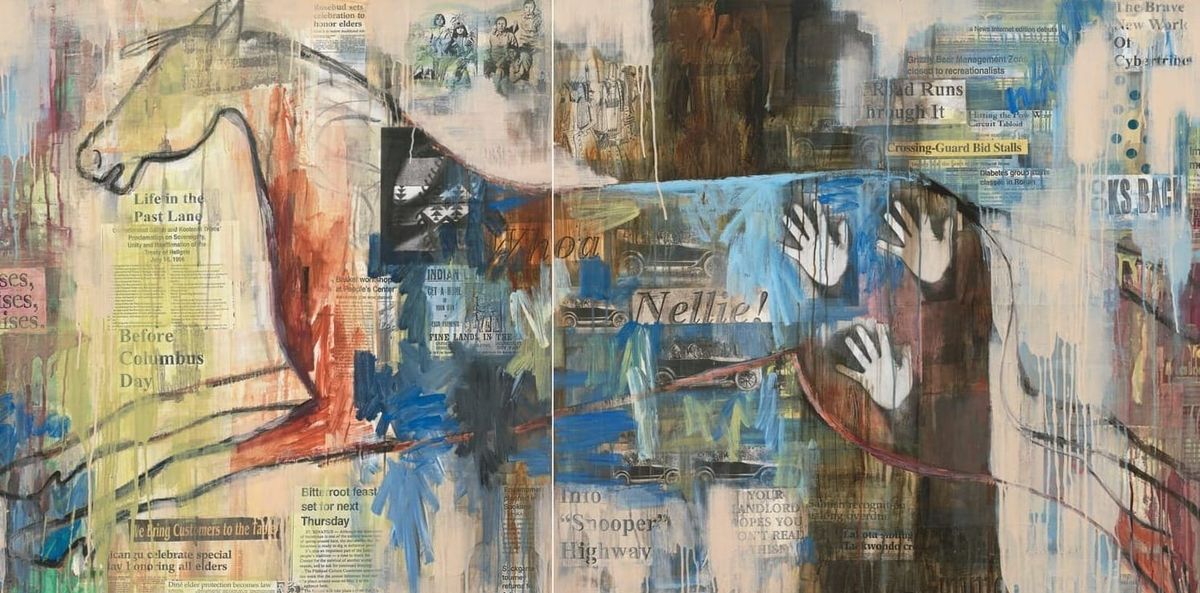
Opening October 15, Dreamtime in Newark: Aljira and the Making of Global Contemporary Art will bring together 66 artworks by 43 artists whose work was supported by Aljira through exhibitions, collaborations, or curatorial projects. On view from October 15 through June 30, 2027, the exhibition will feature works by Amiri Baraka, Frank Bowling, Hew Locke, and Jaune Quick-to-See Smith, among many others, across the museum’s 4,500-square-foot space.
In its early years, the nonprofit’s exhibitions “were strategic in their resolve to call out inequities and institutional deficiencies,” guest curator Alliyah Allen writes in the upcoming exhibition catalog. Its early programming included the 1987 exhibition With and Without Acclaim: International Black and Hispanic Artists, which presented underrepresented artists at a moment when few institutions did so. A year after With and Without, the organization moved into a smaller space nearer to the Newark Museum of Art, where Davson and Hazlewood used exhibitions to examine “racial capitalism” and highlight displacement and gentrification in their downtown neighborhood.
In 1994, Davson and Hazlewood expanded that curatorial approach to an international stage with Current Identities: Recent Painting in the United States, an exhibition of works by seven American artists, including Quick-to-See Smith, at the International Biennial of Painting in Cuenca, Ecuador. After the nonprofit was forced to stop operating in 2018 because of substantial debt accumulated after the 2008 recession, Davson and artist Cecily Cottingham launched an archive project to safeguard Aljira’s legacy. “I remember meeting a diverse group of artists from Brooklyn, Manhattan, and Queens who were all traveling to participate in the program,” artist Jeffrey Gibson, who took part in Aljira’s Emerge program in the early 2000s, said in a statement to Hyperallergic. “I know that starting it in Newark and finding a brick-and-mortar space was not easy,” Gibson said. “But I think Aljira has had a huge impact on the greater New York area art scene.”