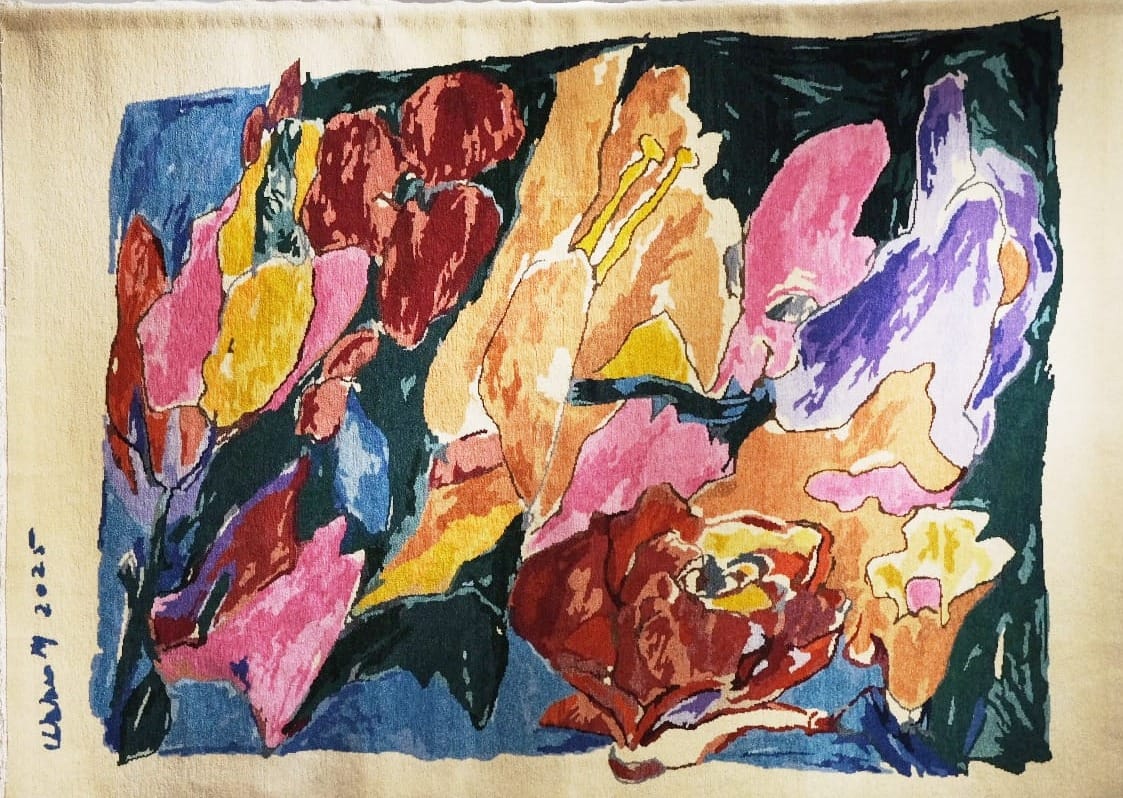
YEREVAN, Armenia — After five decades of traveling the globe, Armenian-Egyptian artist Anna Boghiguian has brought her work to Yerevan, where it is now on view at the National Gallery of Armenia. Weaving Culture presents Armenia as a kind of natural history rendered in carpet, occasionally interrupted by the appearance of people or supernatural figures. Suns, stars, flowers, and animals fill the works, echoing the familiar motifs of traditional Armenian rugs.
In conventional rugs, however, celestial bodies and creatures are usually translated into smaller geometric signs and may not be immediately apparent. Boghiguian turns them into large, figurative presences, though often highly stylized, set against fields of pastel color. As curator Nairi Khatchadourian puts it, the project amounts to the invention of the watercolor carpet.
Anna Boghiguian: Weaving Culture unfolds across 37 rugs and three drawings, arranged in three acts across adjoining halls. The opening section presents the mountains of Armenia — immense forms whose high peaks are often pressed tightly together in a confusion of blues, browns, and purples. A vast red sun with yellow rays dominates the scene, overlooking a landscape framed by two red and grayish peaks separated by what appears to be a valley.
The second act shifts to the garden, where trees and plants bearing large, blooming, blood-red flowers take center stage. A human figure appears in “Man with Pomegranate and Snake” (all works 2025–26). Storks appear throughout these works just as they do in Armenia. The large tapestry “The Sound of Nature is Music” features clearly readable trees, mountains, and flowers, though its winding lines, crowded colors, and rippling forms may faintly recall Arshile Gorky’s landscapes.