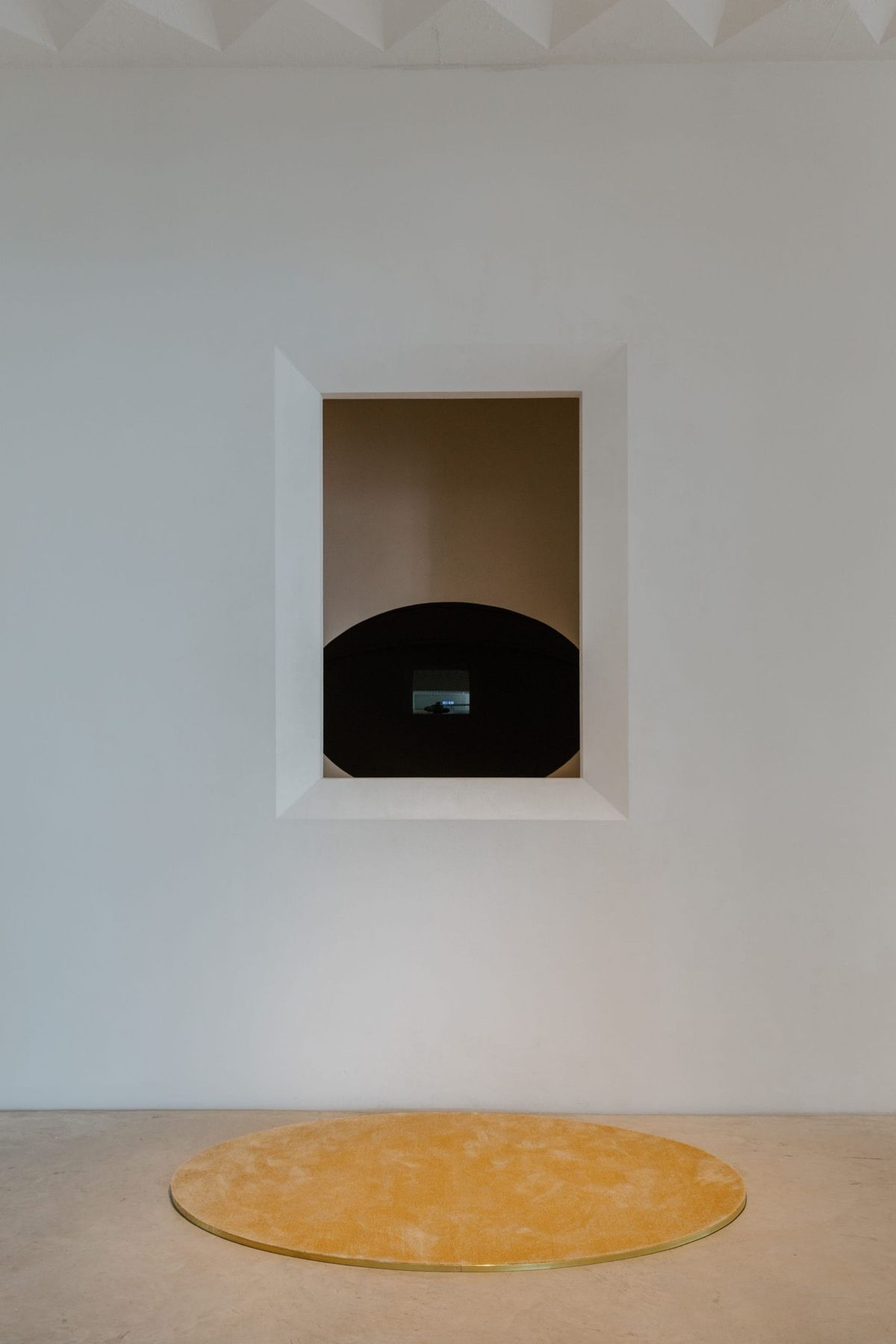
HASSELT, Belgium — The most revealing place to take in This Is Us, the ambitious group exhibition at Z33, is from a somewhat precarious vantage point: leaning out of an open window cut into the second-floor gallery wall by Francesca Torzo, the Italian architect who redesigned the striking institution in 2019. From that small belvedere, visitors can look down into the narrow atrium and trace the ramp-like route that leads into the exhibition.
Curator Fabian Flückiger has made that architectural feature a smart pivot in the installation, because the sightline from the window lands on a large, convex, highly reflective black oval panel hung high on the opposite wall of the atrium. That work is Clare Noonan’s “Pictorial Persuasion” (2023), newly commissioned for the show. The allusion is obvious enough: in this bent glass, darkly, we see ourselves and the gathered world as if through a contemporary “Claude Glass,” the pocket optical device used by early 19th-century Grand Tour travelers to frame their “views.”
Named for the way its obsidian reflection softened bright landscapes into an amber haze reminiscent of Claude Lorrain (1600–82), the device was once associated with a picturesque ideal. But what returns from Z33 is anything but pastoral. Looking through the window, viewers catch Noonan’s black glass across the way and, in its reflection, a disquieting glimpse over their own shoulder at a powerful new work by the Belgian media artist Emmanuel Van der Auwera.
“VideoSculpture XXVI” (2022), subtitled “Over-the-Horizon,” presents Van der Auwera’s striking “knife-to-screen” method of slicing LCD screens and altering their polarizing layers to eerie effect. What first appears to be a field of blinding white light is transformed, when seen through a mounted plate-glass disc, into military surveillance footage. The imagery is familiar, drawn from the dystopian internet archive of American drone killings, yet it emerges unnervingly from a blank blaze of luminosity.
A nearby earlier work by Van der Auwera, “VideoSculpture XIV (Shudder)” from 2018, uses a floor-mounted black glass plate to produce a similar effect. At particular angles, reflected light undergoes polarization that exposes the threatening image hidden within the white glare — here, armed soldiers on the march. The result is emotionally forceful and deeply unsettling: bright light, so often associated with hope, truth, and inspiration, becomes the carrier of ominous news.
There is something inherently coercive about the first-person plural. Who exactly is included in “we”? What solidarities does it assume, and who is excluded? And why should I accept that I am part of it? Such skepticism is understandable. In recent years, intensified suspicion and increasingly isolated cultural and political sensibilities have made appeals to solidarity harder to sustain. Yet exploitative forces, financial and political alike, have also benefited from our automatic resistance to collective identity. Without a “we,” organization becomes difficult; without organization, resistance becomes harder still.
This Is Us moves decisively into that complicated space, using 16 rooms and more than 50 artists to present a picture of who we are at this moment in history. As I leaned out that window, the message felt clear: look over your shoulder, because what is coming may not be visible yet. This Is Us, curated by Fabian Flückiger, continues at Z33 (Bonnefantenstraat 1, 3500 Hasselt, Belgium) through February 18.