ST. LOUIS — A lilac arcade of undulating arches, a box perfumed with honey and rose petals, a slender-necked vessel of iridescent glass: Ancient Splendor: Roman Art in the Time of Trajan, at the Saint Louis Art Museum, presents the Roman Empire through its sensual pleasures rather than its familiar masculine force. Organized by Lucrezia Ungaro, archaeological curator of the city of Rome, with curator Hannah Segrave leading on-site production, the exhibition deliberately avoids the heavy-handed gravitas often attached to ancient Roman art. Instead, it imagines a period defined not only by conquest, but also by flourishing art, architecture, and culture.
Trajan reigned from 98 to 117 CE as the second of the “Five Good Emperors,” a title earned for rulers who promoted growth, stability, and innovation. At the entrance, a marble statue of Trajan in military costume looks less imperious than purposeful, his forward gaze and contrapposto pose suggesting a leader moving Rome ahead. A noted patron of arches as a structural form, Trajan wears a pteryges, or skirt, of scalloped layers that echo their rounded profile. His paludamentum, or cloak, ripples around his shoulder and forearm, softening his determined posture.
Set off by vivid touches of purple and pink — including the purple associated with Tyrian dye, which only the emperor could wear — the exhibition emphasizes the extraordinary influence women held during Trajan’s reign. The monumental bust of Plotina, his wife, matches Trajan’s in size and height and is lit in a way that suggests an equal partnership. “If Trajan saw himself as the new Caesar,” Segrave explained during a private exhibition walkthrough in June, “his sister Marciana was his right-hand advisor, and his wife Plotina was pushing for critical legislation — fairer taxation, access to education, and assistance for the impoverished and orphans.”
In a nearby gallery, a nude statue of Apollo, god of the sun and archery, leans against a small tree trunk, one hand curled through his wavy hair gathered in a tiara-like knot. On the wall, a scent box releases the aroma of perfumed oil once rubbed onto sculptures displayed in Roman homes, while another across the hall evokes garum, the fermented fish sauce used in ancient Roman cooking. Created by Alexy Karenowska, director of technology at the Institute for Digital Archaeology, these olfactory stations immerse visitors in the highly multisensory daily life of the empire.
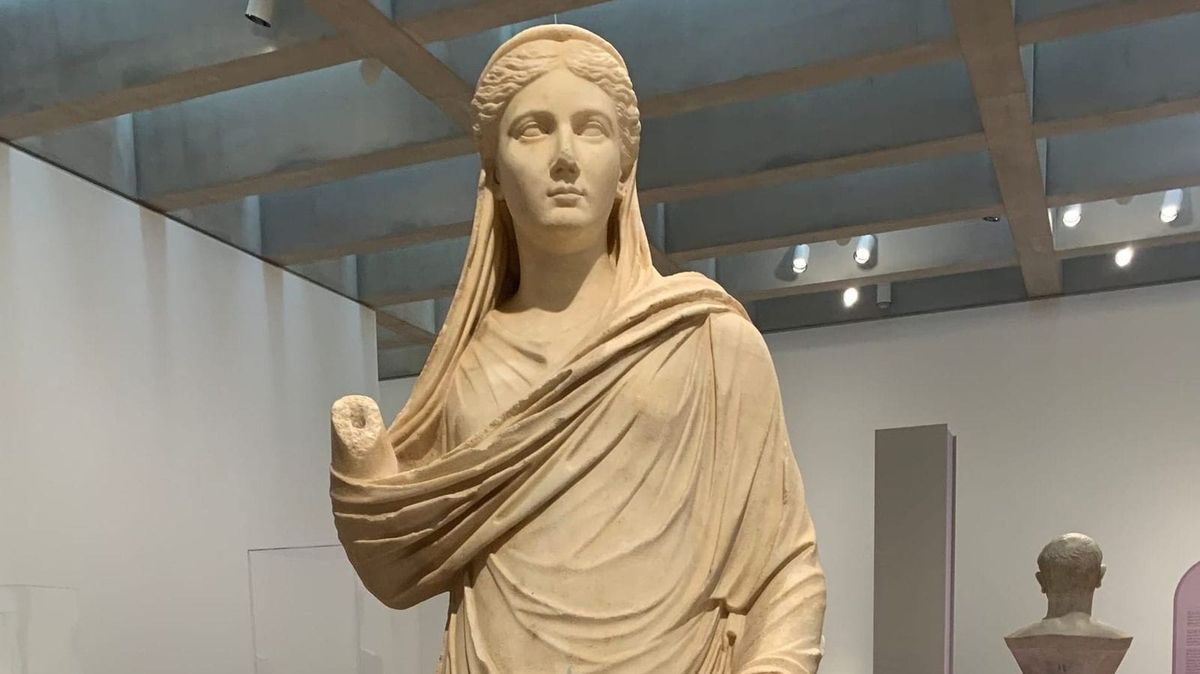
Near the exhibition’s end, a section titled Women’s Spaces and Faces explores the ideals of beauty, taste, and decorum that women were expected to embody, through aristocratic busts, a display of gold, glass, and emerald jewelry, and a fresco showing the judgment of Paris. While the ancient finery is undeniably dazzling, the exhibition also asks visitors to reflect on the invisible labor, often carried out by enslaved people, that supported the beauty “industry” of the period. In Religion and Myth, a statue of Trajan’s grandniece Sabina appears as Ceres, goddess of agriculture and fertility, underscoring how imperial women often served as priestesses in public rituals. Nearly intact despite being almost 2,000 years old, Sabina radiates the composure of classical antiquity, holding flowers and a few shoots of wheat in tribute to the deity.
Visitors drawn to a formidable battle helmet or a scowling statue of Caligula, the notorious “bad emperor” from half a century before Trajan, will find those works here. So too will those seeking a richer immersion in an era when women were not merely adorned but also active participants in civic life. With loans from the Vatican, Ostia Antica, the National Roman Museum, and the Naples National Archaeological Museum — many of them never before shown outside Italy — Ancient Splendor makes clear that civilization’s virtues were not handed down by a crew of toga-clad men, any more than Rome itself was built in a day.
Ancient Splendor: Roman Art in the Time of Trajan continues at the Saint Louis Art Museum (1 Fine Arts Drive, St. Louis, Missouri) through August 16. The exhibition was organized by Lucrezia Ungaro, archaeological curator of the city of Rome.