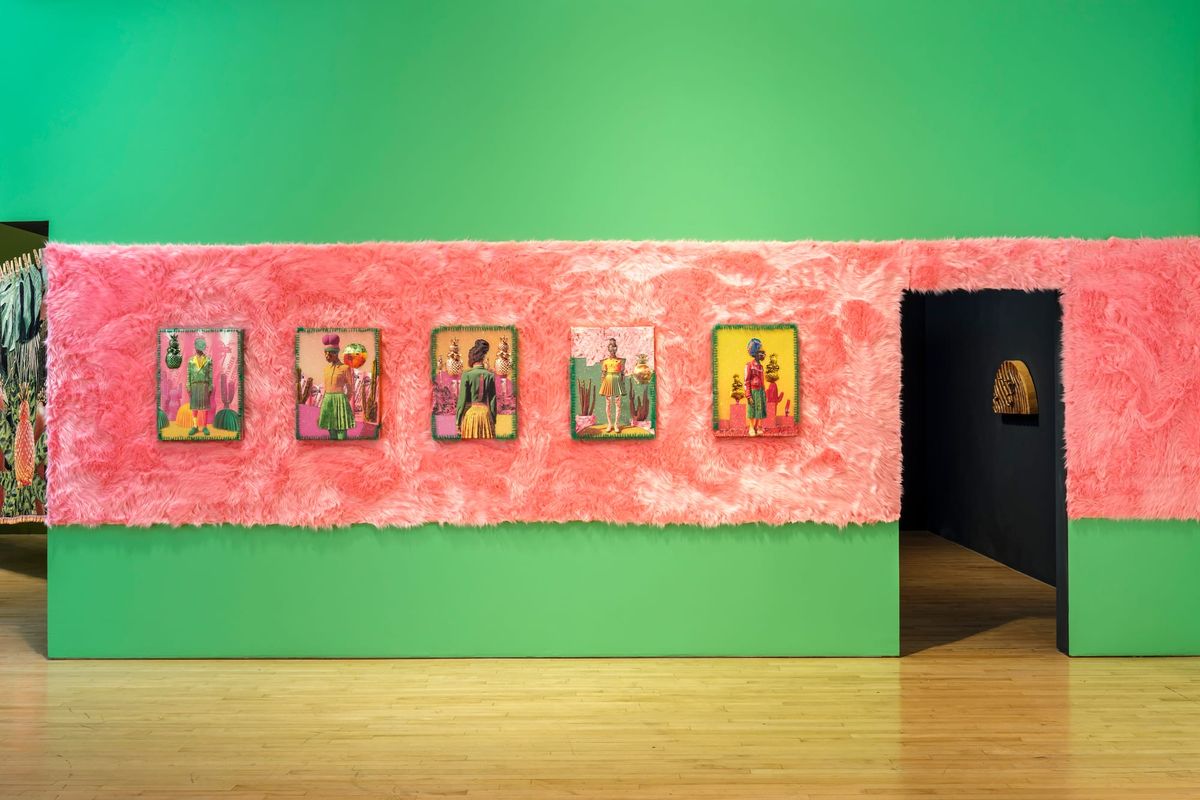
PASADENA, Calif. — When Marshall McLuhan said that “the medium is the message,” he was not thinking of tapestries stitched from crushed velvet or sculptures carved from wood and amethyst crystals — though Material Prophecies: Craft as Divination at Armory Art Center might seem to take that premise in a different direction. First spoken in 1958 on a radio broadcast, the phrase referred to the emergence of then-new technologies such as television and video, which McLuhan argued shaped how content was received, influenced, and even defined. A comparable logic runs through Material Prophecies, which brings together eight artists working with materials long associated with spiritual practice and religious ritual.
The exhibition asks, in effect, how much a medium determines the meaning — or “message” — of art itself. Its response is uneven. Some works adhere closely to the theme by emphasizing raw materials in stripped-down form. Five wall reliefs from Jackie Amézquita’s 2024 Earthworks series use mud, masa, and dried clay to form cracked, rectangular surfaces that resemble painterly canvases. Others move further afield, though still within the exhibition’s material vocabulary.
Joel Gaitan’s sculptures use a similarly unvarnished, unglazed clay “associated with devotional objects,” according to the wall text. In “No Pidas Agua, Cuando No Hay Sed” (2024), a reclining terracotta figure wears a crown, metallic teeth, and heavy gold jewelry. Its assured pose and ornate decoration project a contemporary defiance, while its rounded form and tactile surface recall pre-Colombian ceramic vessels.
At other points, the exhibition’s central idea feels more difficult to sustain. Calethia DeConto’s “Mapping the Emotional Weather of Memory and the Space Between” (2026) is an expansive cyanotype installation made up of 25 small, circular blue-and-white “photographs” pinned across one wall in a web-like arrangement. Exhibition materials describe the work as “intimate” and “emotional,” and the prints show female figures in seaside settings alongside shells, plants, and other natural ephemera. Yet the medium’s history complicates that bodily reading: cyanotypes, invented in 1842 by British electrochemist John Herschel, were first used on scientific expeditions to Antarctica and New Zealand, a history more closely tied to colonization than spirituality.
The exhibition’s strongest pieces are also the ones that fit its premise least neatly. Emmanuel Louisnord Desir’s standout sculptures combine wood and bronze in ways that refer to “African Diasporic traditions of carved and cast figures,” according to the wall text, though the works on view resist any strict classification. “Raging Machine” (2025) brings together industrially manufactured tools and devices — including a pencil sharpener and a handaxe — into a bronze hybrid creature suspended between robot and person. Another highlight is vanessa german’s “DAMN.” (2024), a portrait bust covered entirely in pink rose quartz, with a neck draped in a linked chain made from metal bottle caps. The face appears almost superhuman, its translucent pastel skin wholly singular.