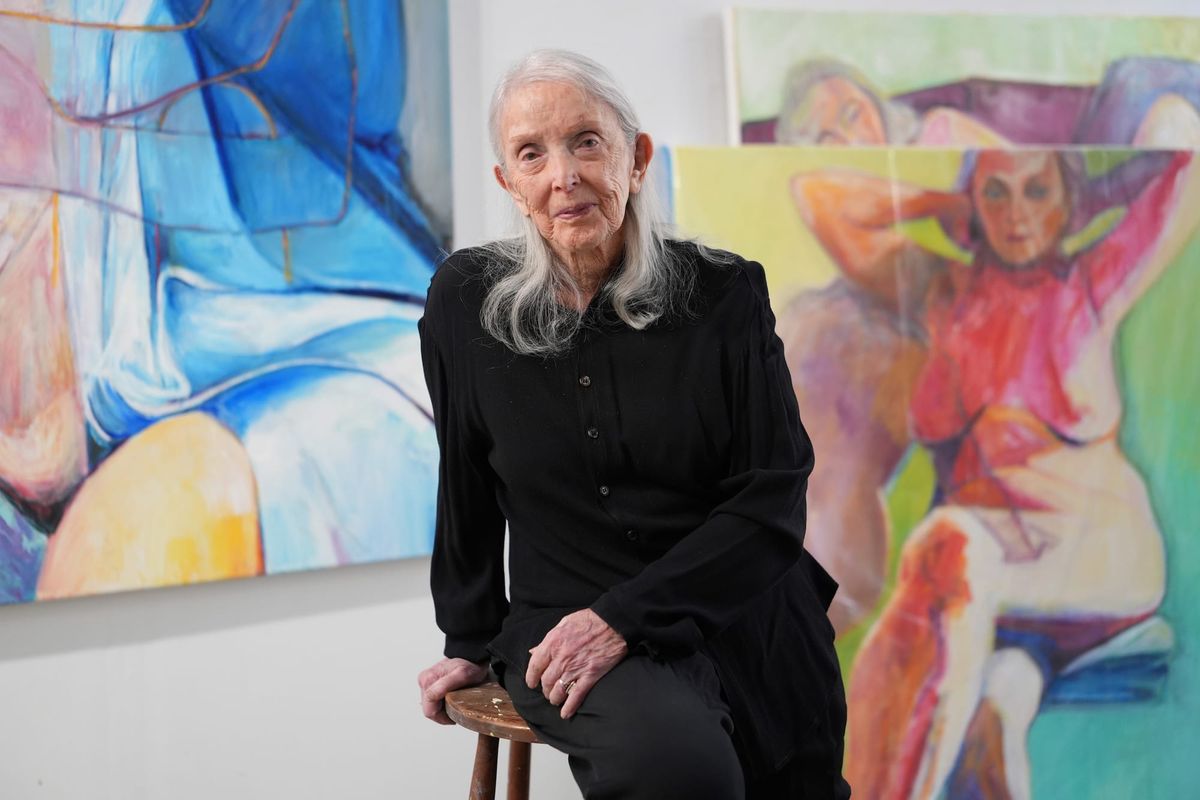
“You say, ‘Fuck you. I’m good and you’re wrong,’” Joan Semmel expressed to Hyperallergic. “This is who I am, this is what I do, and this is what I care about.” Upon entering her Soho loft, visitors are met with an uncanny oil self-portrait of Semmel on a stool, her camera’s flash illuminating a circle of light. The piece, “Mirrored Screen” (2005), is prominently displayed near the entrance of her Spring Street studio, where she has spent over fifty years creating art. When Semmel stands before it, the work nearly becomes a mirror, reflecting her distinct eyebrows and dark eyes, though her once dark hair is now gray with white streaks.
This artwork belongs to a series exploring locker rooms from two decades ago, focusing on the theme of narcissism in popular culture. Semmel found her fitness center on Bleecker Street to be a fitting venue for this investigation, capturing images of fellow artists and dancers with their consent. She positioned herself behind them, aiming her camera at their mirrored reflections to avoid posed shots. The film revealed an unexpected inclusion of herself, adding a unique 21st-century perspective to the series.
Semmel’s portraits are gaining significant traction lately. Recent exhibitions, including those at Alexander Gray and a retrospective at the Pennsylvania Academy of the Fine Arts in 2021, have revitalized public interest. Currently, Joan Semmel: In the Flesh is displayed at the Jewish Museum until May, and Alexander Gray features its ninth exhibition of her work, Continuities, starting April 17. Despite this, Semmel remains humbled by the impact her work has on the younger generation, who often express admiration and inspiration.
Born in 1932 to a secular Jewish family in the Bronx, Semmel’s early life was shaped by limited expectations from her father. She pursued art at Cooper Union and the Art Students League of New York, where she formed meaningful connections. Her life took a pivotal turn during a prolonged hospitalization in the late 1950s, leading her to reassess her ambitions. By moving to Madrid in 1963, she was exposed to a broad social circle and avant-garde art movements, which influenced her own abstract creations.
Returning to New York in 1970, Semmel found herself distanced from the prevailing minimalist art scene. Her fascination with sexuality led her to challenge the portrayal of women in art, resulting in the celebrated Erotic Series (1972–73). These works shifted the narrative from a male gaze to a female perspective. Semmel’s later self-portraits continued to explore themes of female empowerment, capturing her as an assertive figure in the world. Her recent pieces, such as “Blue Space” (2025) and “Satin Wrap” (2026), are considered by her to be among her finest achievements, a testament to her enduring creative journey.