Since its establishment in 1993, the Outsider Art Fair has been a significant addition to New York City’s vibrant art scene, showcasing artists who defy conventional fine art standards. This fair serves as a democratic counterbalance during turbulent times in the art market and the U.S., offering a hopeful moment where art rapidly finds new homes and visitors express genuine enthusiasm. This year’s event, featuring 68 exhibitors at Chelsea’s Metropolitan Pavilion until Sunday, March 22, offers an alternative to the often impersonal nature of traditional blue-chip gallery fairs.
The term “outsider art” encompasses a variety of labels such as “Self-Taught,” “Folk,” “Visionary,” “Naive,” and “Autodidactic,” historically used to describe artists from non-traditional backgrounds. However, the artists showcased at the fair are united by their position outside academic and institutional circles. Research into these genres celebrates the unique creativity of outsider artists, yet paradoxically it often marginalizes their work by considering it separate from that of formally trained artists.
Several standout booths at the fair highlighted the exceptional practices of outsider artists, emphasizing that their art holds equal value and significance to all other forms. Near the entrance, Fleisher/Ollman Gallery from Philadelphia displayed works by renowned self-taught artists, including William Edmondson, a Nashville stonecutter who was the first Black artist to have a solo exhibit at the Museum of Modern Art in 1937. “It’s a fair that’s gained significant traction in the last decade,” said John Ollman, the gallery’s co-owner. “It’s introduced this material to new audiences.”
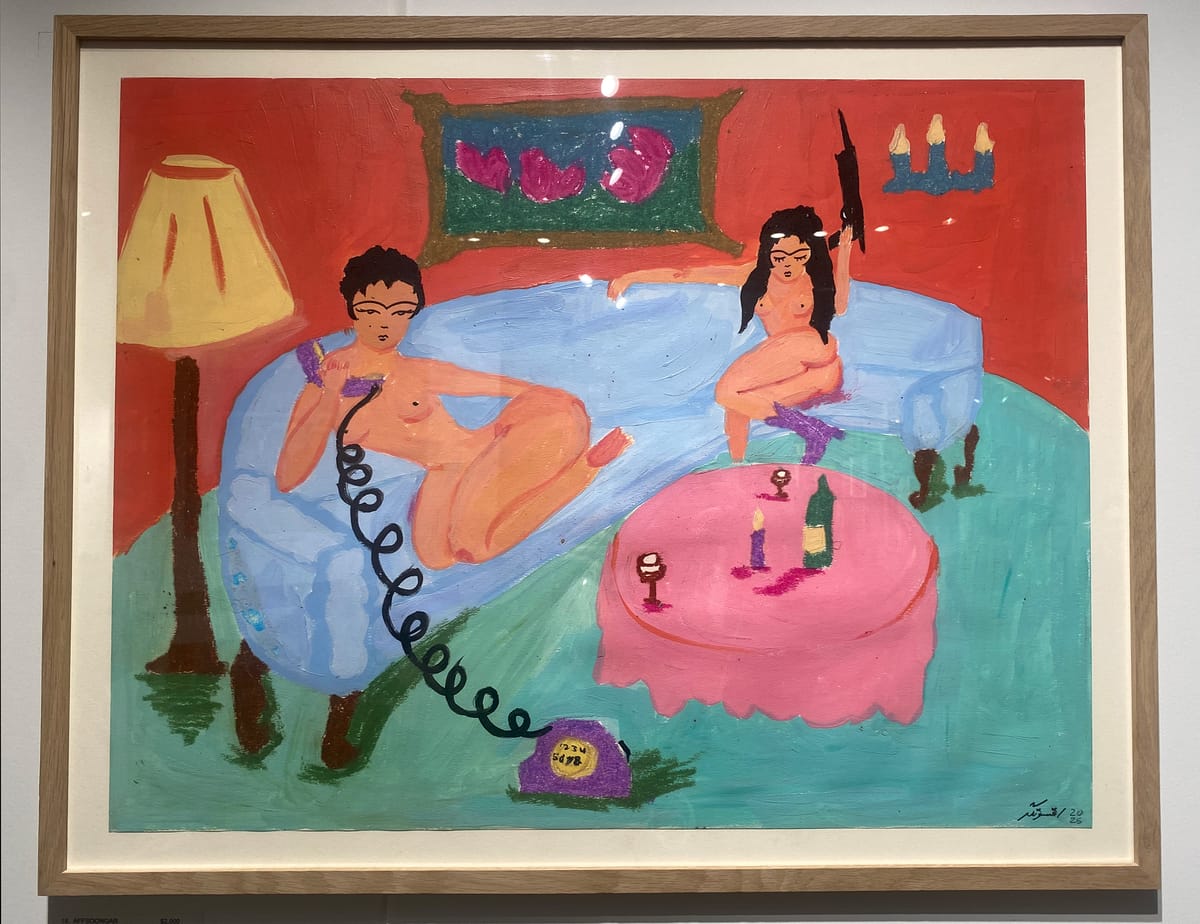
Nearby, SHRINE presented Jon Serl’s distinct figurative paintings in a salon-style setup, complete with his original easel and studio materials, creating the illusion that the artist had just stepped away. Massachusetts-based PULP showcased lesser-known artists, including Afsoongar, an alias for a young Iranian artist whose subversive works challenge the Iranian regime’s patriarchy. Her art features defiant women in scenes reminiscent of action-movie fight sequences, serving as a powerful reminder of the political impact of self-taught art.
Andrea Gutiérrez, featured at Idaho’s Stewart Gallery booth, explores femininity through domestic themes using techniques learned from her mother. Her small-scale works depict everyday tasks like picking potatoes and cutting onions. Brooklyn and Los Angeles artist Jaqueline Cedar, visiting the fair for the first time, noted the connection between formally trained and self-taught artists, highlighting the fluidity of these distinctions. “It was a nice range,” Cedar remarked. “I discovered so many artists. I feel like my work aligns with a lot of these aesthetics.”
Nonprofit art studios across the U.S. provide art education for adults with disabilities, contributing to the rich history of outsider art. Manhattan’s Fountain House Studio and Gallery supports artists like Alyson Vega, who turned to art after a brain injury forced her to leave her teaching job. Her sophisticated compositions depict New York City streets during Trump protests, crafted from fabric, acrylic, and paper.
In the context of an art market crowded with average figurative work, the Milwaukee-based Portrait Society Gallery of Contemporary Art’s display of Marcus Tauch’s portraits stood out. These vibrant line drawings, reminiscent of Pavel Tchelitchew and Egon Schiele’s styles, marked Tauch’s debut at an art fair. Gallery Director Debra Brehmer noted her ongoing discovery of Tauch’s work, saying, “He sent us a box of his sketchbooks, and we thought, wow, they are so delicate and beautiful!” The Outsider Art Fair’s distinct offerings—generosity and possibility—can enrich any artist’s work.