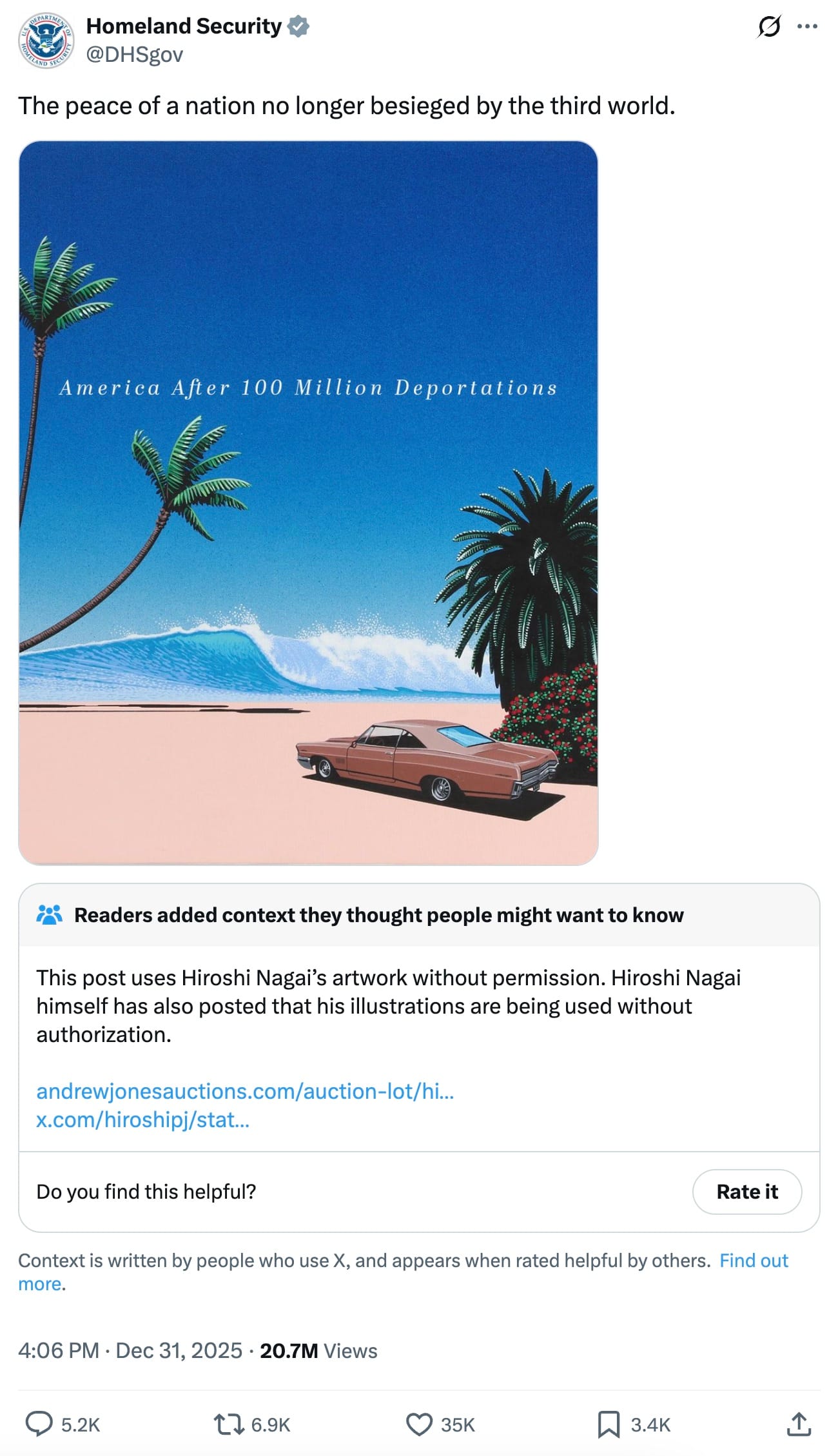
The U.S. Department of Homeland Security’s official X account faced backlash on December 31, 2025, for unauthorized use of an artwork by Hiroshi Nagai, a Japanese artist. The painting, showcasing a beach scene with palm trees and a pink Buick Wildcat, was altered with the phrase, “America After 100 Million Deportations.” The post’s message stated, “The peace of a nation no longer besieged by the third world.” An Andrew Jones Auction record from 2024 identifies the piece as a 2017 work from Nagai’s Beachcomber series, yet the DHS did not credit the artist or mention the artwork’s origins.
Nagai publicly disapproved of this unauthorized appropriation, expressing his dilemma in a repost: “The U.S. Department of Homeland Security is using my artwork without permission … What should I do …” In an email to Hyperallergic, the 78-year-old artist expressed his disappointment, highlighting the irony of a government agency disregarding copyright laws. The DHS and its former Secretary Kristi Noem had previously faced criticism for similar unauthorized uses of art and music in their social media posts.
Despite social media criticism, the DHS has not removed the image, though a Community Note now acknowledges Nagai’s statement and the unauthorized use. When approached for comment by various media outlets, a DHS spokesperson emphasized the agency’s commitment to informing the public, regardless of the controversy.
Hiroshi Nagai, active since the 1970s, is renowned for his album cover designs, notably Eiichi Ohtaki’s A Long Vacation. His art, characterized by bright acrylics and precise forms, draws inspiration from American Pop art and Surrealism, as well as modernist architecture. Nagai’s paintings often depict idyllic scenes reminiscent of the Californian lifestyle, sans human figures, which inadvertently makes them prone to reinterpretation, as seen in the DHS incident.
Nagai’s experiences in the U.S. during the 1970s, particularly his impressions of California, significantly shaped his artistic style. His work offers Japanese audiences aspirational visions of leisure and prosperity, rooted in an idealized version of the American upper-middle-class life. By omitting human presence, Nagai’s paintings emphasize a surreal, narrative-free world, a feature that can lead to their misappropriation in various contexts.