Walking along Pearl Street in lower Manhattan, few people realize that its name points to the original 17th-century East River shoreline of New York City. The street was named for a Lenape shell midden that once stood on its southern stretch, believed to have been near a Lenape canoe landing. It was one of several major middens in the area, and as Mark Kurlansky writes in his bestselling book The Big Oyster: History on the Half Shell (2006), middens are “the most common marker of a pre-European settlement anywhere in the area of the mouth of the Hudson.” He notes that these oyster-shell heaps could be as much as four feet deep, sometimes buried underground and sometimes stacked high.
Early 17th-century Dutch colonists were the first to record these large accumulations, and many survived well into the 19th century before the last remnants were removed and repurposed as fill for roads and other modernization efforts. In his 1839 diary, Brooklyn writer Daniel Tredwell recalled exploring these piles with his father. “On the way out we pass many Indian shell heaps bleached as white as snow, which they much resemble at a distance. Some of them on the banks of the creek extend from fifteen to thirty feet upon the bank, and under water, in many instances entirely across the creek. These shell heaps, long ere this, has excited our curiosity and we had proposed all manner of questioning concerning their authors. These questions my father did not and could not satisfactorily answer, and we were consequently unsatisfied, and hence there was a constantly recurring inquiry.”
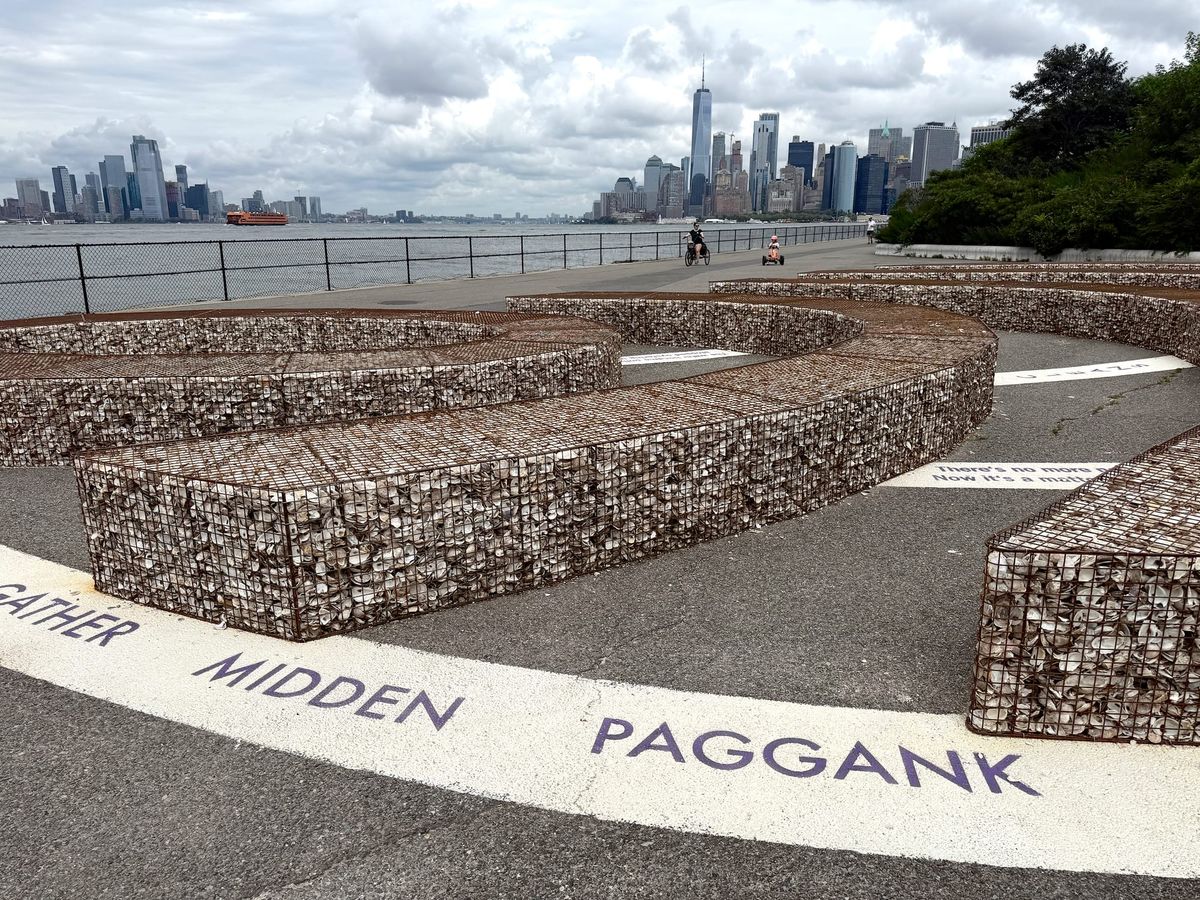
The passage underscores how completely Indigenous settlement was erased in 19th-century New York, so thoroughly that the Tredwell family never considered the landmarks they were visiting as deliberate creations of the people they had displaced. That absence of recognition is central to Alan Michelson’s “The Oyster” project, which opened this past weekend on Governors Island and will remain on view until late fall. Through the work, Michelson suggests that this history is still present and still contested, even as many residents continue to overlook the oyster’s imprint on everyday life.