PHILADELPHIA — Suzanne Valadon was a commercially successful artist in her lifetime, and her work entered national collections in France. Outside her home country, however, she is still often best known as the woman in a swirling pink dress and wide-brimmed orange hat in Renoir’s “Dance at Bougival” (1883), or as Toulouse-Lautrec’s “Young Woman at a Table” (1887), or from various paintings by Degas.
The Barnes Foundation in Philadelphia is now revisiting Valadon more than 80 years after her death with what it says is her first major United States exhibition, Suzanne Valadon: Model, Painter, Rebel. The show is on view through January 2022 before traveling to the Ny Carlsberg Glyptotek in Copenhagen.
Valadon’s life began in poverty. Born Marie-Clémentine, she was renamed Suzanne by Lautrec, her lover, and the transformation stuck. Her single mother worked as a laundress, leaving little opportunity for schooling, and Marie went to work at 11. By 15, she realized modeling could be a viable path.
Standing just over five feet tall, Valadon became a commanding presence in front of the canvas, fully inhabiting the roles she posed in and holding difficult positions for long stretches. She may have developed that stamina while, as is said, working at the circus. In Gustav Wertheimer’s “The Kiss of the Siren” (1882), a near cinema-sized painting, her body rises from the sea to entice a sailor in a scene of charged, theatrical passion. Curator Nancy Ireson likens Valadon’s modeling to performance art.
While she was modeling, Valadon was also learning. She had started drawing at age nine but never received formal art training. Watching artists at work taught her how bodies move, while Lautrec encouraged her and Degas, who recognized her talent, became a mentor and patron, introducing her to printmaking.
An unexpected pregnancy did not derail her career. Valadon used both her mother and her son, the painter Maurice Utrillo, born in 1883, as models. In 1894, she showed work at the Salon de la Société Nationale des Beaux-Arts in Paris, becoming the first self-taught woman artist to exhibit there. Two years later, she married the wealthy businessman Paul Mousis, which allowed her to employ household staff who could also sit for her.
The identity of Utrillo’s biological father remains unknown. Art historians widely believe the artist Miguel Utrillo, a friend of Valadon’s, lent his name to the boy, though he was never truly a father figure. As Utrillo grew older, addiction and mental illness led to hospitalization and incarceration. Throughout it all, his mother’s support was essential to his eventual success, which ultimately surpassed her own.
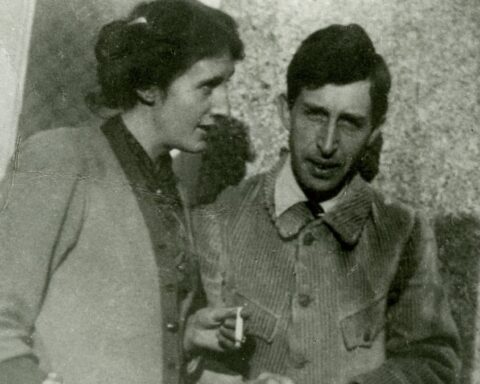
In 1909, Utrillo’s friend, the artist Andre Utter, became Valadon’s lover. More than 20 years younger than she was, Utter took on a managerial role in both Valadon and Utrillo’s careers. Valadon’s 1912 family portrait, which includes herself, her mother, her son, and Utter, presents her as the central force holding the family together.
After divorcing Mousis, Valadon had to support herself through her art and began painting exclusively in oils, focusing largely on nudes because they brought the highest prices. A 1909 work shows her and Utter as Adam and Eve, with her offering him the apple. According to the exhibition catalogue, most viewers at the time saw only the biblical scene, not the 44-year-old artist seducing her 23-year-old lover. A woman painting a male nude was then considered unheard of, and Valadon later added fig leaves so the work could be accepted into an exhibition.
Her 1911 self-portrait, painted when she was 46, presents a confident, resilient woman, perhaps marked by hard experience, with her palette seeming almost like an extension of her body. Her female nudes were equally radical for their time because they depicted female sexual desire. The women she painted rejected conventional femininity, appearing strong and muscular — described then as “masculine” and “virile.” “The Blue Room” (1923) shows a woman in a camisole and striped pants, cigarette in hand, embodying the modern woman. In a 1915 portrait, Mauricia Coquiot, who later organized Valadon’s 1932 retrospective, stands with her chest thrust forward and dark hair on her upper lip, in a manner that recalls Frida Kahlo, though Kahlo’s self-portraits emphasizing facial hair came much later.
Like Matisse, Bonnard, and other artists of the period, Valadon filled her canvases with decorative patterns, though unlike Bonnard she never lets wallpaper swallow her subjects. Her “Reclining Nude” (1928) seems to anticipate Alice Neel’s “Linda Nochlin and Daisy” (1973) — or at least Neel’s choice of settee. Valadon later turned to still lifes, in which even vases and violins suggest the human figure, and to portraits of the bourgeoisie, to which she had risen. Yet she is most compelling when her work seems to tell her own extraordinary story. If funeral attendance is any measure of success, the artists, critics, and former prime minister at her burial support early 20th-century critic and art dealer Adolphe Busler’s claim that Valadon “will hold an enviable position in the history of an epoch already rich with great artists.”
Suzanne Valadon: Model, Painter, Rebel continues at the Barnes Foundation (2025 Benjamin Franklin Parkway, Philadelphia, Pennsylvania) through January 9, 2022. The exhibition is curated by Nancy Ireson, deputy director for Collections and Exhibitions & Gund Family Chief Curator at the Barnes Foundation.