PHILADELPHIA — Picture a walk along a dirt path toward a bright, orderly building in rural upstate New York. Its windows are evenly spaced, shutterless rectangles; its roof curves gently; and from inside comes the rattling mix of screams, shouts, and stomping from dozens of people.
You have reached the Second Meetinghouse of Mount Lebanon, the energetic center of a small, celibate, egalitarian, pacifist Christian sect: the United Society of Believers in Christ’s Second Appearing, better known as the Shakers, named for the ecstatic dances that accompanied their joyful worship. Revolutionary in 18th-century America, they were once seen as deeply alarming. Today, they are often recalled for their elegant chairs, though they aimed for nothing less than building heaven on earth.
The Shakers: A World in the Making, a traveling exhibition that first opened at Vitra Design Museum and is now on view at the Institute of Contemporary Art Philadelphia, brings together historic Shaker objects and contemporary works inspired by Shaker aesthetics and values. Developed with the Shaker Museum, now under construction in Chatham, New York, the exhibition might seem timed to The Testament of Ann Lee, the 2025 quasi-musical film about the Shakers’ founding, though the two projects are apparently unrelated.
That raises an obvious question: why mount an exhibition about the Shakers, and why now? Despite its many compelling examples of Shaker art and craft, the show offers little clear argument. Mostly, it repeats the familiar account of a sect that once numbered 6,000 and now has only three remaining members, yet somehow anticipated modern design and a version of gender equality long before much of the rest of society did. But the objects on view also complicate that narrative, from rugs and drawings full of color and ornament to evidence of the Shakers’ prosperous commercial enterprises.
The contradictions of a society that was both liberatory and rigid do not need to be resolved, but the exhibition makes them more puzzling by withholding the human complexity behind them. The cool, austere installation does little to convey the Shakers’ lively warmth, or the historically intense music, dance, and worship that were central to their culture. Visitors are instead met by a large blue structure by Amie Cunat (2025), intended to evoke a Shaker meetinghouse, and by carefully made practical objects such as wheelchairs, adult cradles for the sick and elderly, and a boot with an extra-tall sole designed for a Shaker Sister with unequally long legs.
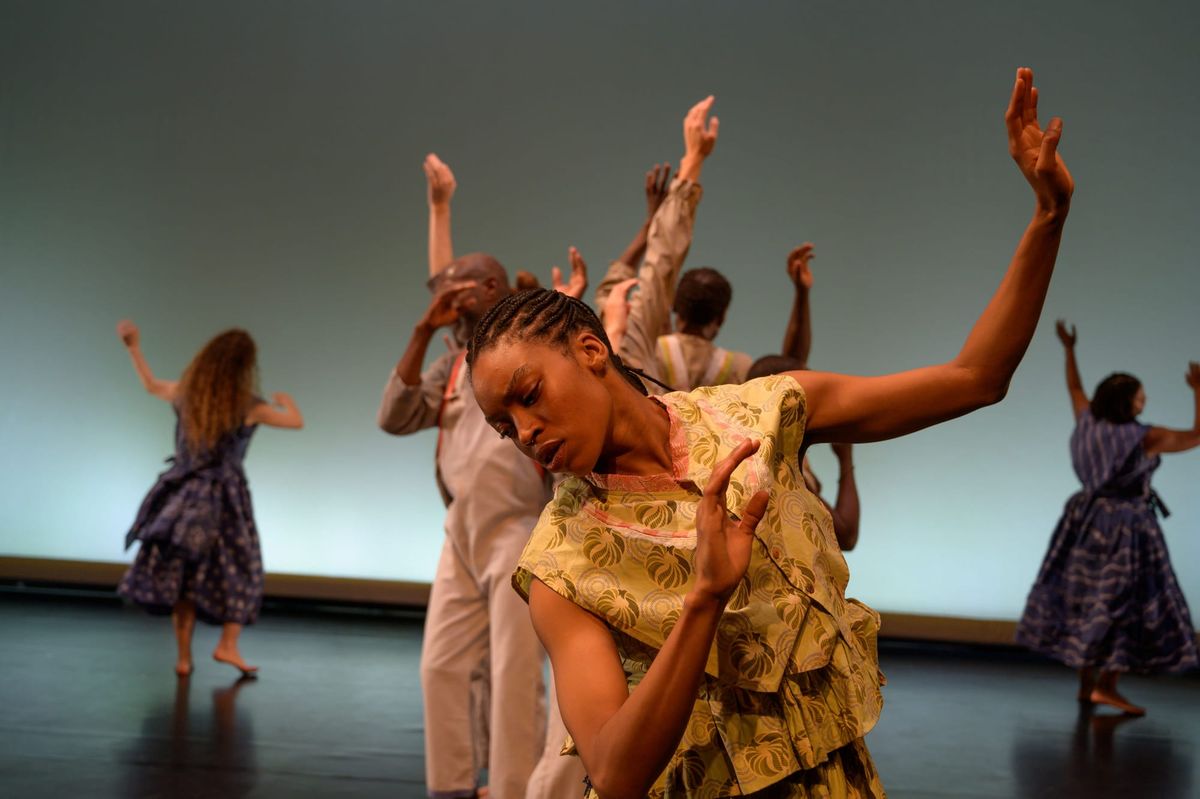
These works reveal both Shaker ingenuity and their care for disabled members of the community, but their separation against stark white walls gives them a clinical feel. The first floor is somewhat softened by the soulful choral score in a filmed dance performance by Reggie Wilson honoring the Black Shaker community that once lived in Philadelphia. That musical presence, one of several faithful reenactments of Shaker worship, might have helped frame the second floor, where chairs, canes, baskets, rakes, and brooms sit beside reproductions of densely patterned “gift drawings” made by Shaker women as messages from the divine.
If, as one wall text claims, “every aspect of Shaker design is intentional and without unnecessary ornament,” then the exhibition leaves unresolved how to understand these objects, or the vivid patterns in a wool rug knitted by Sister Elvira Hulett in the 1890s. Instead of engaging that tension, the show falls back on the familiar link between Shaker craft and minimalist modern design. The wall text for Chris Liljenberg Halstrøm’s contemporary work “My Work Station / My Prayer Room” (2025) points to the “simplicity-qualities shared” by Danish and Shaker designers, but the piece feels less like a relative of the surrounding Shaker objects than something from another world.
What, then, distinguishes simplicity, whether ornamented or not, from minimalism? Is modern innovation possible without industrial inhumanity? Those are questions the exhibition might have pursued through the remarkable objects on view, and they matter now. In an era of AI and robotic warfare, the pacifist Shakers have much to teach us.
Installation view of A World in the Making: The Shakers
Installation view of A World in the Making: The Shakers
Amie Cunat, “2nd Meetinghouse” (2025), washi paper, cardboard, flat latex paint, Flashe paint, acrylic, paper clay, cotton fabric and cord
Installation view of A World in the Making: The Shakers
A World in the Making: The Shakers continues at the Institute of Contemporary Art Philadelphia (118 South 36th Street, Philadelphia, Pennsylvania) through August 9. The exhibition was organized by the Vitra Design Museum, the Milwaukee Art Museum, the Institute of Contemporary Art Philadelphia, and the Wüstenrot Foundation in collaboration with Shaker Museum. The exhibition was curated by Mea Hoffmann.