After the languid stretch of summer, autumn offers a chance to recalibrate and rethink, and the art world is no exception. Across Los Angeles this season, exhibitions revisit important but still underrecognized artists and movements, complicating familiar narratives. Monica Majoli presents drawings inspired by an influential lesbian photography workshop alongside materials from the former Sisterhood Bookstore, while Nurtured Flames at the Armory spotlights Indigenous artists engaging with Native fire stewardship. At REDCAT, Flesh Witness examines systems of power and militarism in the occupied regions of East Asia and the Pacific.
Other shows broaden the citywide survey. A career retrospective of the late Beirut-born artist Huguette Caland at the Hammer honors an artist who spent much of her life in Los Angeles. Another exhibition centers Tokio Ueyama within a wider cultural and political history, including his incarceration with thousands of other Japanese Americans during World War II. At the Getty, five influential Chicanx photographers offer distinct perspectives on the ever-shifting metropolis of Los Angeles.
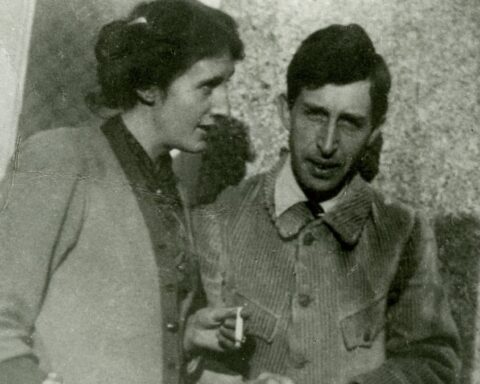
Monica Majoli: Countervision takes place at The June L. Mazer Lesbian Archives, 626 North Robertson Boulevard, West Hollywood, California, from September 19 to November 21. Presented by Los Angeles Nomadic Division (LAND), the exhibition pairs new drawings by American artist Monica Majoli with materials from the archive in West Hollywood. The project grew out of Majoli’s research into the Ovulars, a series of workshops led by lesbian photographers Joan E. Biren (JEB), Tee A. Corinne, Honey Lee Cottrell, and Ruth Mountaingrove between 1979 and ’83.
Majoli made drawings based on photographs from the Ovulars showing nude women united in creative work. These drawings are displayed unframed in a custom-built presentation, alongside objects from the feminist hub Sisterhood Bookstore, which operated in Westwood from 1972 to 1999 and served as an important resource for Majoli as a young woman growing up in LA. The pairing links personal history with archival memory and the visual culture of lesbian feminism.
At Oxy Arts, Hold Each Other’s Hands: Trans Mutual Aid, 1966-1996 runs through December 5 at 4757 York Boulevard, Highland Park, Los Angeles. Named after a phrase popularized by trans activists Marsha P. Johnson and Sylvia Rivera, the exhibition explores networks of care created by transgender people from the mid-1960s through the mid-1990s, presenting them as models for the future. Through archival materials, contemporary art, and community programming, it highlights systems built to provide solidarity, safety, housing, and healthcare.
Archival installations focused on unhoused trans youth in 1960s San Francisco and Street Transvestite Action Revolutionaries (STAR) in 1970s New York City frame the work of six LA-based artists, encouraging intergenerational exchange. Flesh Witness at REDCAT, 631 West 2nd Street, Downtown, Los Angeles, runs September 12 through December 13 and is organized by diasporic Korean arts nonprofit GYOPO and scholar Amy Kahng. The group exhibition spans 50 years of sculpture, photography, mixed media, and installation art by eleven artists and collectives, including Bernice Akamine, Mao Ishikawa, and Stephanie Syjuco.
Also on view is Artifacts from an Unborn Empire at Brand Library and Art Center, 1601 West Mountain Street, Glendale, California, from September 26 to December 31. The exhibition pushes back against the familiar claim that “History is written by the victors,” a maxim often misattributed to Winston Churchill, and questions the biased narratives such a view can produce. Among the 22 artists included is Rubén Esparza, whose serape flag suspended from a used broom honors the unrecognized labor that underpins the nation.