In her final year at Carnegie Mellon University’s Bachelor of Fine Arts program, artist Emily Drew Miller discovered an unexpected inspiration. By rubbing graphite over a paper-covered heater lattice, she created a pattern reminiscent of matzah. “That was around Passover in 2016,” Miller shared with Hyperallergic. “I’ve since been experimenting with matzah annually, realizing it’s become a personal Passover tradition.”
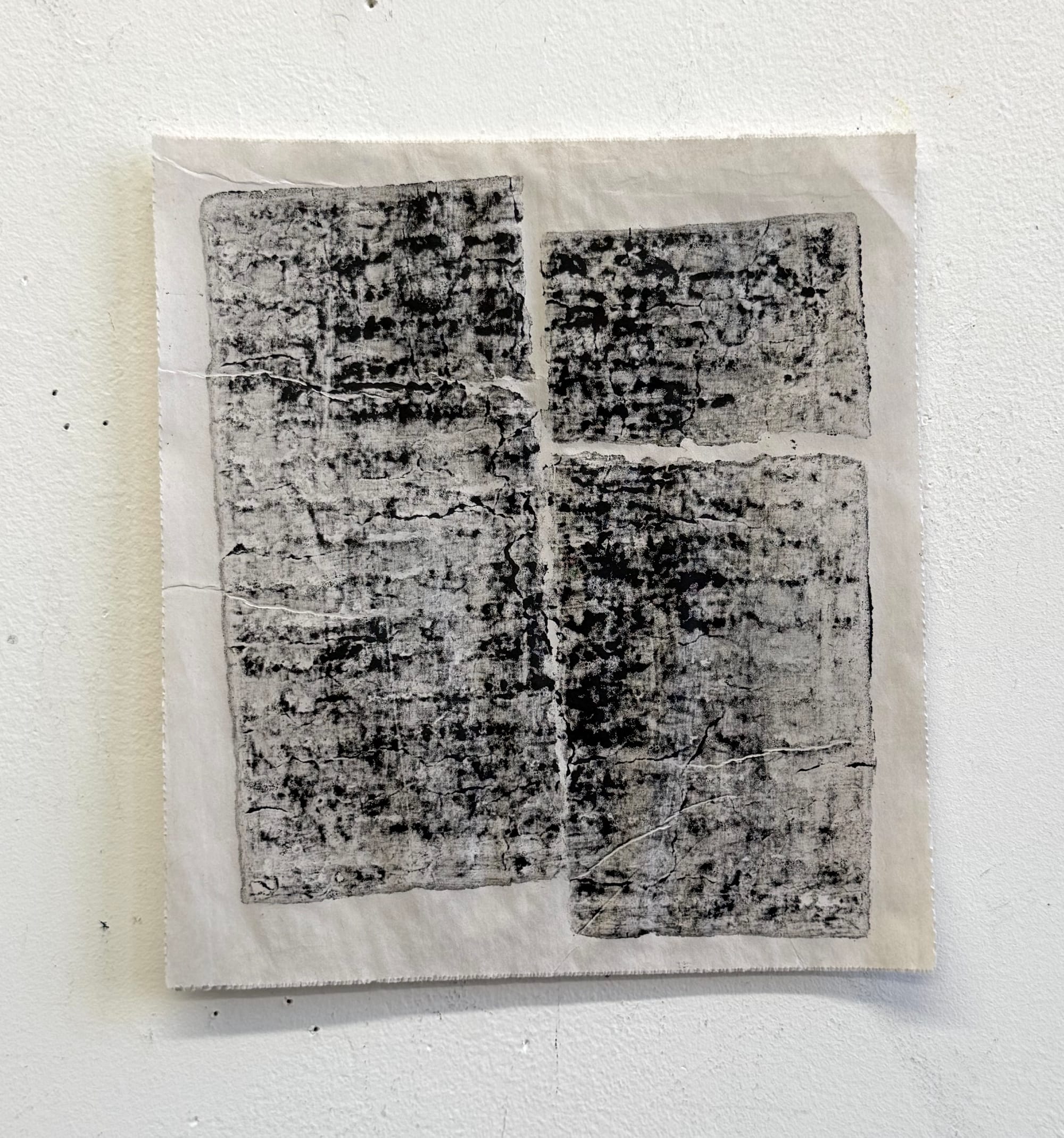
A decade later, based in New York and New Jersey, Miller has woven this unleavened bread into her grid-based painting practice. In her ongoing series, Matzot, started in December, she uses a printing press to form dark collographs from sheets of matzah. These prints reveal the textures and cracks of the matzah, transforming the traditional bread into a political statement. “They’re ominous,” she said of her seven-inch square works, “but also geological and ancient, with a sense of fractures.”
Miller manipulates some matzah sheets, allowing others to disintegrate naturally under the press. She explained, “The fractures in these images symbolize the disconnect among Jewish people today, the metaphorical gaps between those rooted in tradition and those driven by territorial claims and Zionism.” For viewers reluctant to engage with the political undertones, Miller suggests, “They might just see matzah. But deeper inspection reveals more.”
Her collographs challenge the notion of a uniform Jewish viewpoint while highlighting shared traditions. Miller noted, “Everyone I know, from Reform to Orthodox backgrounds, consumes matzah. It’s a unifying food, yet there are fractures.” Her time in Israel and Palestine prompted her to question her upbringing’s pro-Israel stance. There, she painted en plein air, capturing the varied architecture and disparities in the West Bank, Jerusalem, and Tel Aviv.
“I’m proud of my Jewish identity,” Miller stated, “but this pride feels complicated when violence is justified in the name of Jewish safety.” As Passover unfolds globally, she reflects on the diaspora’s connections over matzah, symbolizing the hurried exodus from Egypt. “There’s complexity in our identities and beliefs,” Miller remarked. “Yet foods like matzah remain a shared bond.”