BOLZANO, Italy — The Museion hosts Nicola L.’s exhibition, I Am the Last Woman Object, where her fabric banners, adorned with phrases like “We Want to Breathe” and “Same Skin for Everybody,” hang prominently. These banners, with head-shaped spaces, invite multiple faces to peer through, symbolizing unity and solidarity. Nicola L., born Nicola Leuthe-Lanzenberg in Morocco and active between Paris and Ibiza from the 1960s, crafted art that echoed the playful yet socially critical ethos of Nouveau Realism, alongside figures like Niki de St. Phalle and Yves Klein.
Her oeuvre evolved to include “functional sculptures” such as the Femme Commodes, vividly painted wooden cabinets with drawers positioned in feminine silhouettes, reflecting second-wave feminism. Nicola L.’s creations spanned from a foot-shaped vinyl floor cushion to sofas and lamps that mimic human features. Relocating to New York in 1979, she became part of the Chelsea Hotel’s vibrant artist community, forging connections with Claes Oldenburg and Carolee Schneemann, among others. Her “pénétrables,” including the “Red Coat” for eleven people, were wearable textile works that continued to be used in public performances throughout her life.
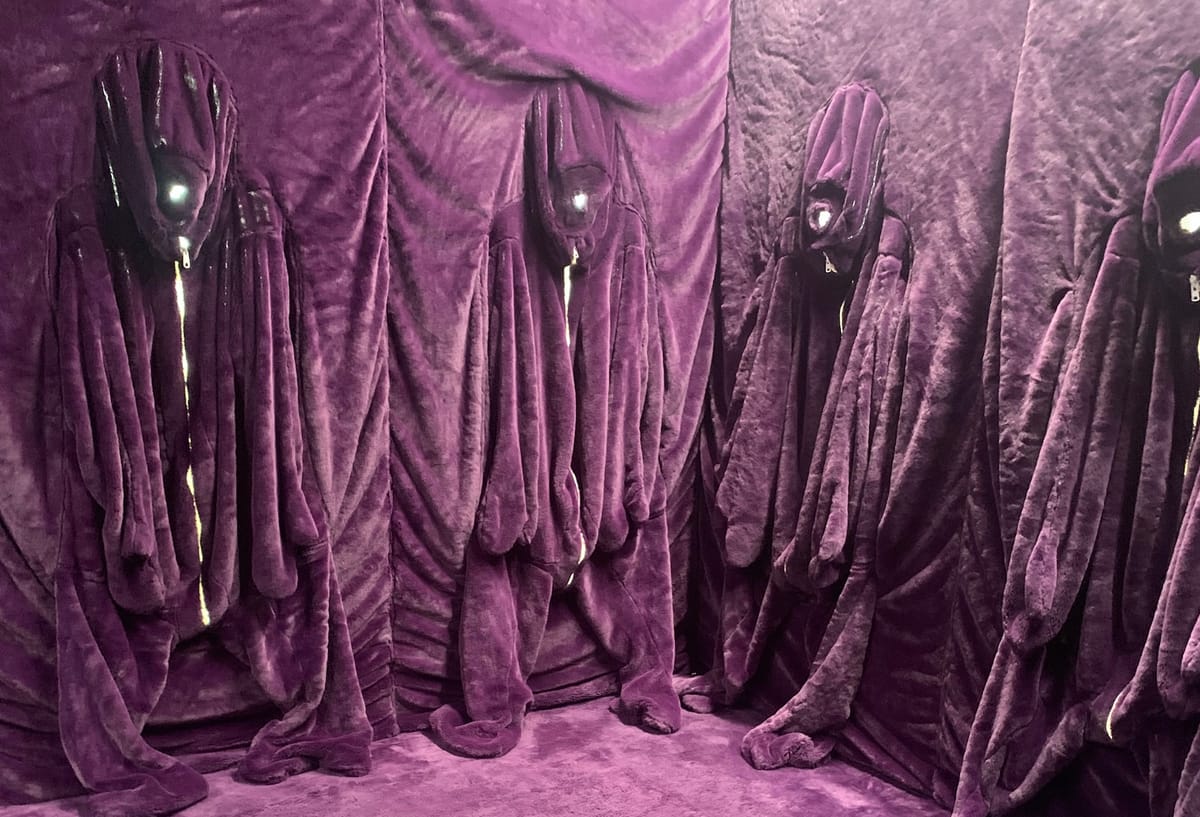
Another notable work, “Fur Room,” presented a womb-like space lined with purple fur, where visitors could zip themselves into body-shaped compartments. Her art, rich with depictions of the human form, extended into collages and drawings, and she documented the cultural and activist scenes around her, including the music at CBGB’s and figures like Abbie Hoffmann. The exhibit, named after a female-shaped vinyl sculpture with a TV screen belly, reflects her life of subtle defiance and celebration of counterculture.
The exhibition, organized by Nicola L.’s estate and initially launched by Alison Jacques gallery in London, culminates in Bolzano after stops at Frac Bretagne and Kunsthalle Wien. Designed by Berlin’s Manuel Raeder, this Italian installment is the most extensive, allowing her work to flourish in a naturally lit space. A visit to the Vienna show earlier this year revealed the enduring relevance of her art, which resonates with contemporary issues, though it was overlooked during her lifetime. Her institutional recognition began only in 2017 with a survey at New York’s Sculpture Center, despite early success and connections in the art world.
Nicola L. joins a lineage of European women artists like Geta Brătescu and Maria Lassnig, who gained broader recognition posthumously. This delayed acknowledgment often results from historical gender biases in the art market, where dealers seek to promote under-recognized talents with unsold work. Yet, Nicola L.’s art, with its “soft resistance,” remains pertinent today, embodying a feminine approach to addressing societal challenges. Museion curator Leonie Radine highlights this aspect in the exhibition’s catalog, emphasizing the collective action and joy her work inspires. As society confronts ongoing issues, Nicola L.’s legacy offers valuable lessons in strategized resilience.