CHICAGO — I found myself astonished to realize I had visited over a dozen of the locations featured in The Disappointed Tourist, a painting series capturing places lost to time, conflict, urban renewal, natural calamities, and more common occurrences. Initiated by artist Ellen Harvey in 2019, the series now portrays over 300 sites across roughly 40 nations, including the Great Synagogue of Warsaw, demolished by the Nazis in 1943, and the Bavinger House in Norman, Oklahoma, an architectural marvel by Bruce Goff, torn down in 2016. Also included are the Colossus of Rhodes, toppled by an earthquake in 226 BCE, and Tower Records, which succumbed to the evolving media market, closing its stores in 2006. The shared theme of loss underpins Harvey’s project, inviting public input via the prompt: “Is there some place that you would like to visit or revisit that no longer exists?”
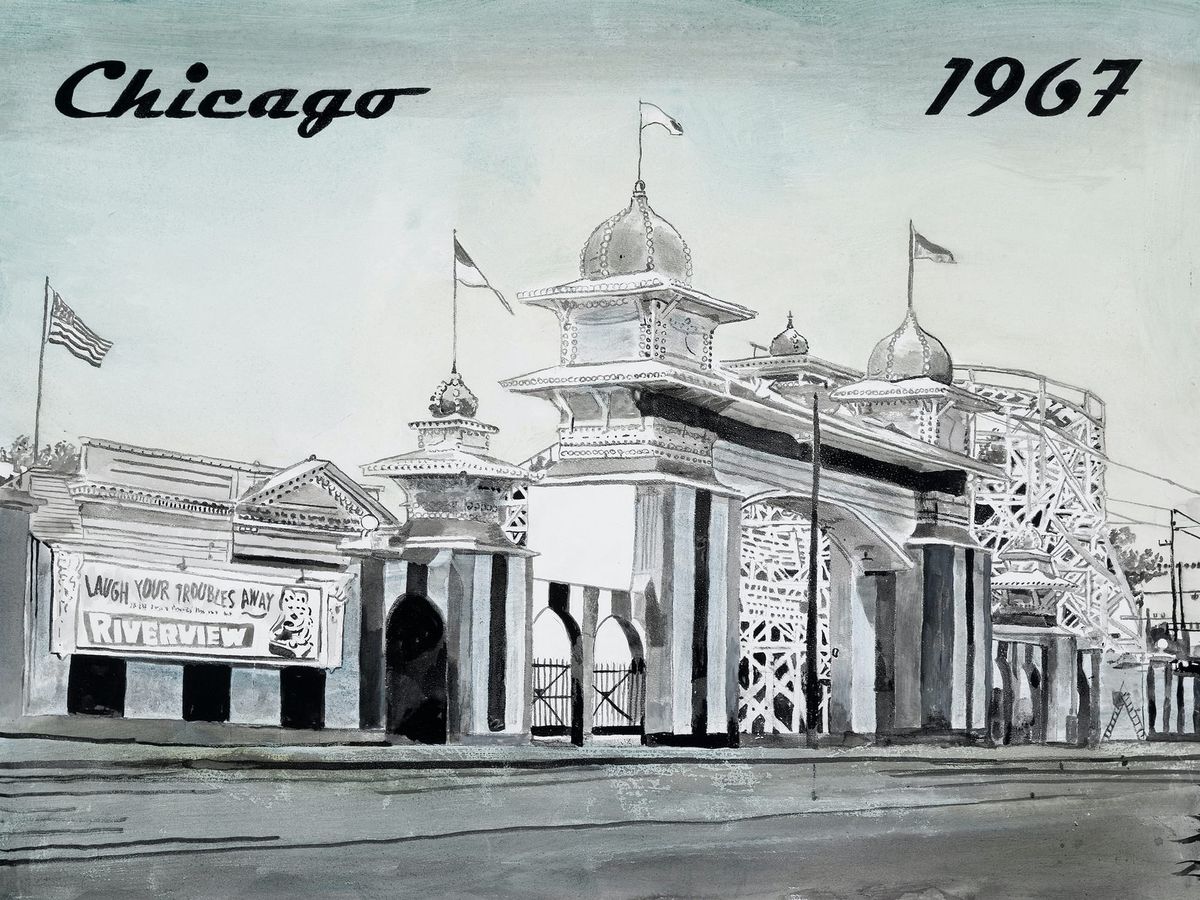
Currently showcased at the Chicago Architecture Center, the collection occupies three walls in a vast, strikingly somber grid. Each depicted site, whether a diner, mosque, castle, or library, is meticulously rendered on an 18-by-24-inch panel in monochromatic acrylic, completed with oil glazes. They are labeled with details such as name, location, and cessation date, presented in thoughtfully selected fonts. The project’s website provides further context for each piece. The visual impression mirrors vintage, hand-colored postcards, making every location appear both beautiful and nostalgically desirable, regardless of its original aesthetics. My personal longing for Blockbuster Video, a casualty of physical media’s decline, illustrates the power of these renderings, despite Blockbuster’s lack of charm. Harvey, born in 1967 in Kent, England, and relocated to the United States as a teenager, initially gained recognition for her New York Beautification Project (1999-2001), where she discreetly painted romantic landscapes on graffitied urban surfaces.
The Disappointed Tourist elevates Harvey’s work significantly due to the depth of meaning attached to these places. Many of the sites resonate with me from my time in New York during the early 2000s, stirring nostalgia for that vibrant period of my life. They also evoke sadness and frustration over the relentless march of urban change. The famed Florent in the Meatpacking district closed in 2008 due to rising rents, while 5Pointz, Long Island City’s graffiti haven, was whitewashed in 2013 before being replaced by condos. The redesign of 2 Columbus Circle in 2008 by the Museum of Arts and Design exemplifies another loss. Chicago, my current home, also features prominently in Harvey’s series, with 14 paintings dedicated to its lost landmarks, like the Berlin nightclub and Bertrand Goldberg’s original Prentice Women’s Hospital, both victims of gentrification and corporatization.
The exhibition also chronicles devastating events such as the September 11, 2001, attacks, which obliterated the World Trade Center, a type of loss echoed across history by conflicts that claimed landmarks like the Great Walls of Benin and the Al Nuri Mosque of Mosul. Anticipated to rise are losses due to climate change, currently represented by the vanished Chacaltaya Glacier in Bolivia, melted away in 2009. The series also honors ancient mysteries, like the rainforests of Ireland or the Hanging Gardens of Babylon, whose stories are largely unknown but deeply felt. Beyond catastrophic events, The Disappointed Tourist serves as an unofficial record of valued places, featuring natural sites like the Salem Oak alongside beloved leisure venues from various eras, including the Moskva Pool in Moscow and the Cliftonville Lido in Margate, England. Such spaces, once centers of enjoyment, are now mere memories as entertainment landscapes shift.
In a world destined for continuous transformation and loss, Ellen Harvey’s The Disappointed Tourist will perpetually uncover new destinations to memorialize, offering her an endless canvas to explore.