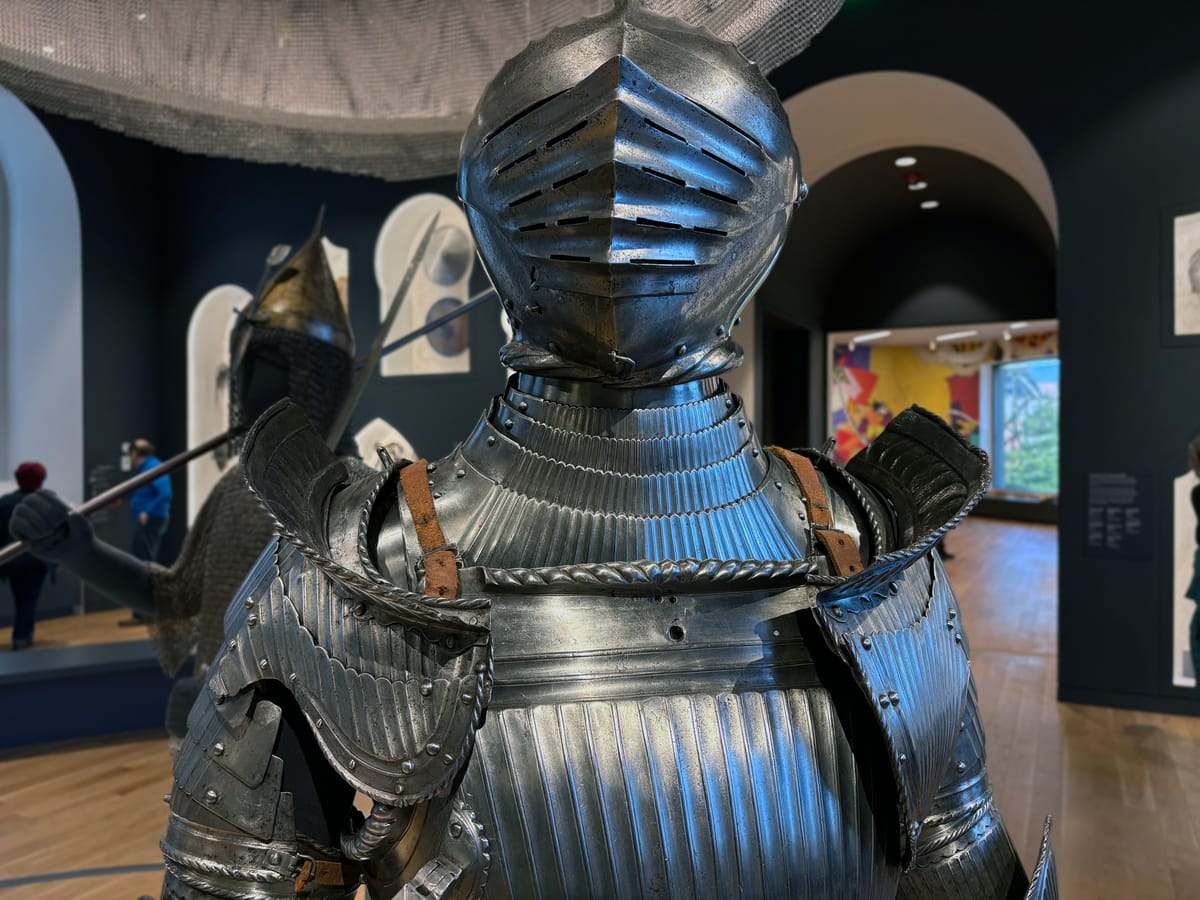
WORCESTER, Mass. — What insights can historical armor provide into the lives of historical knights? Following extensive restoration, the armor galleries at the Worcester Art Museum reopened in November last year, inviting visitors to delve into a world that transcends the romanticized legends of medieval chivalry. This exhibition showcases armor from various cultures, including hoplites, samurai, and Sudanese soldiers, underscoring the global admiration for these artistic armaments.
Why do North American museums boast such extensive armor collections? The answer lies in the Gilded Age, when collectors like William Randolph Hearst and Clarence H. Mackay amassed significant collections, much of which were subsequently donated to institutions such as the Metropolitan Museum of Art in New York City, which boasts the largest collection of arms and armor in the United States. Surprisingly, the second-largest collection is housed not at the Getty or the Art Institute of Chicago, but at the Worcester Art Museum (WAM) in Massachusetts. This collection owes its existence to John Woodman Higgins, a steel magnate and avid collector who initially displayed his collection at the Higgins Armory Museum, which closed in 2013. WAM acquired this archive in 2014.
After more than a decade, Higgins’s collection returns to public view alongside other acquisitions, now featuring armor from around the globe. The exhibits include pieces from India, Japan, Egypt, and beyond, highlighting the diverse history of armor. Notably, one of the earliest depictions of armor is found on the Sumerian Standard of Ur, dating back to 2550 BCE, now housed at the British Museum in London.
WAM’s exhibitions extend the narrative of armor into contemporary times, offering interactive digital displays and opportunities for visitors to engage with fictional armor, such as a Mandalorian helmet. The galleries feature informative diagrams and labels, aiding in the understanding of various armor types, such as samurai Dō-maru gusoku and traditional European suits. This dense arrangement fosters a sense of historical continuity, emphasizing that armor served not only in battle but also in ceremonial contexts like tournaments and parades.
One of the highlights is the intricate horse armor and the unique “dog armor” inspired by a 16th-century European suit for a hunting dog, crafted by Leonard Heinrich in 1943 for the Higgins Museum. By showcasing armor from across the globe, the Worcester Art Museum offers a refreshing narrative that decouples medieval Europe from its traditional centrality, illustrating that tales of armored knights extend far beyond Europe to encompass Eurasia, Africa, Japan, and other regions. These displays invite a reconsideration and retelling of the stories associated with these diverse armaments.