In times of upheaval, the question of what it means to love is often posed, yet seldom in the context of the medieval era. Although the Middle Ages might seem an unlikely source of wisdom on such matters, its culture presents enduring insights into love that resonate today. During periods of crisis, when care is obscured or tested, the essence of love becomes more apparent.
Our current era is characterized by a pervasive exhaustion that hampers focus: humanitarian crises are reduced to statistics, social care systems are weakened by budget cuts, and digital economies prioritize speed over accountability. Care is not entirely absent, but is often delayed, hidden by vast scales, and driven by a notion that vulnerability should be managed rather than directly addressed.
In medieval European visual culture, moments of trial are frequently depicted through blackness, symbolizing humility and spiritual testing. While images of Black figures are not uncommon, they rarely embody love in its fullest sense upon first glance. Figures like Saint Maurice use blackness to invite viewers to reflect on sanctity by confronting their own shortcomings. Meanwhile, figures such as Balthazar emphasize blackness for its symbolic meanings of distance and universality, rather than as an intrinsic condition. These images encourage self-reflection but fall short of portraying blackness as a generative force for love.
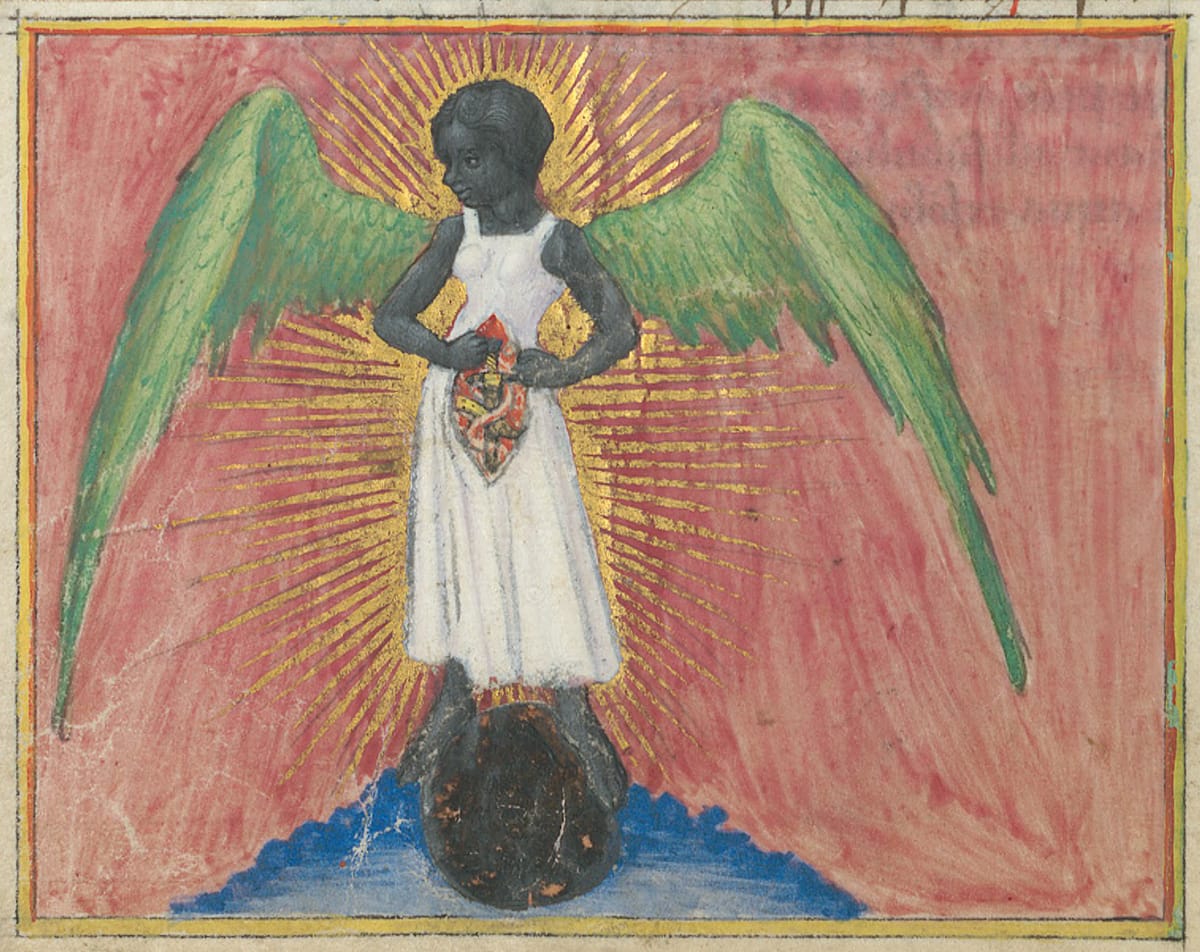
An image from the 15th-century alchemical manuscript Aurora consurgens challenges this notion, depicting a black-skinned angel with green wings and a glowing red interior. Traditionally, medieval theology equated moral goodness with light and whiteness. However, this angel’s blackness juxtaposed with the inner light disrupts conventional perceptions of goodness. The manuscript, attributed to a pseudo-Aquinas, recasts alchemy as a spiritual journey focused on humility and self-knowledge, rather than material gain. The stages of nigredo, rubedo, and albedo in this process emphasize transformation as an integration, not an erasure, of blackness.
The Aurora consurgens suggests that love is not an achievement of purity, but a capacity arising after the self is unmade. The black angel’s skin signifies not a condition to be overcome, but the foundation from which love emerges. This image invites a reconsideration of love as a capacity that thrives on vulnerability. Blackness here is not a barrier, but the necessary space where love can take root.