My initial encounter with John Altoon’s artwork occurred in 1984 at the now-closed Edward Thorp Gallery. Since that moment, I’ve delved deeply into understanding his oeuvre by examining his pieces and engaging with those who knew him, such as poet Robert Creeley, who collaborated with Altoon on the 1966 artist’s book and portfolio About Women, and art dealer Nicholas Wilder, who first showcased his work in 1965. Despite being a highly regarded and innovative figure in the 1950s and ’60s Los Angeles art scene, Altoon, who passed away in 1969 at just 43, has largely remained obscure beyond California. The exhibition John Altoon: Drawings at Franklin Parrasch Gallery sheds some light on this enigma.
After residing in New York during the early 1950s and mingling with Abstract Expressionists, Altoon returned to Los Angeles, shifting away from abstraction towards creating dreamlike, sexually charged drawings. He opposed the formalist notion prevalent at the time that drawing impeded modern art’s development. Altoon’s work distinguished itself by ignoring conventional norms and drawing from dreams and the imagination.
The exhibition features seven pieces from 1963 to 1968, showcasing the breadth of Altoon’s drawing techniques and his use of varied materials. His linear, feverish, and sensual figure drawings in ink and graphite continue to provoke reactions among viewers and institutions, even those displaying work by artists like Hans Bellmer. In his compositions, women often appear larger and more introspective than men, who are depicted as indistinct and ineffectual. Altoon omits contextual clues, placing his drawings firmly within the imaginative realm.
In “Untitled (ABS-81A)” (1966), Altoon illustrates a strange form resembling the lower half of an ostrich against a backdrop of blue and green circles. Three plumes emerge from the form, while a square in its center reveals a linear nude in red, echoing Gustave Courbet’s “Origin of the World” and Marcel Duchamp’s “Étant donnés.” This juxtaposition imbues the drawing with an odd humor, challenging viewers to consider the focus of the image.
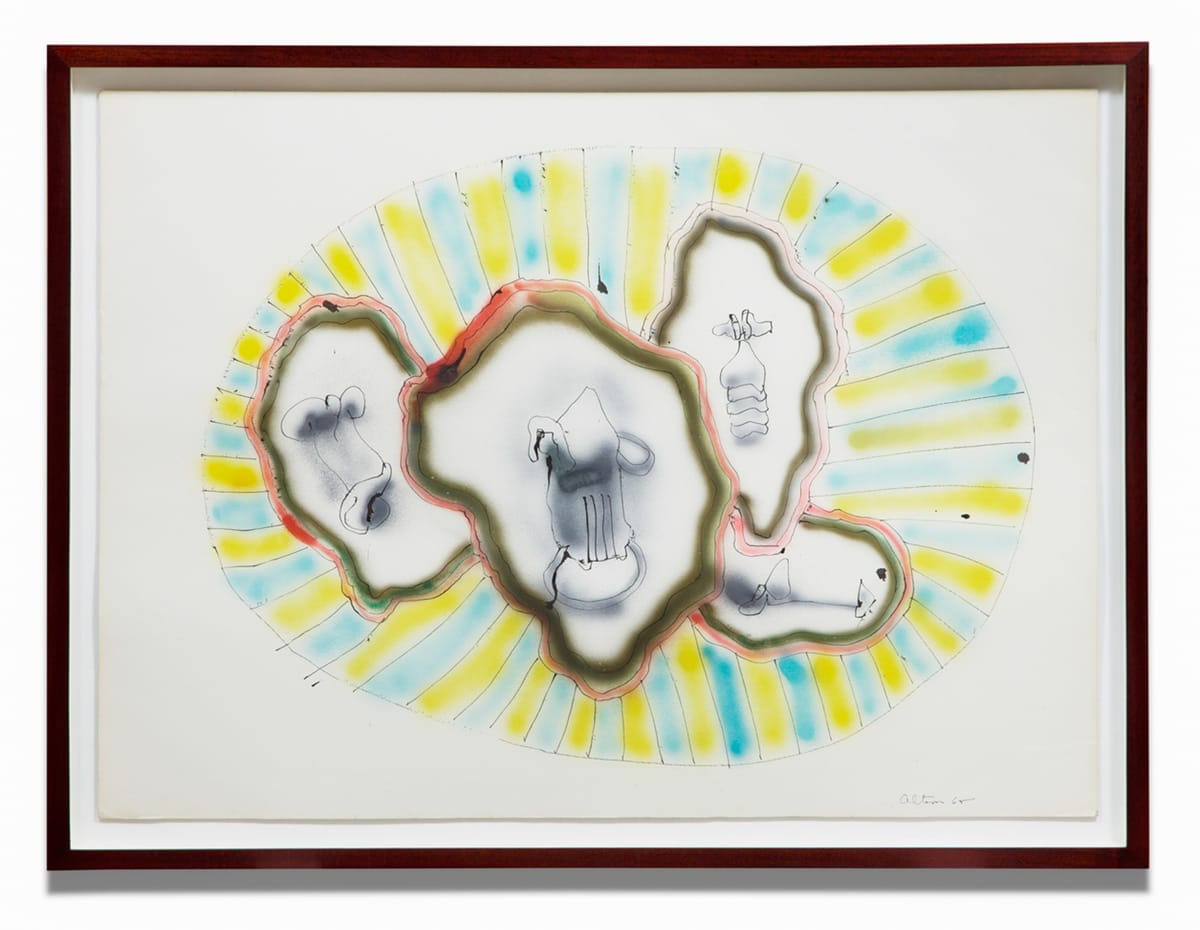
Another piece, “Untitled (ABS-52)” (1965), employs airbrush, pastel, and ink to create overlapping shapes outlined in red and khaki green atop a blue and yellow sunburst. Within each shape lies an enigmatic form, a testament to Altoon’s inventive spirit. At the time of his death, Altoon was reaching his artistic zenith, having mastered diverse media and developed a unique visual language. His embrace of dreams and imagination allowed for groundbreaking creativity in drawing, proving its continued potential post-Picasso, Miró, and Gorky.
John Altoon: Drawings is on display at Franklin Parrasch Gallery (19 East 66th Street, Floor Three, Lenox Hill, Manhattan) until February 27. This exhibition is curated by the gallery.