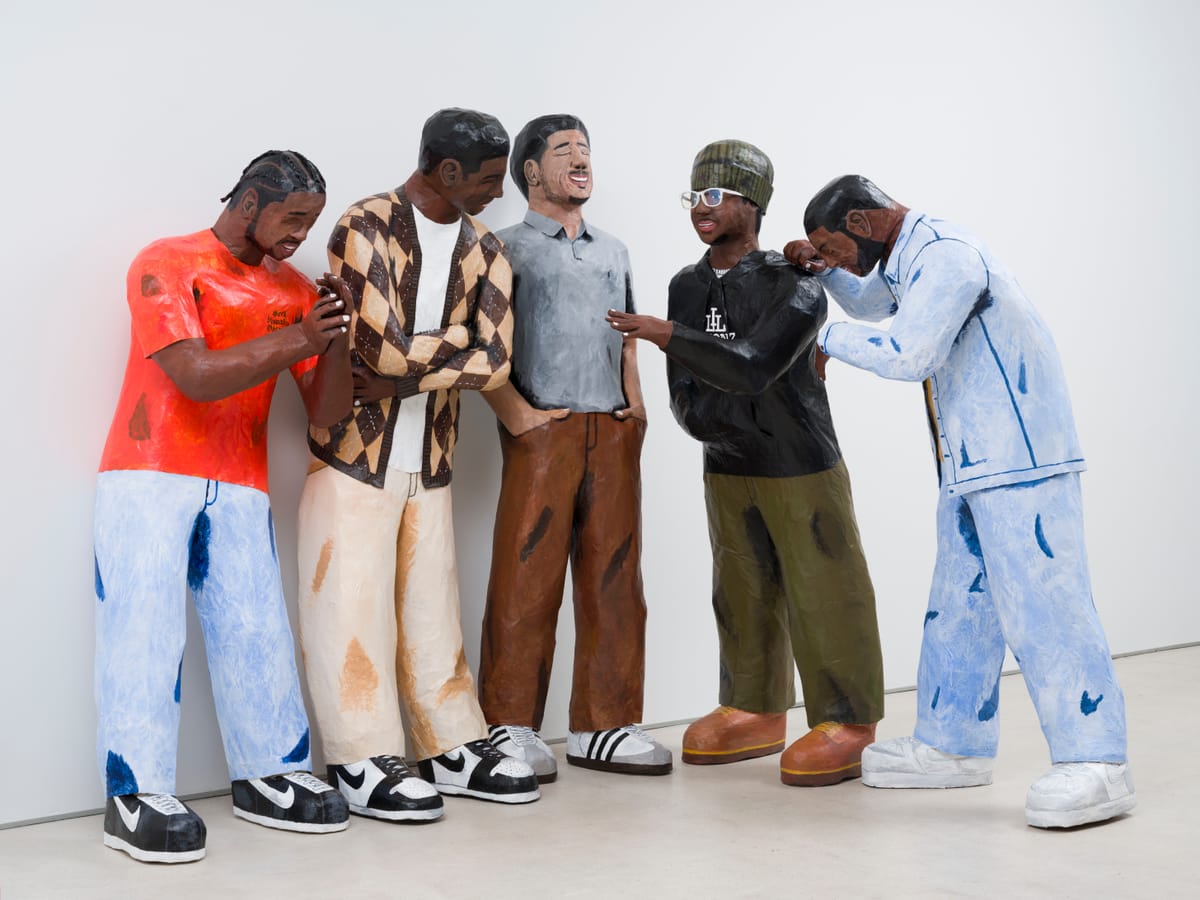
Within the Bronx Museum of the Arts, just before the entrance to the seventh edition of its biennial exhibition, Forms of Connection, stands a trio of life-size figures. These sculptures, created by Piero Penizzotto from papier-mache, foam, and acrylic paint, engage in a silent conversation. Representing people from his everyday interactions, Penizzotto’s work, ‘Big Brother Obii Knows Best (Ft. Freddy & Shawn)’ (2025), portrays men in urban attire, echoing the cultural diversity typical of New York City. This piece is a poignant reflection on how such figures are often absent from mainstream narratives unless cast in stereotypical roles.
Another compelling piece, Bryan Fernández’s ‘Beso a La Cámara’ (Kiss the Camera) (2025), presents a stark view of urban life. It features an MTA bus with exaggerated surveillance cameras and the word ‘FARE’ prominently displayed, capturing a moment where passengers of Asian descent appear to be asleep. The scene critiques the depiction of public transportation as a mercenary entity rather than a community service, highlighting lives often unseen beyond art spaces like the Bronx Museum.
While such artworks aim to provide authentic depictions, they can risk becoming overly sentimental, equating urban life solely with the underclass. However, other artists in the exhibition push boundaries by transforming everyday materials into imaginative forms. Jordan Corine Cruz’s ‘Opportunity for Stillness’ (2025) reimagines a park bench in red votive candle wax, suggesting spiritual resilience, while Katie Chin’s ‘Short Pay, Short Shovels’ (2026) uses metaphor to explore human unpredictability against industrial norms.
Jodie Lyn-Kee-Chow’s ‘Valor and Revolt’ (2024–26) turns tools of conflict into symbolic artifacts, implying past struggles have been overcome. Similarly, DeepPond Kim’s ‘Veil’ (2022) and Skip Brea’s ‘The Gaze’ (2022–24) challenge viewers to envision beyond current realities. These works invite reflection on identity and future possibilities, offering a vision that transcends the present.
In the AIM biennial and beyond, this exhibition showcases art that encourages us to explore horizons that expand rather than remain static. It offers a glimpse into a world that moves past the limitations of the present, urging us to imagine what could be.