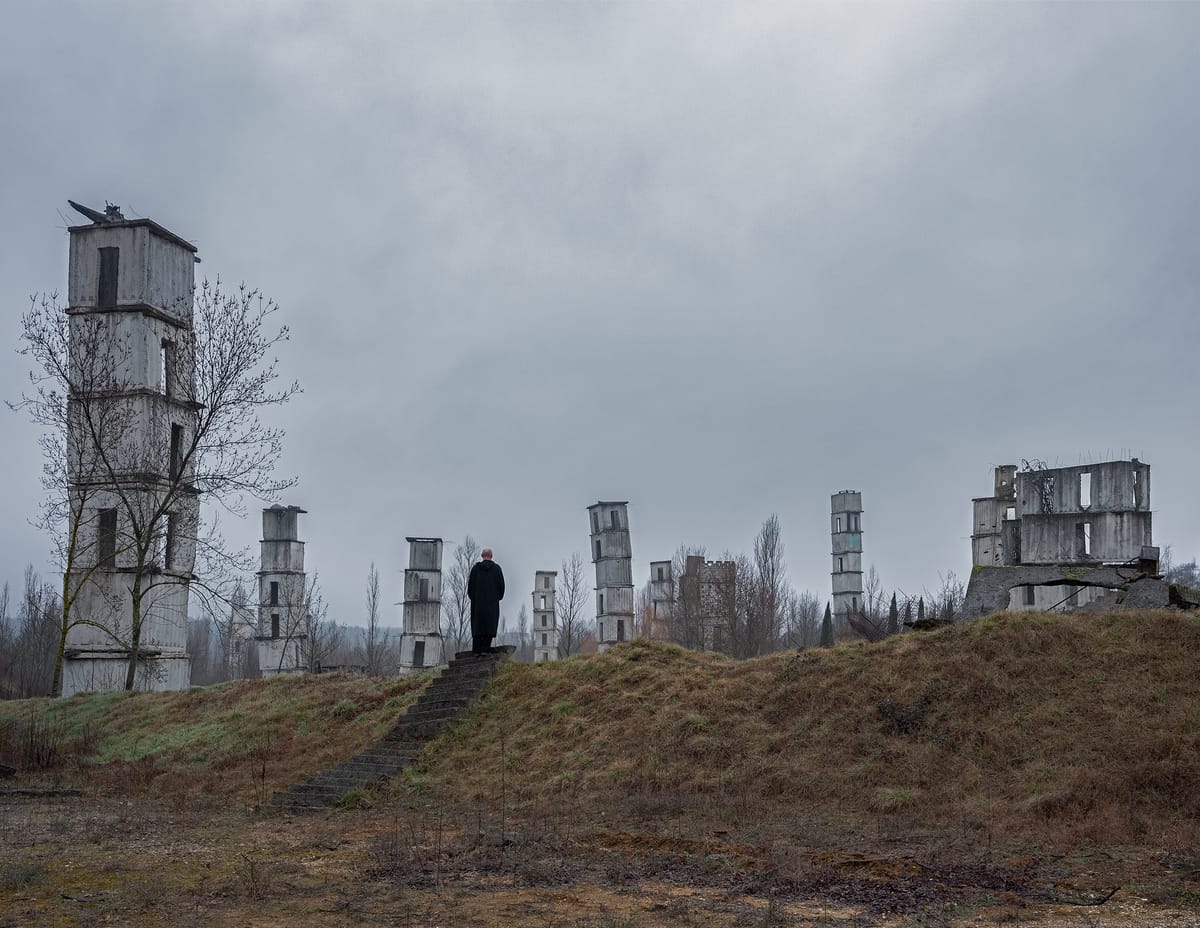
A solitary white dress stands on a hill encircled by woods. Brides line up, their heads transformed into stacks of books, heaps of twigs, or atomic models crafted from lead. Empty greenhouses are punctuated with gowns, set against a serene landscape. The opening scenes of Anselm, captured in 3D and 6K resolution, might be mistaken for a somber cut from The Polar Express. However, in Wim Wenders’s visually compelling documentary about German artist Anselm Kiefer, the aim is to immerse and captivate rather than simply entertain. From the plaster of ‘Femmes Martyres’ (2018–19) to the towering shipping containers at La Ribaute, Kiefer’s expansive estate in southern France, the tactile quality of these works is palpable. Wenders creates a cinematic landscape of vast, layered dimension, inviting both awe and contemplation.
The composition of Wenders’s shots reflects the intricate layering in Kiefer’s large-scale collages, featuring elements like charred sunflowers and shattered glass. With the camera’s movement through each shot resembling a dancer’s steps, it echoes Wenders’s first 3D film, a documentary on choreographer Pina Bausch in 2011. Anselm emerges not as a tribute to a single individual but as a profound poetic dialogue between two German artists exploring form, content, collective trauma, and creativity. Both born in 1945, Kiefer and Wenders have been lifelong friends, navigating the shadows of Germany’s past transgressions, which have been a persistent presence in their lives.
Wenders layers footage of post-World War II German ruins with the poetry of Paul Celan and Ingeborg Bachmann to portray Kiefer at various life stages, proposing that understanding his art requires grasping his experiences across different periods of postwar Europe. The younger Kiefer is portrayed by Wenders’s grand-nephew and Kiefer’s son, intertwining familial legacy with artistic expression. It’s unfortunate, however, that Wenders overlooks the current relevance of Kiefer’s themes — collective memory and the deliberate forgetting of traumatic history. As Kiefer and Wenders continue to examine the cultural myths fueling National Socialism and the Holocaust, their connection to today’s fascist and alt-right movements remains unexplored.
The question arises of how a film with political themes can avoid taking a political stance. Wenders has frequently navigated this territory; his 2023 film Perfect Days, set in Tokyo, and the 1987 Wings of Desire, set in divided Berlin, both touch on political themes without delving deeply into them. Wenders asserts in his 1988 book The Logic of Images that films claiming to be apolitical are indeed the most political, as they dismiss the potential for change. While Anselm doesn’t seek to entertain, it hesitates to position Kiefer’s work within a modern sociopolitical framework. Kiefer’s quiet opposition to American imperialism and the consumer-driven art market goes unexamined in the film.
In voiceover, Kiefer muses, “The greatest myth is the human race itself,” encapsulating the film’s mix of profundity and ambiguity. Fortunately, Wenders refrains from glorifying the myth of the Great Male Artist, consistently highlighting Kiefer’s collaborative influences. Anselm serves as a poignant reflection on the experience of two German artists creating in the shadow of 20th-century devastation. Yet, its connection to the issues of the 21st century remains elusive, demonstrating the limited scope of their otherwise remarkable imagery. Anselm will be available in select theaters starting December 15.