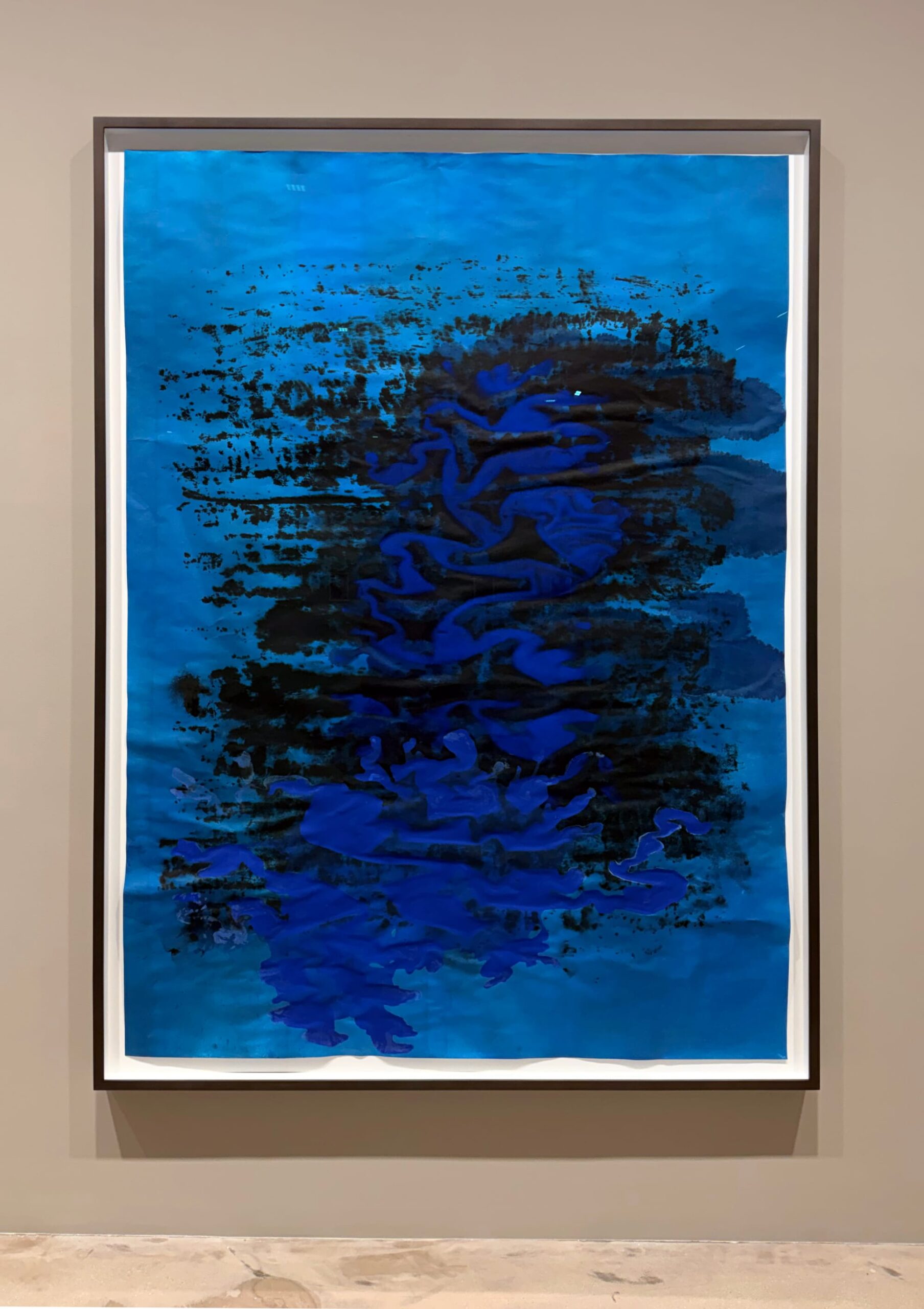
On a chilly January day, stepping into Hauser & Wirth, I was immediately enveloped by the artificial warmth and then captivated by Glenn Ligon’s paper works. The overwhelming expanse of blue in these pieces drew me in, particularly in Ligon’s ‘Blue (for JB) #18’ (2025). This piece, constructed with carbon ink and acrylic on torinoko paper, presents an almost abstract canvas with subtle black letters emerging amidst the deep blue. The swirling cobalt tones and black bulbs create a dynamic visual experience.
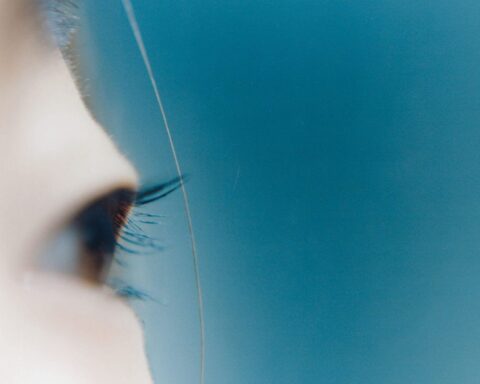
Within this series, a striking resemblance caught my eye. Lorna Simpson’s ‘Night Fall’ (2023) seemed to echo within Ligon’s work, as if a figure was staring back at me with a similar intensity. Ligon’s ability to transform static forms into experiential art makes him seem like a magician. His exhibition, ‘Late at night, early in the morning, at noon,’ builds on his exploration of abstraction and text, inspired by James Baldwin’s 1964 introduction for Beauford Delaney. This new work continues themes from his ‘Stranger’ paintings, integrating Baldwin’s 1953 essay ‘Stranger in the Village.’
Ligon’s latest series, ‘Blue (for JB)’ (2025), extends his investigation into how language and color might converge to create figuration. By layering rubbings on Japanese kozo paper and transforming them into silkscreens, Ligon explores the merging of text and color. His use of water to manipulate ink further blurs these boundaries, suggesting a unique expressive potential. The series poses a central question: how can these elements together achieve something that neither could alone?
Ligon also reflects on Baldwin’s description of light as ‘blue as the blues.’ This evokes a transition from light to darkness, symbolizing his deeper inquiry into the interplay of light and shadow. This exploration resonates with David Hammons’ 2002 installation ‘Concerto in Black and Blue,’ where participants used blue flashlights in darkness, and Imani Perry’s ‘Black in Blues’ (2025), examining the intersection of racial identity and color.
The second part of the exhibition, in a smaller gallery, revisits Ligon’s printmaking from the 1990s onward. The diptych ‘Untitled (Cancellation Prints)’ (1992 and 2003) challenges racialized color concepts with a repeating phrase on a white background, canceled by a thin ‘X.’ The light cream text and letter lack contrast, complicating racial color constructs and illustrating how ‘blue’ and ‘black’ serve as conceptual canvases rather than mere descriptors.
‘Glenn Ligon: Late at night, early in the morning, at noon’ is on view at Hauser & Wirth in Chelsea, Manhattan, until April 11. The exhibition is curated by the gallery.