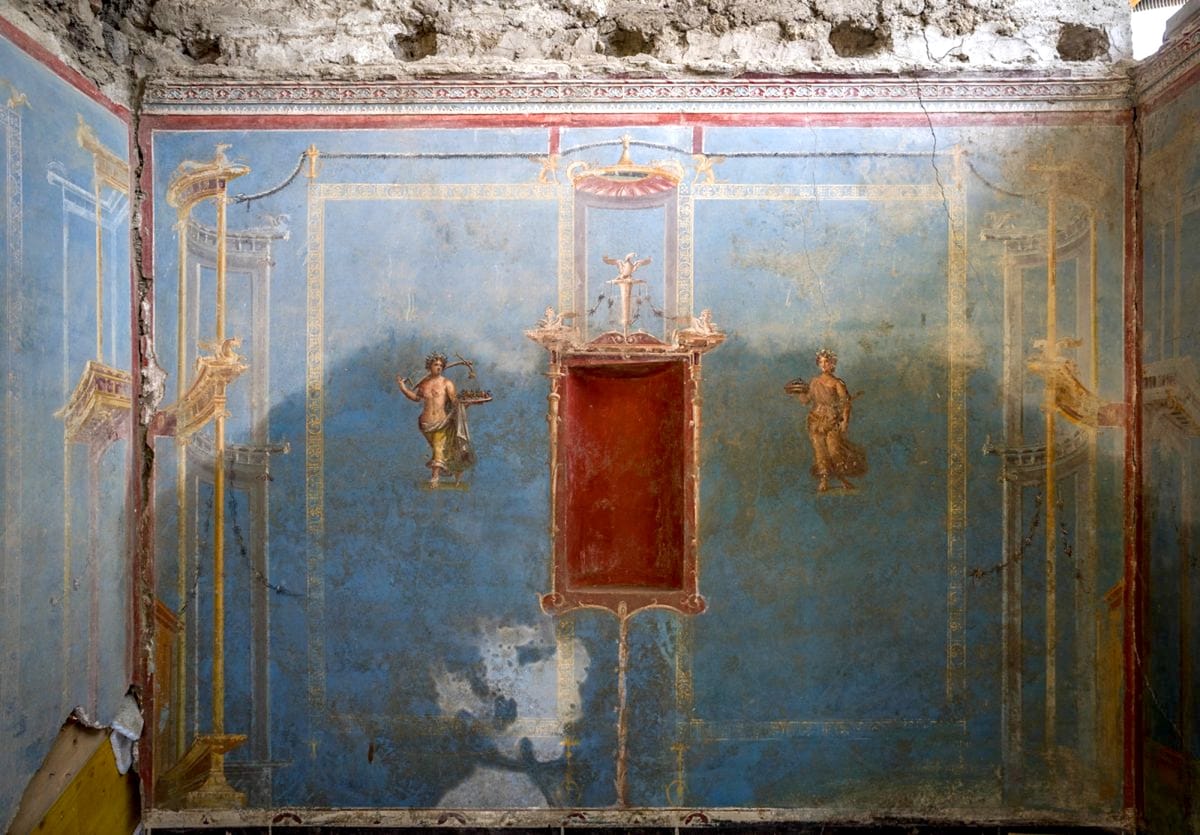
In the summer of 2024, an extraordinary discovery emerged from the ruins of Pompeii. An exquisite “Blue Room” was unearthed during the ongoing excavations in the central area (Regio IX) of this ancient Italian city. The vivid Egyptian blue adorning its walls suggested to archaeologists that the room was more than a simple domestic space; it likely functioned as a sacrarium, a sacred place for household rituals or storage of religious items. But what was the financial burden of these costly pigments for affluent Romans? A recent paper in Heritage Science explores the opulence of luxury paints and estimates the substantial expense of using Egyptian blue to embellish an entire room in the first century CE.
Blue is a visually stunning yet challenging color to recreate naturally. The pigment derived from Lapis lazuli was scarce and had to be mined from the remote mountains of Badakhshan, in present-day northeastern Afghanistan, making it a valuable resource. This scarcity led to innovation in ancient times, resulting in the creation of Egyptian blue. Artisans manufactured this pigment by combining heated sand, lime, copper, quartz, and an alkali flux. Evidence of Egyptian blue dates back to Ancient Egypt around 3300–3200 BCE and later gained popularity in Anatolia and Mesopotamia. By the first century BCE, the architectural writer Vitruvius acknowledged its existence and its Roman name, caeruleum, noting its production in Puteoli, near Pompeii.
The analysis of Pompeii’s newly revealed Blue Room exemplifies how modern studies of the ancient world integrate literature, archaeology, and innovative science. Led by Mishael Quraishi, a recent MIT graduate with a focus on material science and archaeology, the research team employed techniques like visible light-induced luminescence and spectroscopic and electron microscopy analysis to chart the blue pigment in the room. Their findings showed that the artisans required between 2.7 to 4.9 kg (5.95 to 10.80 lbs) of pigment to cover its walls.
The opulence of the household owning the “Blue Room” was evident, featuring a thermal bath, central courtyard, staircase, an upper floor, and a vast dining hall accommodating 20 to 30 guests. But what was the expense of painting their shrine in Egyptian blue? Researchers relied heavily on the work of Hilary Becker, an expert in ancient history and pigments at Binghamton University. Becker evaluated the various grades of Egyptian blue, as documented by Pliny the Elder, who perished in the eruption of Vesuvius in 79 CE. Pliny recorded that general caeruleum cost 8 denarii per libra, while the superior caeruleum vestorianum was priced at 11 denarii per libra.
Quraishi and her team applied these historical prices, coupled with mathematical formulas for room size and paint coverage, to estimate the cost at between 93 and 168 denarii. This cost equated to purchasing “744 to 1344 loaves of bread,” according to the authors. For context, a Roman soldier’s annual salary was around 187 denarii, indicating that the pigment expense was between 50% and 90% of this income. Though not as costly as indicum (indigo), often imported from India, Egyptian blue was still an expensive pigment. This study also highlights the labor costs associated with wall painting in antiquity, with prior research by Francesca Bologna estimating 31 to 56 labor hours just to grind the pigments for the room’s paint.
The research on Pompeii’s Blue Room underscores the use of Egyptian blue by wealthy residents to decorate their homes, reflecting a penchant for conspicuous consumption. The study is a significant advancement in applying scientific techniques to reconstruct the polychromatic lives of Pompeiians, where colors conveyed profound meanings. In ancient times, blue hair often indicated divinity. A full blue room, however, was a bold statement of Roman prosperity.