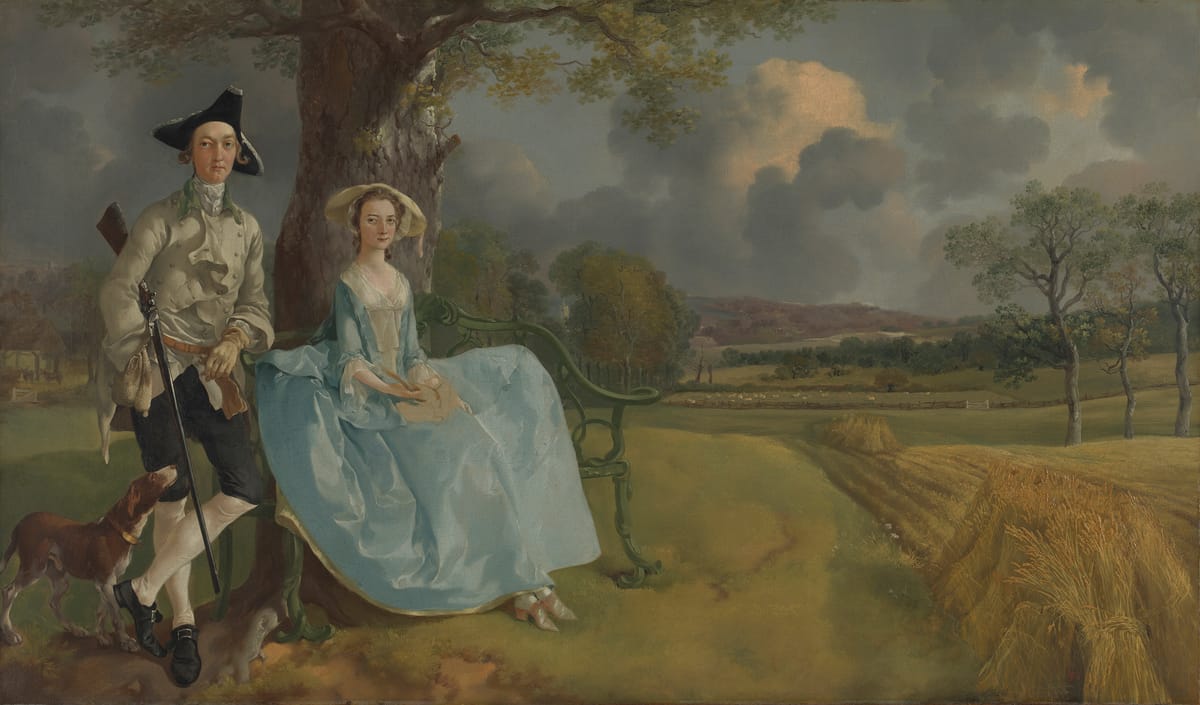
The exhibition ‘Gainsborough: The Fashion of Portraiture’ begins with a display of ‘conversation pieces,’ a genre already losing its popularity when Gainsborough painted them. These works, such as ‘The Gravenor Family’ (1754), were dismissed by the London elite as provincial, with their formal composition influenced by the dated style of English painter Francis Hayman. However, ‘Mr. and Mrs. Andrews’ (1750) showcases Gainsborough’s unique ability to depict landscape and attire as symbols of ownership, equally emphasizing the lush farmland and Frances Andrews’s delicate dress and shoes. Gainsborough’s move to Bath in 1759 marked a stylistic evolution as he engaged with the works of Flemish artist Anthony van Dyck, adapting his style to the Georgian era’s self-presentation.
Curator Aimee Ng highlighted the recent critical view of British portraiture, often seen as representing the affluent who thrived on colonialism and slavery. Acknowledging this, the exhibition also argues for the role of fashion in social negotiation. In 18th-century Britain, taste was a moral compass, as philosopher Anthony Ashley Cooper, Third Earl of Shaftesbury, suggested that beauty and virtue were linked. Amidst the rapid wealth creation from colonial trade, discerning virtuous consumption from mere extravagance became crucial, with taste seen as a means to regulate luxury and refine desires. Gainsborough’s portraits visually articulated this promise of taste transforming wealth into virtue.
The 1759 portrait of young Sarah Hodges, holding a rosebud with cascading sheer fabric, and ‘Mary, Countess Howe’ (1763–64) in her pink silk and lace, illustrate the notion of belonging among the esteemed. Their portraits emphasize taste as the measure of youth and status, with fashionable elements like rosy cheeks and exquisite fabrics signaling their place above the ordinary. Gainsborough often revised his paintings to align with shifting trends, as seen in ‘Mrs. Sheridan’ (1783) and ‘Mrs. Samuel Moody’ (1779), where he updated personas and removed accessories to reflect changing definitions of respectability.
The exhibition is most insightful when examining the complexities of Georgian taste. A notable juxtaposition is ‘Mary, Duchess of Montagu’ (1768) with ‘Ignatius Sancho’ (1768), who overcame enslavement to become a notable intellectual. Though Gainsborough portrays Sancho with dignity, the painting reveals the limitations of fashion in transforming social structures. While fashion allows Sancho a temporary status, the systems benefiting from his labor remain unchanged.
The artworks strive to present hierarchy as both beautiful and natural, with their detailed depiction of porcelain faces and rich fabrics. The exhibition excels in highlighting the artistry involved in these paintings, yet its most compelling aspect is uncovering the labor of taste and the persistent illusion that style can elevate wealth to moral virtue. Today, this promise appears increasingly tenuous, with the paintings oscillating between fantastical allure and social critique.