LONDON — In a timely coincidence, the Courtauld Gallery’s exhibition, Seurat and the Sea, follows closely on the heels of the National Gallery’s comprehensive exploration of the same artistic era. Notably, one painting transitioned directly from the National Gallery’s show to the Courtauld without returning home. Unlike the National Gallery’s exhibit, which delved into themes of socialism and politics with pieces from the Kröller-Müller collection, the Courtauld’s display—billed as the UK’s inaugural exhibition devoted to Seurat’s seascapes—resembles a collection of exquisite postcards.
This is not to diminish its value; indeed, Seurat’s paintings were conceived with such charm in mind. Of the approximately 45 canvases Seurat completed, over half depict seascapes painted during his annual summer sojourns to the Channel coast from 1885 to 1890. He envisioned these works as a way to “cleanse one’s eyes of the days spent in the studio.” The exhibition’s focused theme highlights the limits of pointillism as a technique, similar to the National Gallery’s show.
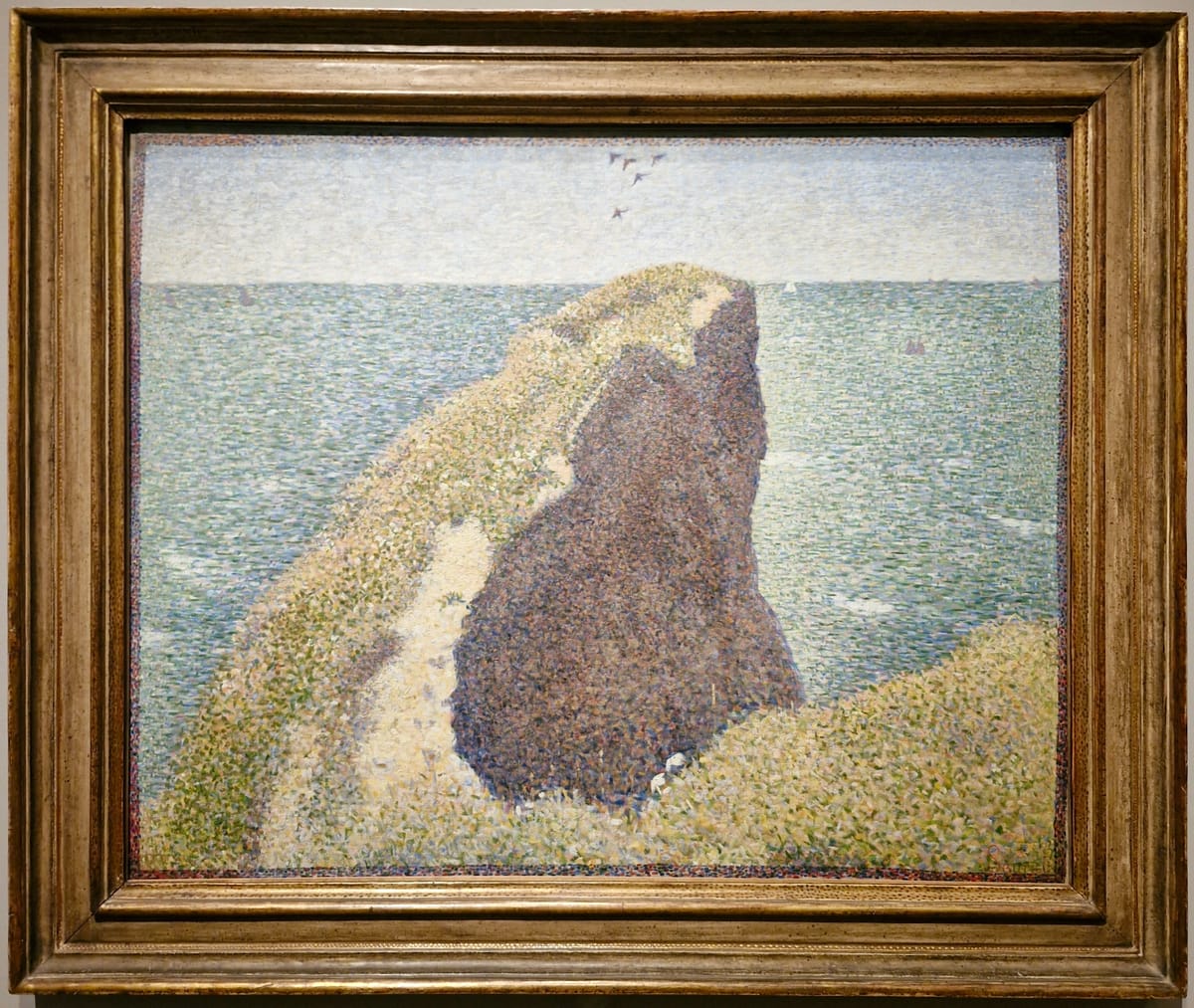
Explanatory diagrams accompany the exhibit, illustrating how Seurat employed opposing color theory to craft an optical illusion of tonal depth through myriad short strokes and dots of pigment. Unlike the Impressionists, whose mastery of contrasting pastels achieved vibrant seaside light, Seurat’s brilliance emerges from densely clustered dots in contrasting primary tones, creating a fully textured pictorial space.
The exhibition shines with its preparatory studies for larger works. For instance, comparing the Tate’s “Le Bec du Hoc (Grandcamp)” with its smaller study from the National Gallery of Australia, Canberra (both 1885), reveals larger, uniformly distributed “points” in the study. The final version enhances angular dash direction and diagonal hatching, generating a dynamic atmosphere. Likewise, a study for “The Channel of Gravelines: An Evening” (1890) from the Victoria & Albert Museum contrasts starkly with its finished form at the Museum of Modern Art in New York.
The repetitive captions—focused on pointillism’s mechanics and foundational theory—highlight a lack of deep artistic or academic discourse. Statements like “Seurat’s radical technique consisted of juxtaposing dashes and dots of unmixed colour” and “Each colour appears in varying intensities, harmonising the scene” are applicable to most works. Nonetheless, the exhibition’s true insight is Seurat’s unwavering dedication to his technique, even during leisure time. The artworks invite viewers to enjoy them as serenely as the coastal landscapes they depict.
Seurat and the Sea is on view at the Courtauld Gallery (Somerset House, London, England) until May 17. The exhibition is curated by Karen Serres.