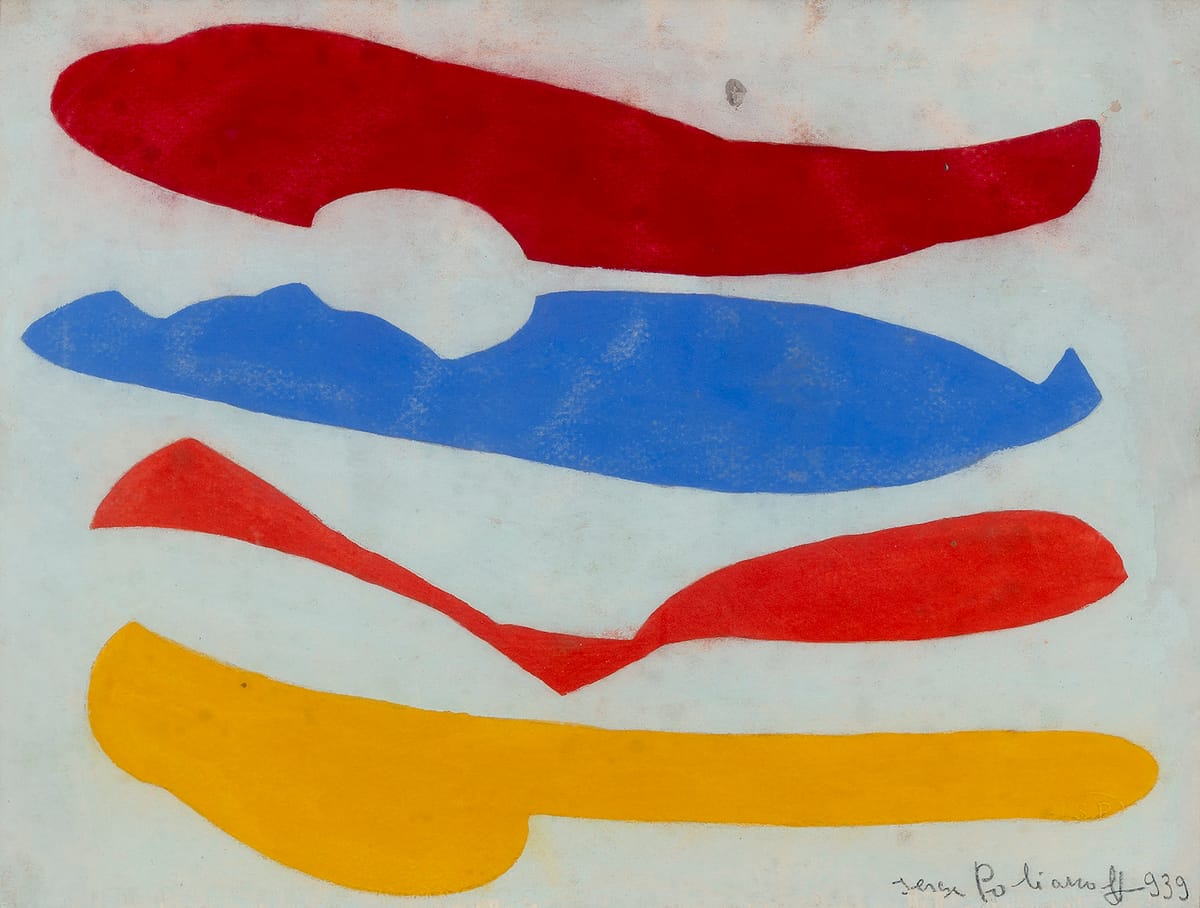
Serge Poliakoff (1900-1969), a painter originating from Russia, is an intriguing artist whose contributions deserve more recognition in the United States. Fleeing the Russian Revolution, Poliakoff found refuge in Bulgaria before traversing Europe as a balalaika musician in the early 1920s. By 1924, he had settled in Paris, performing in Russian cabarets to support his painting pursuits. His artistic education began in 1929 at renowned Parisian academies under the tutelage of Othon Friesz, a former Fauve who later adopted a more muted palette after his World War I experiences.
Poliakoff’s fascination with vivid colors likely stemmed from his childhood exposure to Russian religious icons, influenced by his devout mother. In 1937, he returned to Paris from a brief stay in London and began mingling with influential figures like Robert and Sonia Delaunay, Otto Freundlich, and Wassily Kandinsky. This environment catalyzed his exploration of color, leading to his first abstract paintings in 1942 and their exhibition three years later.
Poliakoff is frequently associated with notable French artists such as Jean Fautrier, Nicolas de Staël, Pierre Soulages, Hans Hartung, and Maria Helena Vieira da Silva. Despite working contemporaneously with American Abstract Expressionists, these artists, except for Soulages, did not receive the same acclaim in America. Poliakoff’s bold use of color and adherence to the picture plane likened him to postwar American artists.
In 2016, Joe Fyfe curated a seminal exhibition at Cheim & Read that highlighted Poliakoff’s work, featuring insights from artists like Brice Marden and Patricia Treib. Fyfe’s exhibition, along with the 2021 show Serge Poliakoff: Gouaches 1938-1969, underscores Poliakoff’s lasting impact and relevance in abstract art, particularly for those outside mainstream movements.
The gouaches span three decades, reflecting Poliakoff’s consistent innovation and avoidance of repetition. Early works like “Étude de Cercles” (1938) show his dynamic use of shape and color, reminiscent of Robert Delaunay’s Orphism. Poliakoff’s distinct approach to color and shape is evident in works such as “Composition Jaune” (c. 1955) and “Composition Abstraite” (1959), where he masterfully balances figure and ground, inviting viewers to engage deeply with each piece.
Serge Poliakoff: Gouaches 1938–1969 is open at Cheim & Read (23 East 67 Street, Upper East Side, Manhattan) until September 25. These exhibitions inspire a deeper appreciation for Poliakoff’s unique contributions to abstract painting.