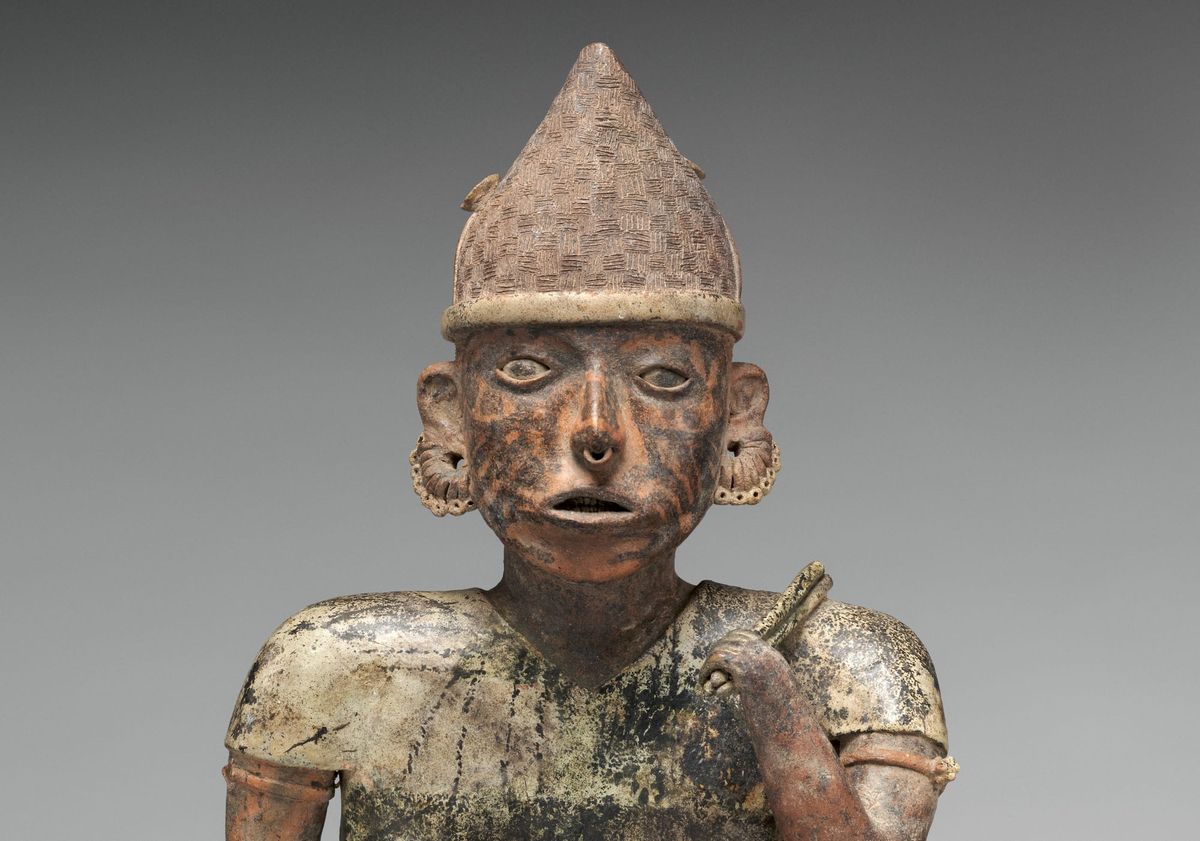
The Manhattan District Attorney’s office announced on Wednesday, July 15, that a 1,600-year-old sculpture once held by the Metropolitan Museum of Art is being sent back to Mexico.
Following new information from the Antiquities Trafficking Unit’s ongoing investigations, the DA’s office seized three archeological objects: a ceramic Nayarit sculpture dating to c. 100–400 CE that was formerly in The Met’s collection, a Xochipala Bowl from c. 1200–900 BCE seized from New York’s Merrin Gallery in 2025, and an obsidian stone core dating to c. 1000–1500 CE used to make Aztec blades. The stone core had previously been in the possession of trafficker Eugene Alexander, who was convicted in 2025 for his role in New York’s illicit antiquities trade.
According to the DA’s statement, the three objects have a combined value of more than $160,000. The office added that it has now returned 52 antiquities to Mexico, with a total value of over $13 million.
Recent seizures involving objects from The Met have raised the total valuation of looted artifacts surrendered by the museum to $95 million, according to reporting earlier this month. In a Hyperallergic article last week, art crime scholar Erin L. Thompson said The Met had also repatriated a Roman bust to the Republic of Turkey in February, one of many works in US museums acquired through Phoenix Ancient Art, whose co-founder was convicted on antiquities trafficking charges.
The return of the three Nayarit objects was marked by a ceremony in which Consul General Marcos Bucio represented the government of Mexico and underscored the country’s commitment to defending its cultural sovereignty. “This Nayarit figure is far more than an archaeological object: It is a powerful testimony to the creativity, identity, and collective memory of the peoples of ancient Mexico,” Bucio said in a statement. In a separate press release, Met Director and CEO Max Hollein thanked “the experts and authorities whose work helped clarify the provenance of this object,” noting that The Met created its own provenance research team in 2023, which has since doubled in size and now works regularly with investigators from the DA’s Antiquities Trafficking Unit.
“We believe that the trafficking networks we have identified are responsible for other pieces looted throughout Mexico,” DA Bragg said in a separate press release. “And our work continues.”