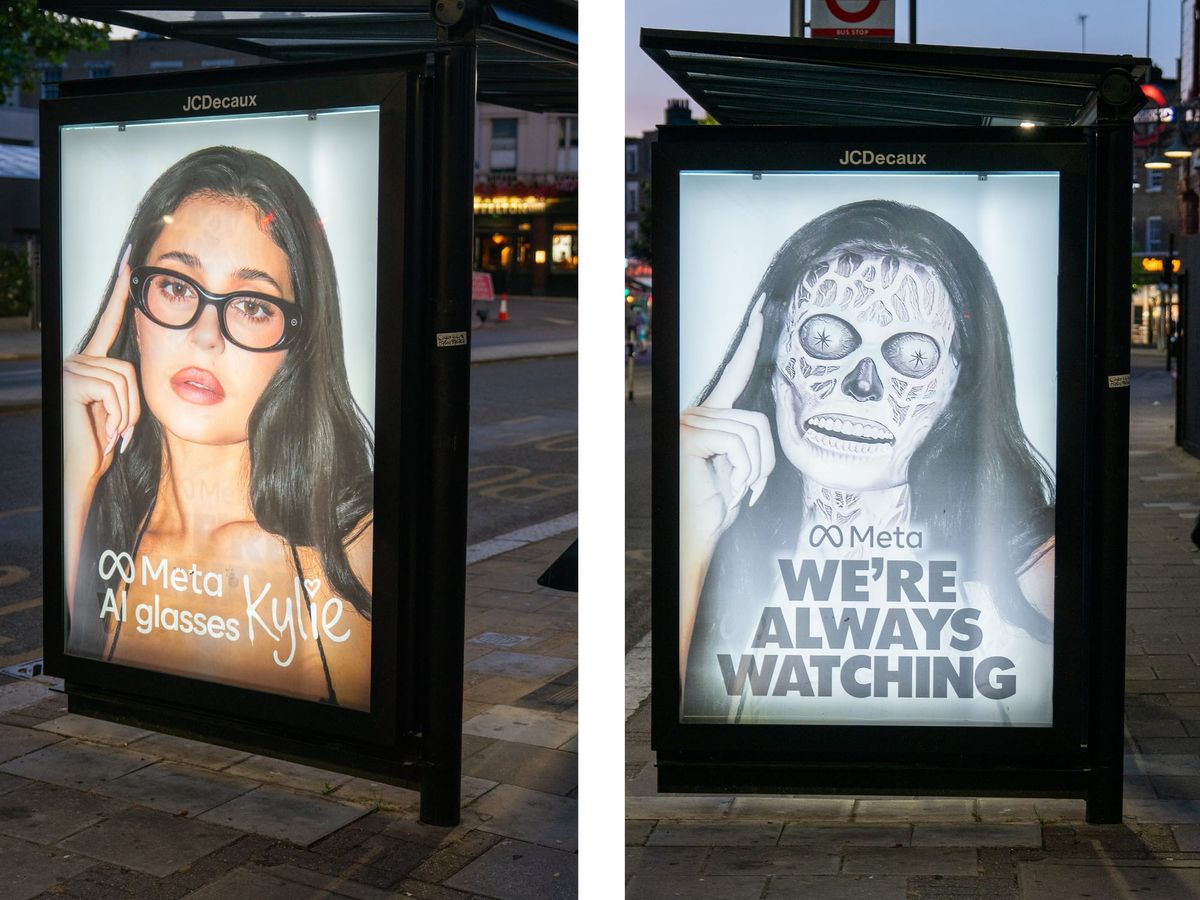
Late last month, Meta teamed up with controversial TV personality and cosmetics mogul Kylie Jenner to design and promote an “entry-level” version of its widely criticized camera glasses. The campaign promptly drew intense backlash over lingering questions about privacy, consent, and personal safety as surveillance technology continues to advance.
In the United Kingdom, the class-based activism group Everyone Hates Elon (EHE) turned those anxieties into a lenticular spoof ad that changes depending on the viewer’s angle. From one side, it shows a glossy marketing image of Jenner wearing Meta glasses; from the other, it reveals a black-and-white skeletal, X-ray-like version of her with the slogan, “We’re always watching.”
The shifting image and overall poster design seem to echo the politically charged sci-fi film They Live (1988), in which the protagonist discovers sunglasses that expose the manipulative messages of advertising and reveal humanity being controlled, subdued, and exploited by aliens disguised as people. The film also later reveals that some humans have accepted money to help the aliens.
Known for public interventions on both sides of the Atlantic, EHE had affiliated activists place the mock advertisement at a bus stop near Meta’s London headquarters as a sarcastic rebuke of the company’s expanding surveillance tools. A visual showing the ad’s transformation from different viewpoints underscores the effect.
Meta introduced its first Ray-Ban smart glasses in 2021, offering up to 30 seconds of camera recording, later extended to one minute. The newest generation now allows for three consecutive minutes of recording, intensifying concerns that people may be filmed in public without their knowledge and raising questions about what could happen to that footage.
“Meta has spent years tracking us online,” an EHE spokesperson told Hyperallergic in an email. “Now it wants to track us in the real world too.”
To address fears that the glasses could secretly record people, Meta said it would release a software update that would shut off the camera if the built-in LED recording light were blocked or damaged. Even so, the product has been widely mocked online, especially amid its popularity with “Manosphere” creators who post point-of-view videos of themselves cold approaching — and, in effect, sexually harassing — women in public without their knowledge.
“Meta and Ray-Ban’s new AI glasses can be used to secretly record women and young people for sexual reasons,” the EHE spokesperson added in the statement to Hyperallergic. “Simply put, that’s abuse.” The group also pointed to the growing gap between what is legal and what is ethical as smart glasses increasingly create risks in places where privacy is expected, including hospitals, restrooms, fitness spaces, locker rooms, and private businesses.
In 2024, Harvard researchers were able to use facial recognition software on footage recorded by Meta’s Ray-Ban glasses to identify the names, addresses, and other personal details of passersby through public databases. With privacy law struggling to keep pace with rapidly developing smart glasses and other AI systems that process biometric data, EHE offered one final question: “Billionaires could fund cures for cancer — so why are they funding glasses for perverts instead?”