This article is part of Hyperallergic’s 2026 Pride Month series, featuring interviews with queer and trans elder artists throughout June.
When the off-Broadway theater Soho Rep left its longtime Tribeca home in 2024, it made an unforgettable exit. Its final production in the space, Give Me Carmelita Tropicana!, served as a fitting salute to the venue’s legacy as a downtown theater center. The title figure, Carmelita Tropicana, has been a constant presence in New York’s downtown theater and performance art world since the 1980s.
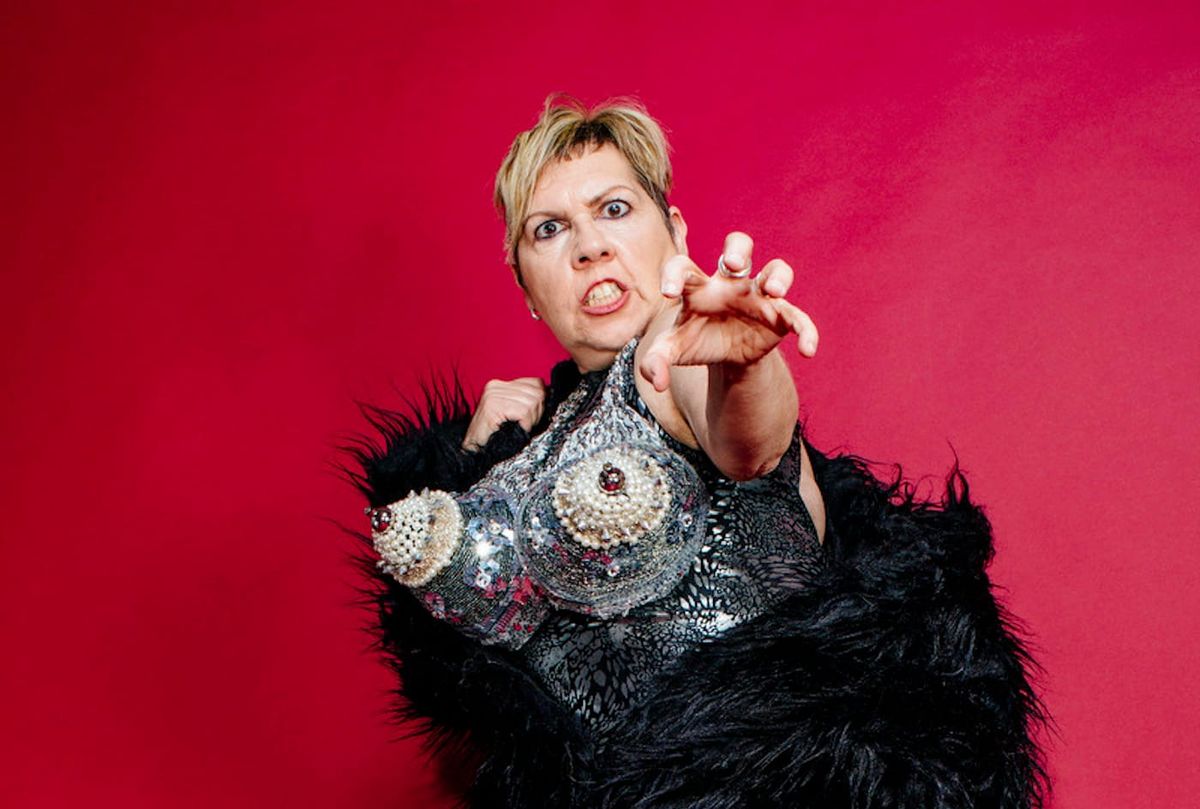
As the alter ego of Cuban-American writer and performer Alina Troyano, Carmelita Tropicana has pushed back against stereotypes of Latina and queer women, taking on multiple genders and personas — including animals — while urging audiences to see their worlds differently. Carmelita’s origin was almost accidental in the East Village, when a radio performance led Troyano to adopt a pseudonym and a standup set for a comedy class she took with Holly Hughes gave shape to a stage character. The result was not only, in her words, an outrageous and out lesbian “Latin spitfire,” but also a body of film and theater work spanning racism, homelessness, revolution, and identity.
In Give Me Carmelita Tropicana!, which Troyano cowrote with award-winning playwright and former student Branden Jacobs-Jenkins, she plays with the idea of selling the Carmelita persona to Branden, portrayed by Ugo Chukwu. Troyano was also a key figure in the early days of WOW Café Theater, the queer feminist East Village collective where artists such as Hughes, Eileen Myles, and the Five Lesbian Brothers performed. She is now developing a podcast for Soho Rep, That’s Not What Happened, which will eventually become a theater piece and is directed by her collaborator and sister, filmmaker Ela Troyano.
Hyperallergic spoke with Carmelita about her rapid entry into writing and performing in New York’s 1980s club culture, the collaborators and influences around her, and the queer community that shaped her work. The conversation has been edited and condensed for clarity. The discussion began with congratulations on her Obie Award for Lifetime Achievement, which she said was deeply meaningful, as was the party her friends organized for her, with speeches from Holly Hughes, Lois Weaver, and her sister, Ela Troyano.
Asked about legacy and artistic lineage, Troyano said Give Me Carmelita Tropicana! reflects those themes in both its story and its collaboration with Branden Jacobs-Jenkins. She explained that they met in 2007 at New York University, where she was teaching and he was a student who had just come from Princeton and was already working at the New Yorker. Their friendship grew into a creative partnership, eventually leading to a Creative Capital grant in 2016 for the project, which began as a conversation between an older Latina lesbian and a young Black American playwright. Over time, the piece evolved through delays, including Jacobs-Jenkins becoming a father and the disruption of COVID, while a 2018 London workshop helped develop its central premise of Branden attempting to buy the Carmelita character.
Troyano also described the play’s shifting structure, including a lawyer’s office scene and a Freaky Friday-style turn in which Carmelita becomes angry with Alina and enters the body of the actor playing Branden. She said the work also draws on autobiographical material, including the real-life dynamic behind their collaboration and a piece Jacobs-Jenkins made involving a goldfish. For Troyano, the play became a way to explore two intergenerational artists shaped by very different moments in downtown theater — her in the 1980s, and Jacobs-Jenkins in the late 2000s and early 2010s — through a conversation that unfolds across many characters rather than just two people.