KINGSTON, N.Y. – Throughout my career, I have frequently explored the works of East and South Asian diaspora artists such as Jiha Moon and Sangram Majumdar. Their art often reflects their divided lives. However, this is my first examination of a Scandinavian artist in the diaspora, whose art is clearly influenced by the colors, light, landscapes, and narratives of her upbringing. Anki King’s exhibition at the Lace Mill in Kingston, on display until March 29, showcases such influences. Born on a Norwegian farm, King attended Oslo Drawing and Painting School before moving to America at 25. Settling in New York, her art has absorbed the local scene while maintaining a unique style. Unlike Susan Rothenberg, whose art often depicted New Mexico, King draws from her memory and imagination.
The exhibition features 40 pieces spanning various media, including oil paints, ceramics, thread, and mixed media on paper, all created between 2015 and 2026. King’s moody color palette of dark blues, blacks, grays, and occasional yellows and greens reflects Norway’s polar night, where the sun remains below the horizon for weeks, creating a unique twilight. Her artwork uses tonal contrasts to depict faceless, elongated figures against abstract backgrounds, creating a painted rather than spatial world. This separation evokes an inner space, enhanced by her recurring motifs and themes of isolation.
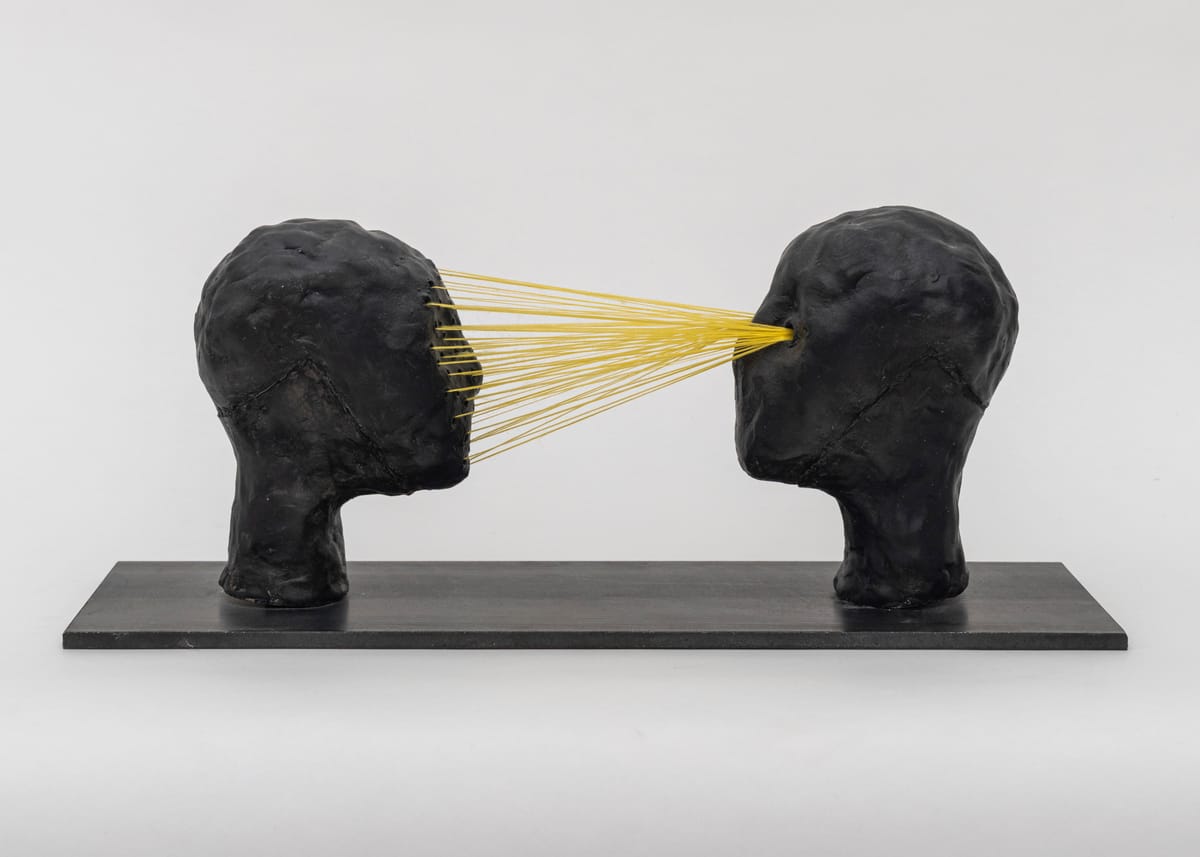
King’s work explores ambiguous states of isolation, imparting a strong visual impact. Her ceramic heads, pierced with holes and interwoven with yellow threads, form intricate nets over faces or link heads with crisscrossing threads. These elements raise questions about energy exchange, hidden identities, and communication. The resistance to simple interpretations makes these pieces memorable. In several paintings, mirrored figures either face each other or look away, probing silent communication and identity exchange. The figures’ stillness suggests calm acceptance, adding depth to the theme of isolation.
Another recurring motif is a woman with leafless branches extending from her body. This imagery might symbolize rebirth or humanity’s inevitable return to the earth. Despite their simplicity, King’s works offer multiple interpretations, influenced by her earthy palette and enigmatic details. For instance, the black foot and hands on a gray figure provoke questions about their nature—are they protective garments, natural oils, or earth’s blood?
Set on the ground floor of a former mill with large coal boilers, the exhibition space itself connects to King’s art. The building’s worn brick walls echo the past toil of female textile workers, reflected in the palette and history of labor. The figures’ tenderness and stoicism enhance their power, as they neither seek our sympathy nor understanding, but instead exude a dignified presence, a rare quality in today’s world.
Anki King: Then and Now remains open at the Lace Mill (165 Cornell Street #214, Kingston, New York) through March 29, curated by the gallery.