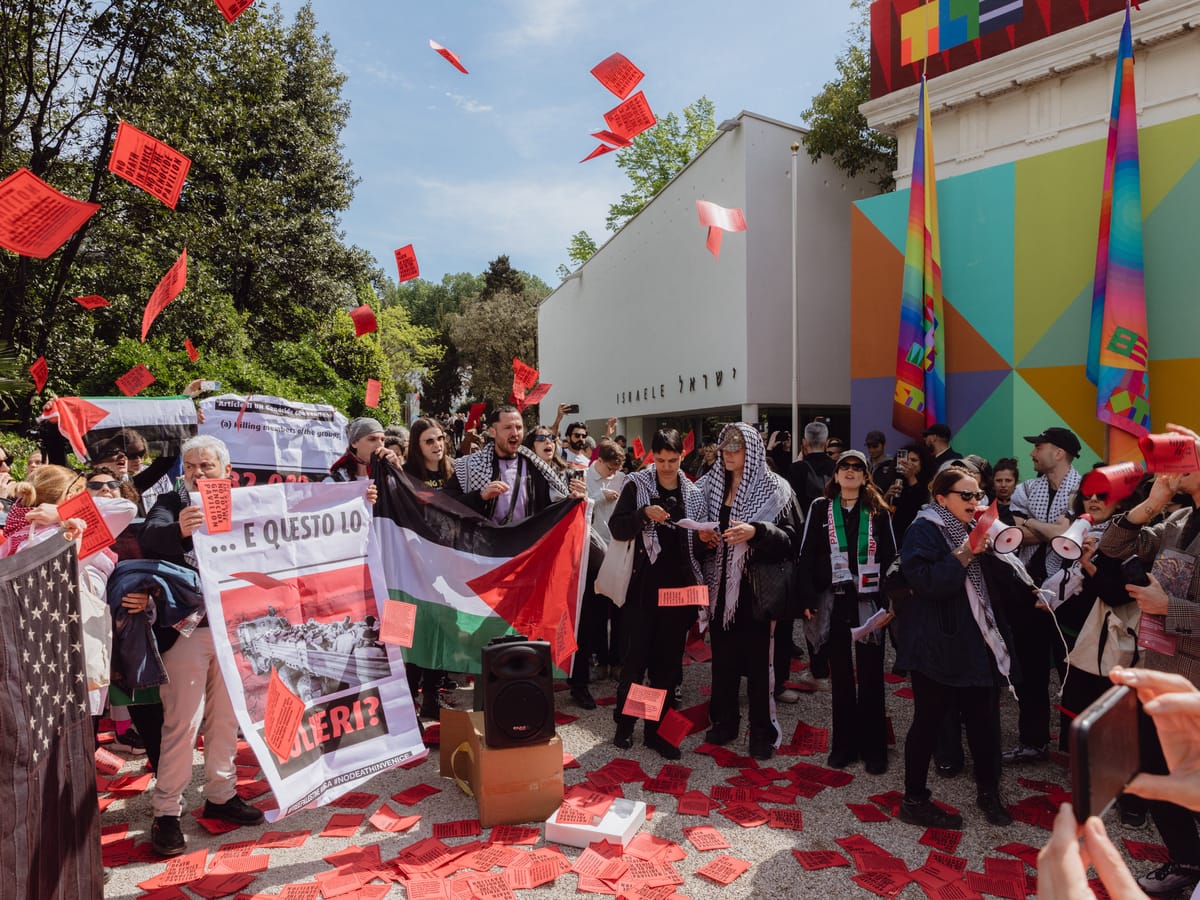
With the Venice Biennale approaching in less than two months, almost 200 artists, curators, and staff participating in the 61st edition have issued an open letter to the event organizers, urging them to exclude Israel from this year’s program. The letter, released on March 17, states, “The Venice Biennale’s complicity with the attempted destruction of Palestinian life must end. No artist or cultural worker should be asked to share a platform with this genocidal state.” Among the 178 signatories are pavilion artists Yto Barrada (France), Isabel Nolan (Ireland), and Asmaa Jama (Somalia), along with artists from the central exhibition like Carolina Caycedo, Gala Porras-Kim, and Alfredo Jaar.
Carolina Caycedo, a Los Angeles-based Colombian artist known for her environmentally engaged art, expressed her motivation to sign the letter to Hyperallergic via email: “Signing this letter is the minimum I can do in the face of genocide and ecocide. Our voices, our demands, our non-hegemonic stories, though plural and diverse, become stronger when woven into collective gestures of care and resistance.” The letter was organized by the Art Not Genocide Alliance (ANGA), which opposes Israel’s pavilion at the Biennale. ANGA’s past efforts have included a petition with over 24,000 signatures to exclude Israel from future Biennales, arguing that the Biennale administration is supporting a state founded on ethnic cleansing.
Despite receiving significant support, the Biennale Foundation maintains that nations recognized by the Italian Republic can request participation, and they do not consider petitions to exclude Israel. In response to criticism, curators Mira Lapidot and Tamar Margalit, along with artist Ruth Patir, decided to close the Israeli pavilion until a ceasefire and hostage release agreement is achieved. However, this move has been criticized as insufficient amid growing support for the Boycott, Divest, Sanctions (BDS) movement against Israel.
ANGA’s call for a boycott resurfaced when it was confirmed that Israel would participate in a temporary pavilion during renovations. Belu-Simion Fainaru, a Romanian-born Israeli sculptor, was chosen to represent Israel at the Biennale. Caycedo shared with Hyperallergic her concern that artists are being “dragged into a position of complicity,” emphasizing that art is a form of re-existence and solidarity, and signing the letter is a response to Palestinian civil society’s call to denounce Israel’s actions.
The letter also highlighted previous political actions by the Biennale, such as the 1974 focus on Chile’s liberation and the exclusion of apartheid South Africa. The collective noted the controversy over Russia’s inclusion in the 61st Biennale, which sparked a political crisis in Italy and brought attention to the Biennale’s political nature and perceived double standards. Matteo Norzi, co-curator of Peru’s pavilion, reflected on the decision to sign the petition, questioning how one could choose not to sign given the ongoing atrocities.