Black-and-white checkered floors are a natural fit for an art fair, but few suit the Spring Break Art Show quite as well. In its former Upper East Side home, moving through the eclectic fair often felt like solving a three-dimensional puzzle, or wandering into a bizarre board game with the instructions missing. For its 13th edition, on view through Monday, September 9, Spring Break has carried that inventive energy into a space that could use it: the 10th floor of a Tribeca office building.
Even with oddly vacant in-between rooms that felt like dead zones in an Ikea display and awkward lines of repurposed cubicles, the triangular booth layout still led to a number of standout works and memorable discoveries from first-time exhibitors. A more corporate atmosphere dulled some of Spring Break’s strongest qualities, yet several artists still managed to bring a vivid pulse that cut through the Armory Week din. Below, Hyperallergic Editor-in-Chief Hrag Vartanian and I share our highlights. —Lakshmi Rivera Amin, Associate Editor
Terra Keck told me she sees a connection between aliens and angels — and that was enough to get my attention. In her works, she layers graphite and color washes before erasing them to form luminous, otherworldly images that seem to glow with the optimism of theosophical thought. Backlit panels and a metallic wall painting amplify the effect, making these small pieces feel charged with the energy of a world just coming into being. —HV
Justin Yoon’s cinematic, color-rich paintings use glitter sparingly, which only makes their sense of enchantment stronger. Curated by Kaizhou Allegro Yang, The Discreet Charm of the Dreamers presents a queer fantasy without relying on familiar camp conventions, instead giving its figures an everyday quality that makes them feel imaginable in real life. —HV
Victoria Martinotti and Aidan Barker-Hill’s two-person presentation, REFLUX, curated by Zachary Lank, is a reminder that realism can still hit hard. Barker-Hill’s “Watermelon Picnic” feels especially timely and political in its strange sensuality and composition, while Martinotti, in still lifes that recall Jean Siméon Chardin, gives equal attention to creams, silvers, and satin ribbon with exquisite refinement. The result is proof of both the artist’s command of paint and still life’s ability to open an intimate mental space even amid the noise of an art fair. —HV
In Alexandra Rubinstein’s I’d Rather Sink Than Call Brad for Help booth, there is a palpable sense that she is thinking through ideas in real time. She links men’s bodies to what is traditionally understood as a feminized landscape while considering masculinity in the “imminent disaster and politics of climate change,” in her words. The work avoids becoming preachy, aside from the wonderfully funny testicle-shaped disco balls overhead, and instead turns relationship dynamics into a kind of imaginative release. —HV
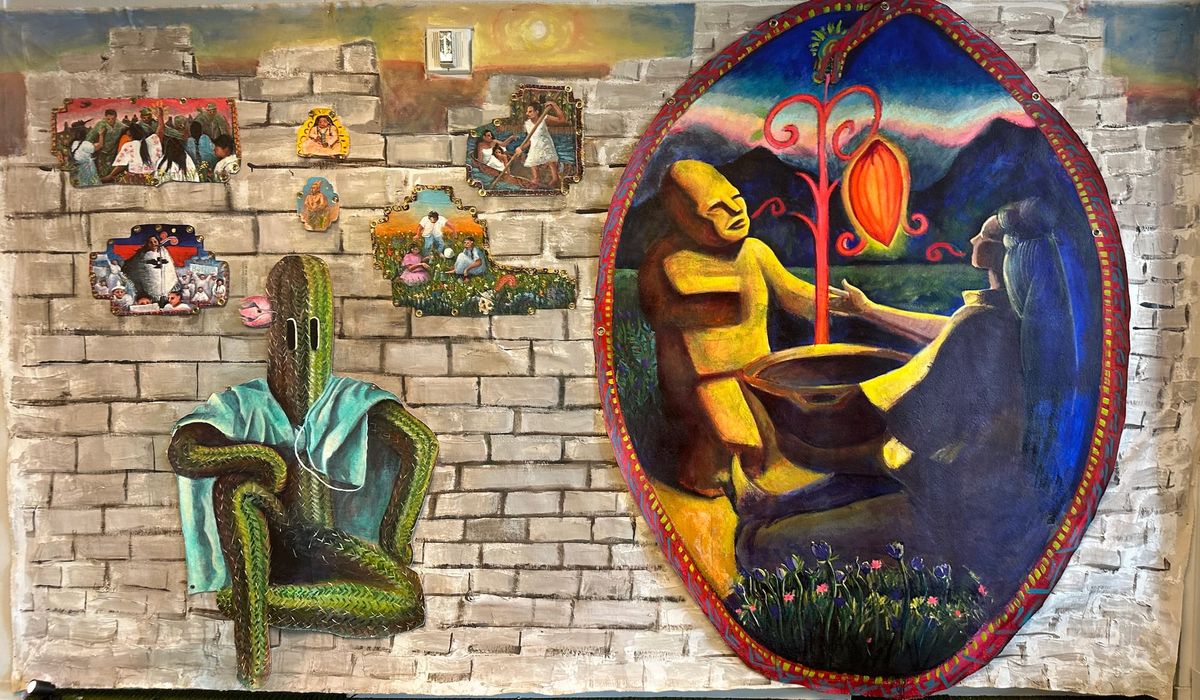
Manuel Hernandez Sanchez packs a great deal into the three walls of The Singing Wall, weaving Nahuatl stories together with family scenes and a vivid imagination. I was first drawn to small, grommet-lined canvas cutouts mounted against a painted brick backdrop, but when I asked whether the fair’s theme shaped his installation, the artist pointed to the landscape beyond the wall. “I made these Hudson River School-type paintings to play with that idea of land being advertised,” he said. “I wanted to put a mural over those paintings.” His revision makes room for a portrait of his niece at Chapultepec Castle in Mexico City, Dolores Huerta speaking, and a radiant vision of his community. —LA
LaThoriel Badenhausen was impossible to miss, and impossible not to appreciate. The 83-year-old assemblage artist wore a Wonder Woman t-shirt and a bright red skirt on opening night, a sparkling match for her cosmic installation co-curated by Giovanna Lazzarini and Kat Ryals, who also has work on view in the booth. After decades of fitting art into spare moments, Badenhausen has returned to her practice in recent years with renewed attention to women’s labor, her Midwestern background, and inventive repurposed materials. One sculpture, she calls a “prairie bug,” is made from deconstructed glasses and delicate dried grass. —LA
Yoshie Sakai’s booth-turned-beach felt like a surprise party and offered much-needed relief to a tired fairgoer. Her Grandma Entertainment Franchise presentation, titled Grandma Is Cool AF, drew families and solo visitors alike and delivered a gleeful escape from conventional booth fare. In Sakai’s unapologetically fabulous world, the pressures of age, sexism, and buttoned-up seriousness are washed away. —LA
In PASSAGEWAYS, newcomer Aleksandra Dougal strips recognizable industrial fixtures of New York City down to their bare structure, allowing viewers to see them anew. She said that she and the All Street Gallery curators created the ghostly installation — complete with paint splatters, faint charcoal drawings, and white footprints — specifically for the bright corner room. With the afternoon sun casting window outlines across the floor, the installation offered a rare moment of quiet reflection and a fresh perspective to carry beyond the fair. —LA