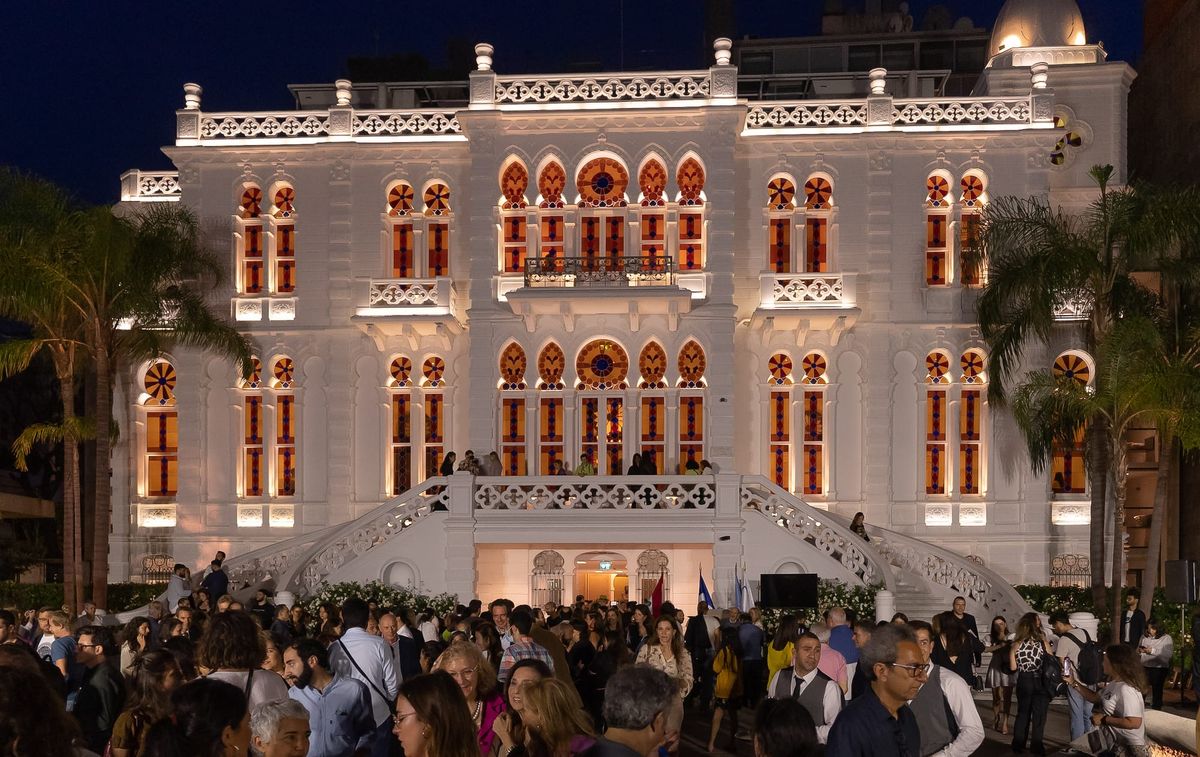
Lebanon’s Sursock Museum reopened to the public last week for the first time since the Beirut port explosion on August 4, 2020. Situated in Achrafieh, just over half a mile from the blast site, the museum suffered extensive structural and cosmetic damage in the explosion, which displaced more than 300,000 people, injured over 7,000, and killed at least 217, according to Amnesty International.
A 127-page Human Rights Watch report said the blast — regarded as one of the largest non-nuclear explosions on record — was caused by the negligent storage of ammonium nitrate, an explosive chemical, amid years of mismanagement and corruption at the port. In an interview with Hyperallergic the day after the explosion, former Sursock Museum Director Zeina Arida called it “incomparable to anything we have ever witnessed.”
“At first, we feared it was bombing, and that there would be more to follow, so we stayed in the building,” Arida said. “We quickly realized how great the damage was.” Following the explosion, the museum remained closed for nearly three years while repairs were carried out through LiBeirut, a UNESCO-led effort to restore educational and cultural institutions in the Lebanese capital damaged by the blasts. The nearly $2.5 million restoration was backed by €1 million ($1,072,535) from the Italian Agency for Development Cooperation (AICS), along with support from other donors including the International Alliance for the Protection of Heritage in Conflict Areas (ALIPH) and France’s Ministry of Culture.
On the day of the blast, the Sursock Museum had two major exhibitions on view containing at least 126 works from the institution’s permanent collection, along with loans from private sources. The museum said 32 paintings, 28 paper-based works, and six sculptures shown on the first and second floors sustained the worst damage, including tears from shattered glass, stains, and substantial paint loss. Other works exhibited at the time were damaged less severely, mostly by dust from the explosion.
The building itself also required major restoration. Its historic Ottoman and Venetian Gothic architecture was heavily affected, with all stained-glass windows shattered, metallic doors and dropped ceilings blown out, and damage inflicted on the white exterior walls and intricately carved wood-paneled doorways. Formerly the 1912 villa of Lebanese aristocratic art collector Nicolas Sursock, the museum is considered a beacon of Lebanese culture and history, with more than 1,500 paintings, sculptures, tapestries, and installations in its permanent collection. It also houses the Fouad Debbas Collection, a photographic archive of over 30,000 photographs, postcards, and manuscripts from Lebanon, Syria, Palestine, Egypt, and Turkey dating from 1830 to the mid-twentieth century.
The museum reopened on May 26 with five galleries of classical and modern artworks on display, marking its fourth reopening since 1961. Sursock Museum says it recovered 55 damaged works from its collection, most of which were repaired in-house through a careful restoration process that began in May 2021. Three works — “Untitled (Consolation)” (1970) by Armenian-Palestinian artist Paul Guiragossian, “Portrait d’Odile Mazloum” (1967) by Croatian-born artist Cici Tamazeo-Sursock, and Dutch-French painter Kees van Dongen’s “Portrait of Nicolas Sursock” (circa 1926-1930) — were restored at Paris’s Centre Pompidou and returned in April 2023 after an extended conservation effort.
Beyond the artworks, the restoration project included replacing all of the building’s windows, repairing its doors, elevators, ceilings, and skylights, and adding a solar panel system to improve the museum’s energy sustainability.