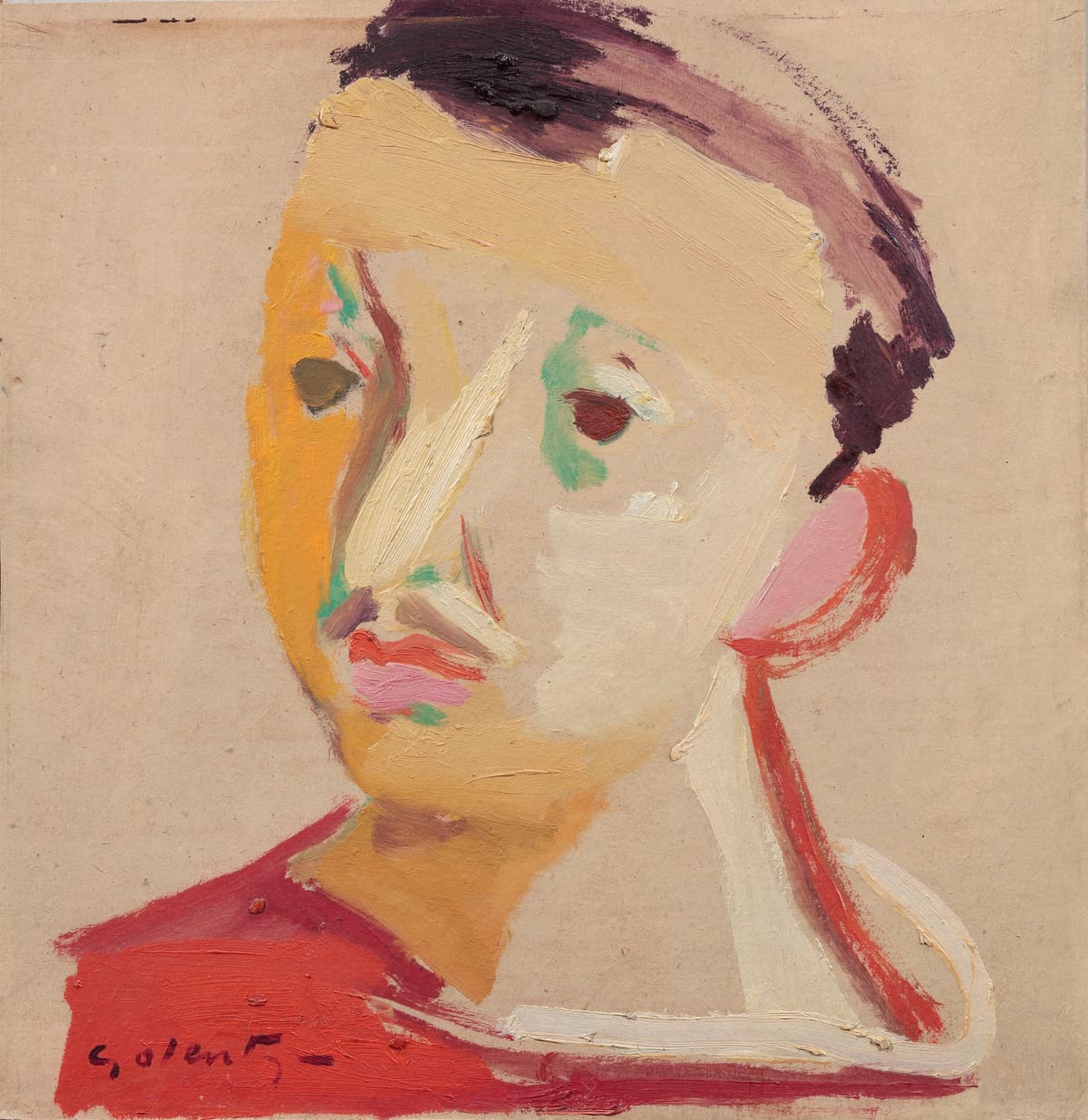
Haroutiun Galentz: The Form of Colour (Skira, 2025) revisits the work of a pivotal modernist from the 20th century, known for defying easy classification. Edited by Vartan Karapetian and Marie Tomb, this first English-language monograph on Galentz features pieces from the Janibekyan Collection and the National Gallery of Armenia, as well as works from museums and private collections throughout Europe, Asia, and North America. Through an array of paintings, archival documents, letters, and memoirs, the publication positions Galentz as a cosmopolitan modernist whose art transcends national boundaries.
Galentz’s position in 20th-century art history is complex. As an Armenian Genocide survivor, he rebuilt his life and artistic career in Beirut, becoming an influential figure in the development of modern painting during the interwar and immediate postwar periods. Between 1920 and 1946, he was actively engaged in Beirut’s artistic and intellectual communities, which were both cosmopolitan and politically unstable. His involvement in the Lebanese Pavilion at the 1939 New York World’s Fair represents an early instance of Lebanese modernism gaining international recognition, challenging later narratives that suggest its emergence post-1950s.
His postwar move to the Soviet Union marked another intricate chapter in his career. In this new ideological setting, his paintings maintained a luminous, introspective quality that clashed with official aesthetic doctrines. His first solo exhibition in 1962, praised by critics like Ilya Ehrenburg and Alexander Gitovich, occurred just before Nikita Khrushchev’s notorious condemnation of nonconformist art at the Manège, highlighting the subtle dissent in Galentz’s work, manifested through ambiguity, introspection, and formal experimentation.
Galentz’s art, encompassing both portraiture and landscape, reflects a continuous interplay between inherited artistic traditions and personal experiences. His early instruction in the Beaux-Arts system and ongoing interaction with French avant-gardes shaped his use of color and composition. Rather than outright rejecting Socialist Realism, he adapted and transformed it, progressively moving towards more abstract forms in his later works. The resulting oeuvre is not a straightforward stylistic evolution but is shaped by themes of displacement, adaptation, and a steadfast devotion to painterly independence.
To purchase Haroutiun Galentz: The Form of Colour, visit bookshop.org. The book is also available on skira-arte.com and artbook.com.