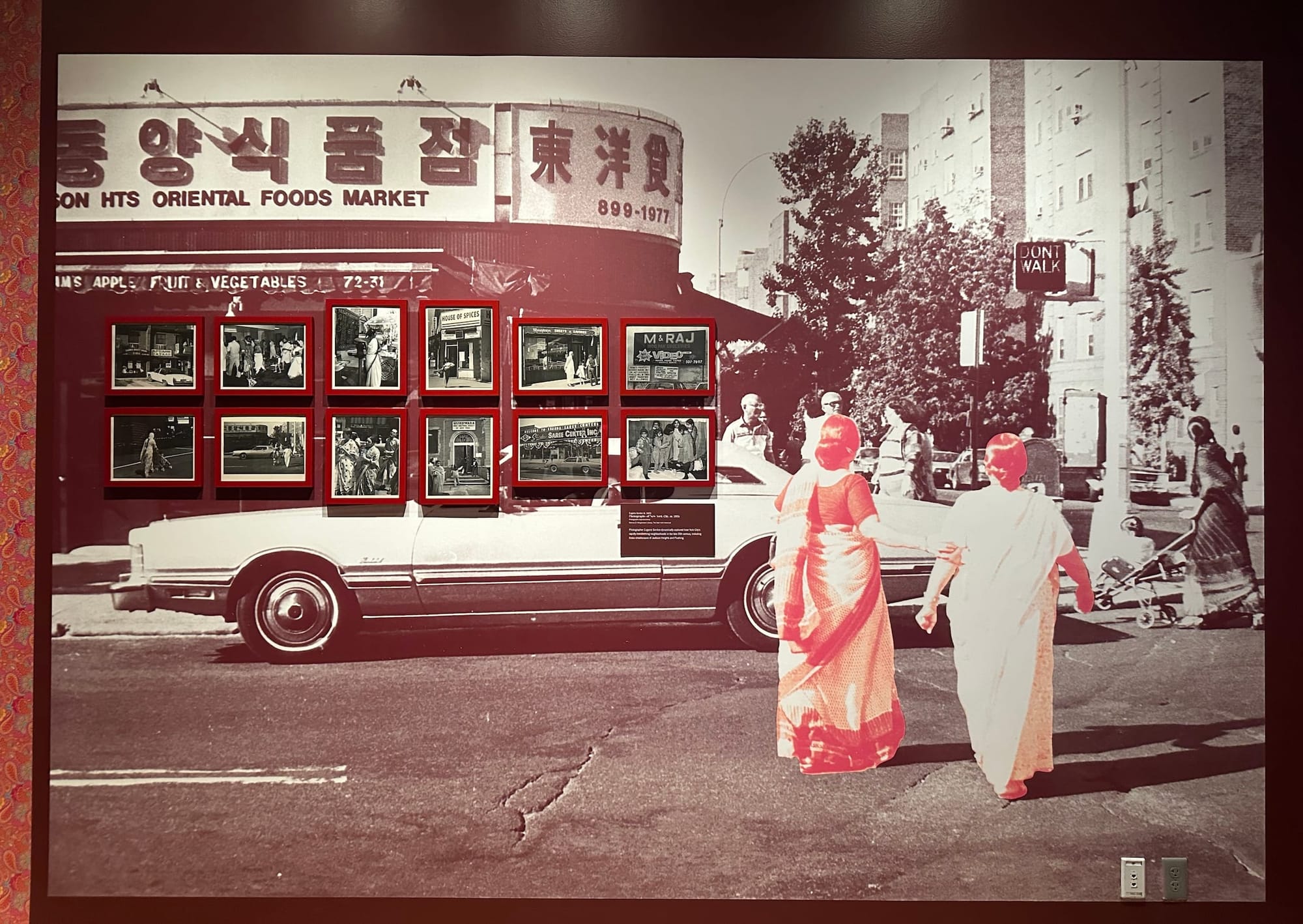
Before you even lay eyes on ‘The New York Sari’, you’ll hear the harmonious blend of Anoushka Shankar’s sitar, Arooj Aftab’s vocals, and Alice Coltrane’s harp echoing through the corridor. This one-room exhibition at the New York Historical Society, available until April 26, greets visitors with Suchitra Mattai’s ‘she arose (from a pool of tears)’ (2024), depicting a Bharatnatyam dancer crafted from cherished saris. The exhibit serves as an insightful introduction to South Asian history in New York, using the sari’s myriad folds and patterns as a lens.
Curators Salonee Bhaman and Anna Danzinger Halperin approached the sari as a living, evolving artifact rather than a static historical piece. Acknowledging the diaspora’s unique influence on the garment, Bhaman remarked to Hyperallergic about the multifaceted narratives the exhibit aims to embody. This vibrant collection, featuring contributions from artists like Chitra Ganesh and Shradha Kochhar, along with historical materials, creates a dynamic tapestry of South Asian life in New York.
The exhibition highlights the sari as more than clothing—it’s an emblem of identity and politics. The traditional sari is rarely seen in its expected form. Instead, pieces like Shahana Hanif’s ceremonial sari and Narbada Chhetri’s zerzet sari are featured, each with their unique stories. A significant part of the exhibit also examines gender and sexuality’s interplay with the sari, a narrative often overshadowed in both South Asia and the diaspora.
Historical and contemporary tensions are woven through the exhibit, challenging perceptions tied to the sari. The garment’s complex role within cultural and political movements, such as its misassociation with Hindu identity, is explored. The exhibition also includes community-sourced stories, such as those from Sharmin Hossain, emphasizing South Asian progressive activism in New York City.
Artworks like Shebani Rao’s comics and Sunil Gupta’s photography further dissect the sari’s narrative, confronting casteism and colonial legacies. Each piece in ‘The New York Sari’ not only explores the sari’s rich history but also its ongoing narrative, offering a platform for stories that challenge and celebrate South Asian identity in its full complexity.