PARIS — The Polish artist Magdalena Abakanowicz once remarked, “The organicity of the human body we’re born inside of is encoded in us.” This idea of our intrinsic organic nature as a source of both straightforward and enigmatic knowledge is woven through the textural abstractions in her exhibition, Magdalena Abakanowicz: The Thread of Existence, at Musée Bourdelle.
The Paris exhibition features approximately 80 of Abakanowicz’s creations, including large textiles, sculptures, and drawings from the 1960s through the early 2000s. Although her works were censored in Communist Poland for being too formalist, her reputation flourished. She participated in the Lausanne Tapestry Biennials during the 1960s and won the Grand Prix at the 1965 São Paulo Biennial. In 1980, she represented Poland at the Venice Biennale.
Part of the Eastern European arts vanguard, Abakanowicz stood alongside Polish contemporaries like Tadeusz Kantor and Jerzy Grotowski, who opposed socialist ideology with their mystical approach. They viewed the body as spiritually vibrant, resisting the industrial productivity imposed on it by modernity.
Her sculptures, dubbed “abakans,” resemble decorative gobelins typically found in Polish homes, but on a grander scale. The giant pieces at Bourdelle, such as “Abakan Orange” (1971), express earthiness and sensuality through natural fibers. Its fiery color suggests a plasmic heat, with a raised center resembling vulvar labia beneath a long, hanging weave.
Nearby, the imposing “Abakan Red” (1969) features two large flaps and an erect, sword-like protrusion, creating sexual connotations. The interplay of softness and hardness, alongside textures ranging from velvet to rough burlap, adds complexity to the works. Visitors can feel these textures by touching ropes in an educational display.
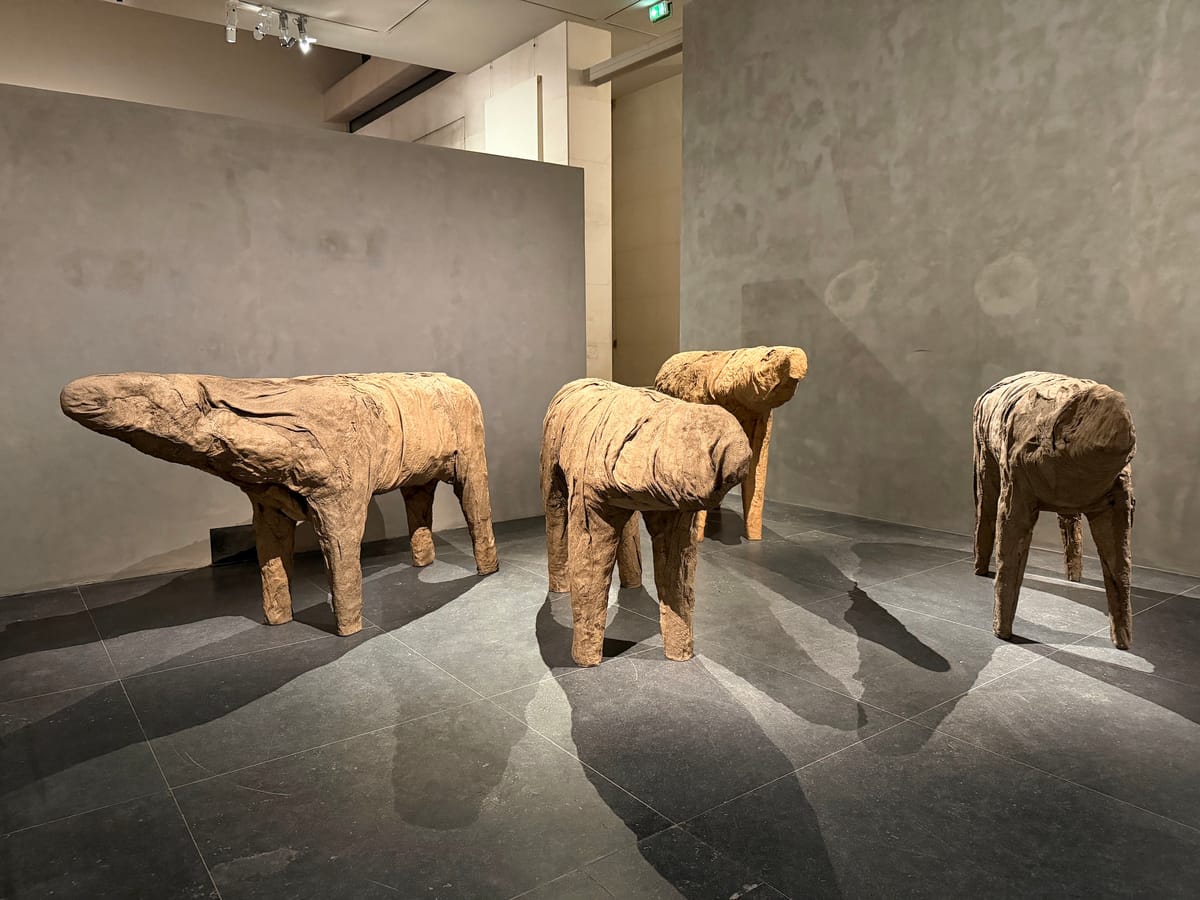
The exhibition’s final section showcases sculptures exploring collectivity. Pieces like “Standing Mutants” (1992–94) and “Crowd V” (1995–97) highlight themes of control and unity under Poland’s communist regime. Despite its ominous nature, “Crowd V” conveys a sense of collective power. Meanwhile, works like “Dancing Figures” and “Backs” (1976–80) evoke ritualistic elements, with resin-jute bodies positioned in supplication, reflecting a quiet strength in their anonymity.
Magdalena Abakanowicz: The Thread of Existence will remain on display at Musée Bourdelle (18 rue Antoine Bourdelle, Paris, France) until April 12. The exhibition was curated by Ophélie Ferlier Bouat with Jérôme Godeau, Colin Lemoine, and Margaux Coïc.