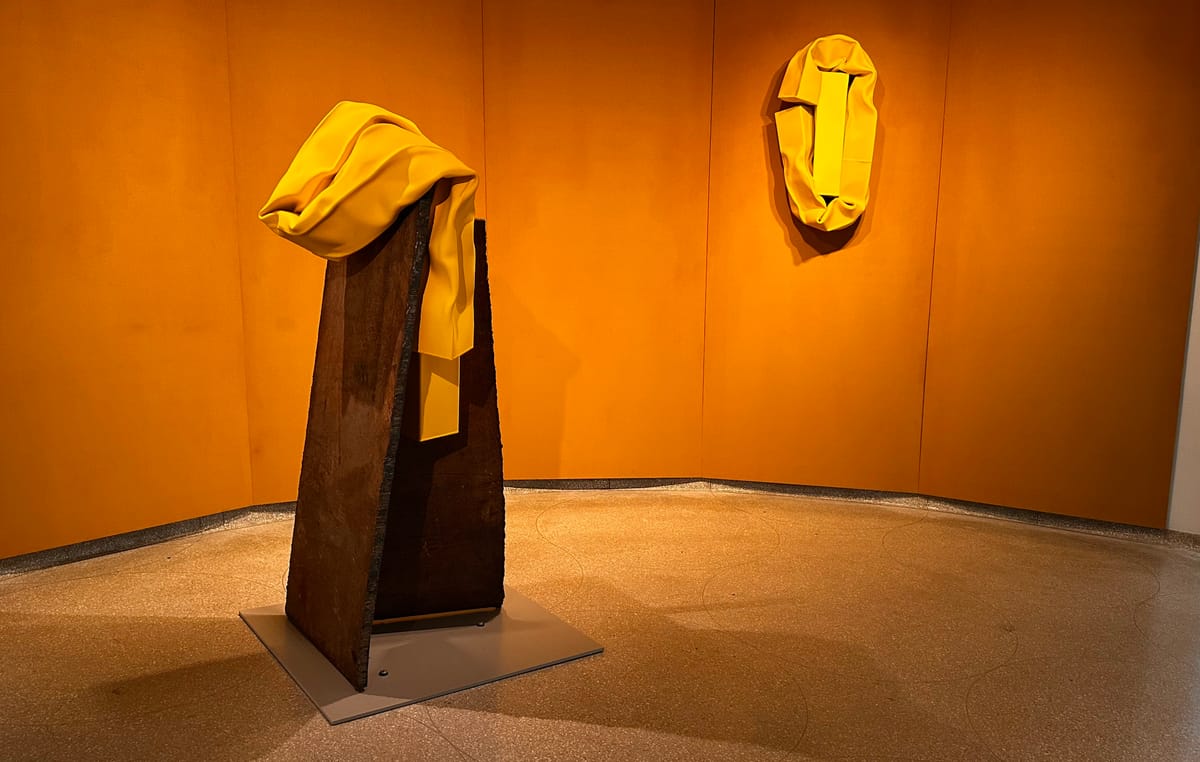
During my visit to the expansive Carol Bove exhibition at the Guggenheim, a particular moment captured the essence of the entire show for me. This occurred when I discovered “10 Hours” (2019) on the museum’s third ramp—a hollow, crimped rectangular tube in a bright banana yellow, draped over a rough-cut steel stanchion. It evokes the image of a towel casually tossed over a rack, defying the expectations of its steel and urethane composition. Bove’s transformation of industrial materials into seemingly soft textiles is remarkable. However, it took some time to encounter another piece that offered such insight.
“Field Figures” (2008) combines driftwood and steel, with metal supporting weathered timber, reminiscent of a post-apocalyptic memorial. Similarly, “Peel’s foe, not a set animal, laminates a tone of sleep” (2013) initially appears like a brutalist building model but reveals a labyrinth of bunkers upon closer inspection. Meanwhile, “The Night Sky Over New York” (2007) features bronze needles suspended like cosmic rain, contrasting with the delicate peacock feathers of “Untitled (The Middle Pillar)” (2007) that seem misplaced underfoot.
Bove emphasizes tactile engagement, with a library of materials from her studio available for visitors to touch. Led by curator Katherine Brinson, the exhibition includes a scaled-down machine for crumpling steel and various paint samples. Visitors can also interact with pieces like a monochord instrument, co-curated by Bove at the Whitney Museum in 2023, highlighting artist Harry Smith’s work.
Interspersed with works by Agnes Martin, Édouard Vuillard, and others, Bove’s art engages in a dialogue with these artists, enhancing its meaning. Notably, a site-specific mural by Joan Miró and Josep Llorens i Artigas, unseen for 23 years, is framed by Bove’s cutout. Yet, Richard Berger’s “My Couch” (1976), with its shimmering silver beads, stands out as the exhibition’s most enchanting piece.
The retrospective feels overwhelmed by its ambition to chronicle Bove’s career over 25 years, with many works appearing as steps toward artistic enlightenment. The entrance features cylindrical white sculptures akin to headless snakes, while crumpled steel tubes and abstract aluminum paintings seem more like preliminary studies. Installations like “The Equinox” (2013) appear as arbitrary material assemblies, lacking depth in their proximity. The exhibition’s extensive nature overshadows Bove’s brilliance, suggesting a more focused presentation in the adjacent galleries could better highlight her artistic journey.
Carol Bove’s exhibition runs at the Guggenheim Museum (1071 Fifth Avenue, Upper East Side, Manhattan) until August 2. The show was curated by Katherine Brinson, Charlotte Youkilis, and Bellara Huang.