In the mid-1980s, as the AIDS crisis deepened in New York’s apartments and bathhouses, a group of frightened, angry young men began heading to copy shops across the city. They were watching friends, partners, and lovers deteriorate from a mysterious virus that some cruelly labeled the “Gay Plague.” Knowing exactly what they were doing, they took jobs at Kinko’s and, after hours, secretly ran the printers, reasoning that indifferent corporate America owed the public more than the price of a few printouts.
The result was a stream of visually sharp, brightly colored flyers, posters, and stickers — in effect, a public relations campaign. Those materials were then wheat-pasted across New York in an aggressive push for action. Ian Bradley-Perrin, curator of Love and Fury: New York’s Fight Against AIDS at Poster House in Chelsea, presents the work as a powerful advocacy system shaped by designers, many of whom were personally affected by the epidemic.
The exhibition, installed in the museum’s small but electric subterranean gallery, follows how graphic design helped force AIDS into the American public consciousness. “Those activists figured out who the gatekeepers in the media were,” said Bradley-Perrin, an HIV-positive socio-medical historian. “They imagined how we can create visuals and images that will grow our numbers but also speak to the general public.”
Poster House organizes the story into four sections, and the show can be viewed in either direction because, as Bradley-Perrin puts it, “In the context of AIDS, everything was happening all at once.” The first section covers early grassroots efforts to educate people and promote safe sex. Farther along, the display turns to urgent, confrontational graphics from agitprop groups such as the AIDS Coalition to Unleash Power (ACT UP) and Gran Fury, aimed at political inaction and unequal access to healthcare.
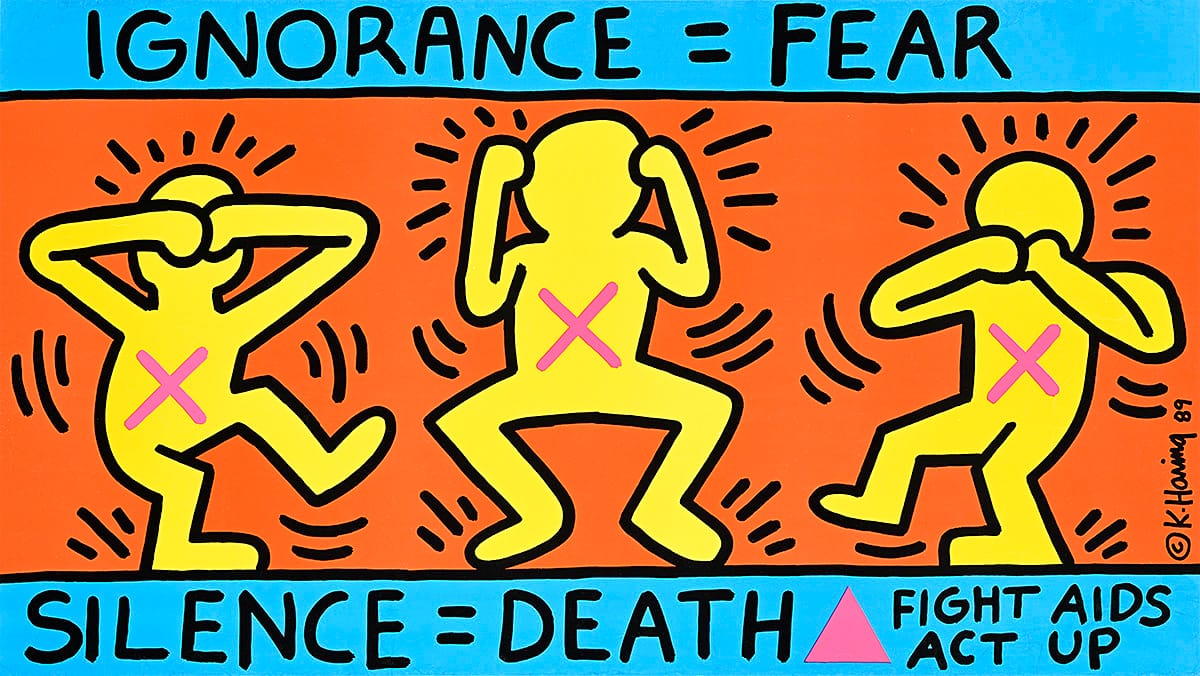
The final two sections, “The Power of Design” and “The City that Danced for its Life,” show how activism was adapted to mainstream fundraising, gala culture, and even expressions of joy. Among the defining works is “Silence = Death,” with its stark black field and central pink triangle, a reuse of the Nazi symbol for LGBTQ+ prisoners that makes the poster feel ominously charged. Keith Haring’s “Ignorance = Fear” poster is also featured, with three boldly outlined figures, crossed-out tummies, and raised dukes set against neon orange and cobalt blue, New York’s classic color scheme. Together, the two works underscore how fully the city’s AIDS agitprop machine fused art and urgency.