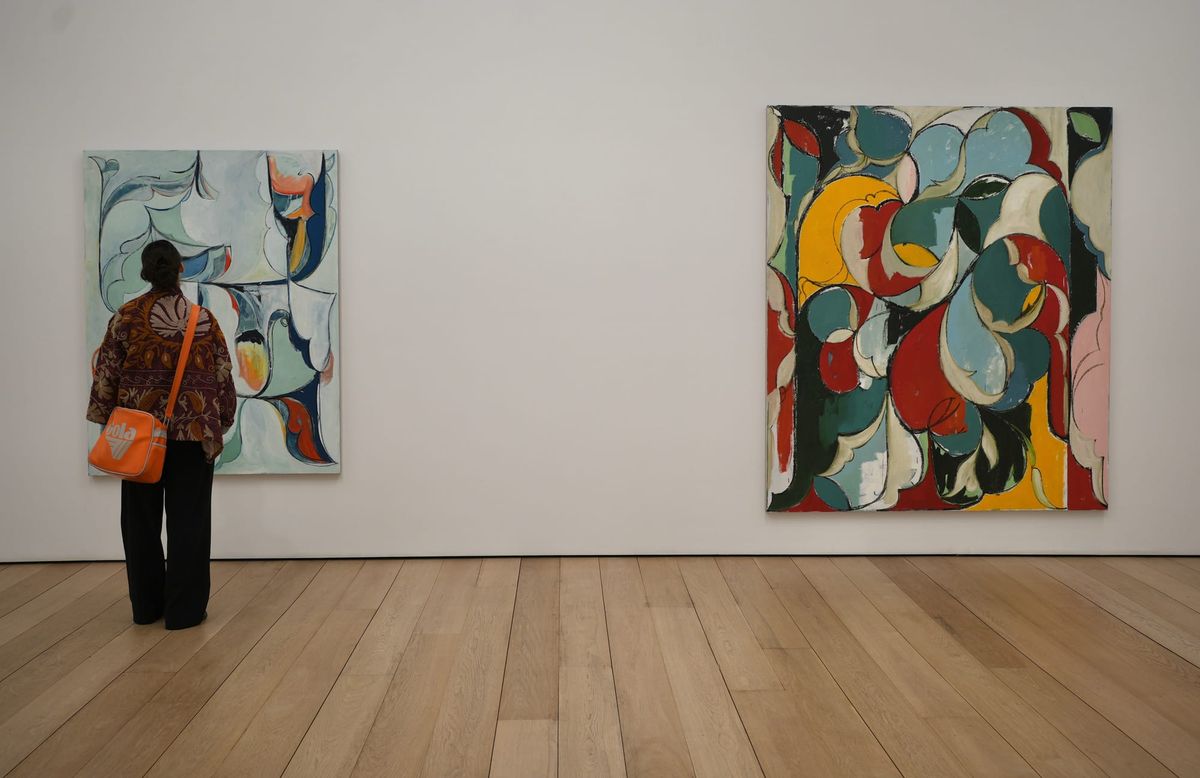
During the early months of 2026, Kamrooz Aram’s work seemed to follow me wherever I went, and I consider myself fortunate for the experience. His art was showcased at Nature Morte in Mumbai as part of Mumbai Art Week, is currently on display at Alexander Gray Associates in Tribeca, and takes a prominent role in the 2026 Whitney Biennial with what feels like a mini-solo show.
Born in Iran and an alumnus of Columbia’s MFA program, Aram is celebrated for his unique exploration of the grid. His work delves into both archeological and critical dimensions, bridging the gap between Western modernist abstraction and non-Western, particularly Western Asian, decorative traditions such as pottery and tilework. Aram’s vibrant paintings challenge the binary perception of these influences, suggesting that the grid is a space where order gives way to a more nuanced understanding of the relationship between line, shape, color, and cultural exchange.
In Mumbai, the grid took center stage in a series of paintings featuring vertical arrangements across canvases, disrupted by curving forms reminiscent of both organic and non-organic elements. The color palette, comprising reds, grays, blue-greens, and other hues, occupied a space between natural and supernatural realms. This abstraction invites viewers to project their interpretations, much like the rhythmic stylization of Henri Matisse’s “Bathers by a River” (1917), highlighting how modernists drew inspiration from Islamic decorative arts.
At the Whitney Biennial, Aram’s work, such as “Descendants (Luster on Blue Glaze)” (2025), critiques art history’s simplistic cultural dichotomies. By recontextualizing a marbled vase within a grid and introducing a Persian blue element, Aram emphasizes the intertwined nature of cultural experiences. “Requiem for Perpetual Defeat” (2026) features ceramic vessels displayed in a tripartite walnut shadowbox, each section offering a unique interplay of abstract compositions and cultural references.
Aram’s exhibition at Alexander Gray Associates, titled “Infrequencies,” showcases a dynamic shift in his practice. The seven paintings on display, created between 2020 and 2026, reveal an evolution toward gestural brushwork that challenges the grid’s structure. Works like “Exuberant Flâneuse” (2020) burst with color and energy, while “Old World Telepathy” (2026) explores more fluid, surrealistic influences. Aram’s art embodies a rich tapestry of global influences, transcending singular origins.