CHICAGO — Upon discovering that Leah Ke Yi Zheng’s exhibition, curated by Myriam Ben Salah and Karsten Lund, was scheduled for the Renaissance Society, I aligned my Chicago visit to ensure I could experience her art. My sole regret was not having the opportunity to visit twice, as I had with her 2023 New York debut at David Lewis Gallery, which I previously reviewed. The continual process of learning to interpret Zheng’s work is a rewarding aspect of engaging with art.
Zheng’s art offers intellectual stimulation and introspection, bridging Western oil painting and Eastern ink painting. I perceive her as embarking on a significant journey — merging two distinct cultural heritages. I regard her as a leading figure among Asian-born artists reimagining ink painting history while residing in the diaspora. Her work transcends mere personal identity, transitioning it from a static self-representation to a dynamic, evolving concept.
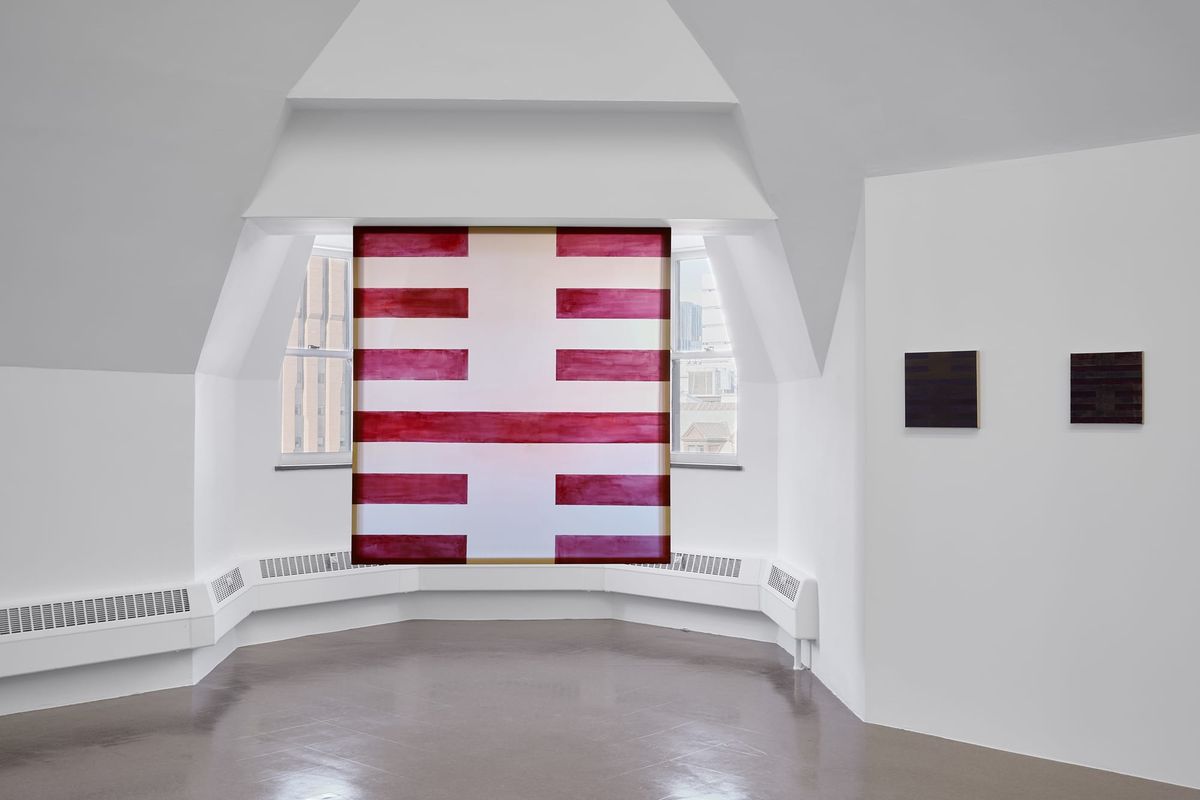
In preparing for my review of Zheng’s inaugural exhibition, I encountered an interview with Nicky Ni (Sixty Inches from Center, March 26, 2021), where she stated: “My paintings branch off from the lineage of Chinese traditional paintings — it’s important for me to receive but also move beyond the influence of history…” This philosophy is evident in her decision to paint all 64 I Ching hexagrams using oil or acrylic on silk, reflecting her aim to connect and advance the histories of both Chinese and Western art.
For this exhibition, Zheng modified the gallery space, altering wall dimensions and covering windows to create a “new rhythm,” as described in the press release, enhancing the “light of the here and now.” Her exploration of light and painting expands on Robert Ryman’s approach to natural light in art, reminiscent of his works at Dia Beacon. Zheng’s paintings, especially No. 63 and No. 64, are strategically placed to emphasize their thematic duality.
Each painting offers a unique interaction, influenced by the silk weave and paint texture. Although Zheng views all 64 works as a single oeuvre, each stands independently through its distinct color and surface. The varied dimensions and materials highlight Zheng’s openness and inventive interpretation of the I Ching, making it distinctly hers. This remarkable collection deserves to be preserved in a museum setting.
Leah Ke Yi Zheng: I Ching (Book of Changes) is displayed at the Renaissance Society (5811 S Ellis Avenue, Chicago, Illinois) until April 12. The exhibition is curated by Myriam Ben Salah and Karsten Lund.