At the close of a workday, a Brooklyn sunset can put my mind at relative ease. One of the week’s most striking art encounters turns out to be a discarded still life of white roses in a gold frame, left beside a pile of black trash bags outside someone’s home. A new storefront church opens near my house; I notice it one night while out buying milk for the kids, complete with a lobby furnished with polished brown leather sofas for worshippers to sit on.
Walking past a bookstore, I spot a photobook by Hans Wilschut, titled Beirut, Epi-Centre Ville. The book traces the damage of the devastating 2020 blast and its impact on the city’s streets and soul, and it catches my attention. I keep moving, though, and notice a Honda Civic with a license plate that reads “FATIGUE.” I take out my phone to photograph it, and am reminded that it is August 4, the sixth anniversary of the blast.
At work, we publish a piece about the heartbreaking drawings made by immigrant children held in ICE detention camps. News that community members are fighting to reinstate SAIC professor Savneet Talwar, who was unjustly placed on leave after asking students to imagine treatment for a pro-Palestinian protester, helps restore some of that broken heart.
Outside an open studios event in Brooklyn, I speak with an artist who argues for “holding on to hope.” I ask, “Isn’t hope for people who have no power?” She replies, “Exactly,” —Hakim Bishara, editor-in-chief
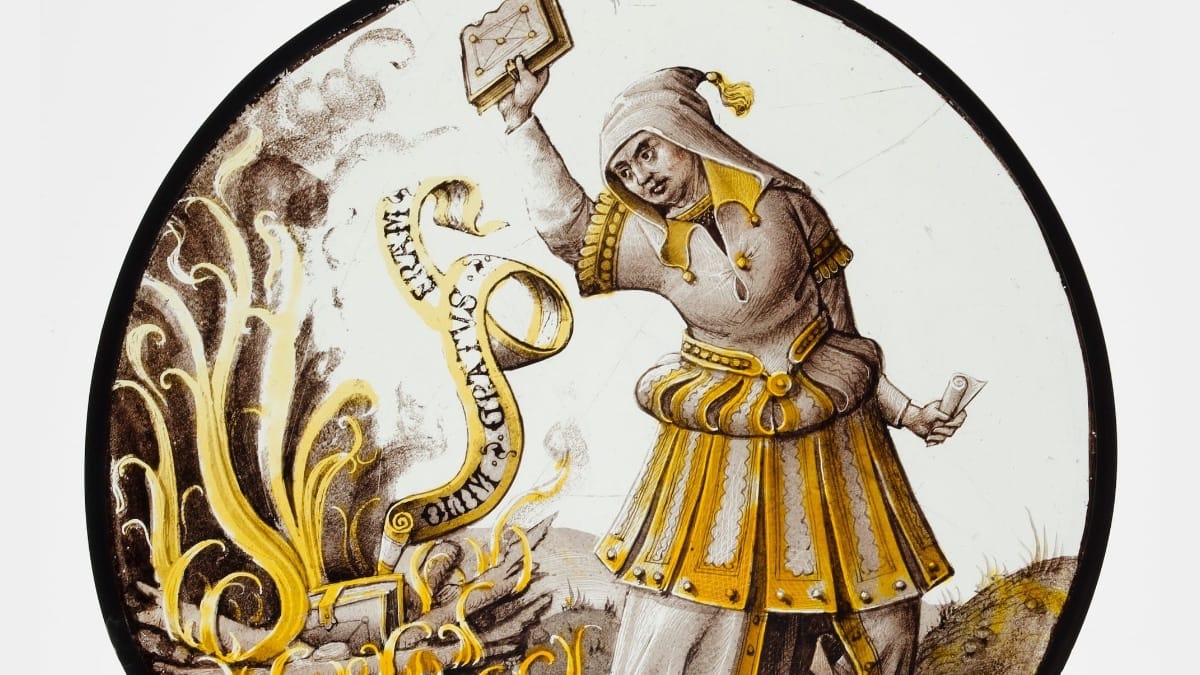
After Spanish physician and theologian Michael Servetus was burnt at the stake in 1553 for religious heresy, only three surviving copies of his The Restoration of Christianity were spared from the flames. One copy, now in the University of Edinburgh library, is ironically believed to have been personally saved by Protestant leader John Calvin, who was responsible for Servetus’s execution in Geneva.
Anyone familiar with Calvin, who boasted in a letter that he had “purged the Church of so pernicious a monster,” understands that the book was not preserved out of sympathy for Servetus, but from a bibliophile’s impulse — even that of a doctrinaire, zealous, tyrannical bibliophile. Yet for all the strangeness of Calvin’s motives, he still does not match the harm done by artificial intelligence companies, including Anthropic, which have bulk purchased, digitized, and then pulped out-of-print books to train their large language models. Calvin at least had the excuse of his God; AI companies do not. | Ed Simon
News includes more than 400 members of the School of the Art Institute of Chicago community renewing calls to reinstate Savneet Talwar, the death of Francisco Correa Cordero, founder of the downtown New York gallery Lubov, at 37, and ICE releasing scans of nine pages seized from children detained in Texas after a March lawsuit by podcast host Allison Gill.
Also reported are the arrest of 16 protesters who unfurled banners with portraits of Immigration and Customs Enforcement victims on the marble floor of the Hart Senate Office Building, Trump’s historically low Smithsonian budget proposal amid efforts by his appointees to stifle funding, and Sharmistha Ray’s transformation of three Pittsburgh pickleball courts into vivid artworks in “Geometry of Play.” Other items note unionization efforts at the Eric Carle Museum, a unanimous strike vote by workers at the Victoria and Albert East Storehouse, and the exhibition Help Wanted / Leave Now, which examines “Operation Wetback.”
Further headlines cover the Solomon R. Guggenheim Foundation’s plans to open its Frank Gehry-designed Abu Dhabi outpost on December 11 after 20 years of delays, allegations, and recalibrations, as well as a new study suggesting arts and culture organizations that received more local government funding during the COVID-19 pandemic generally fared better in later years. The section Art Movements rounds out the update with Gray Wielebinski’s scented artworks for Frieze London’s bathrooms, Michelle Grabner’s gift to a Wisconsin museum, and Gagosian’s shrinking real estate footprint.
From Our Critics features Natasha Seaman on The Fruitless Search for Vermeer’s Personal God, Gladys Lou on Ellen Pau’s Elegy to a Vanishing Hong Kong, and Eileen G’Sell on The Scent of Ancient Rome in St. Louis. Interviews include Julia Bryan-Wilson’s never-before-published conversation with Simone Forti and Avedis Hadjian’s talk with Anna Boghiguian on Weaving Armenia.
Feature highlights include Livia Caligor’s The Day I Pleated With Iris van Herpen and Rea McNamara’s Kimsooja Comes Full Circle, while the Guide lists 10 Art Shows to See in Los Angeles This August. Community coverage ranges from required reading and memorials to A View From the Easel, and Opportunities gathers residencies, fellowships, grants, and open calls from the Erie Canal Museum, Jentel Artist Residency, Princeton University, and more.