In a muddled X conversation in mid-August, former President Donald Trump praised Elon Musk’s efforts against strikes. This promptly led the United Auto Workers (UAW) to file federal labor charges against both the Trump campaign and Tesla. Recently, videos surfaced of Republican vice presidential nominee JD Vance being jeered by a union of Boston firefighters, extending the streak of disapproval directed at the Ohio senator. These incidents underscore the increasing focus on organized labor, with visuals and coverage of union activities bolstering public backing. With a 43% rise in major work stoppages last year, some have labeled 2023 as the ‘year of the strike.’ But what do we know about the origins of labor strikes, and how have artisans and artists contributed?
The word ‘strike’ was first used in 1768 to describe British sailors who refused to raise the topsails of ships. However, the concept of halting work to negotiate better conditions is much older, as are the countermeasures by employers and leaders to thwart these actions. The earliest documented strike occurred in the artisan village of Deir el-Medina around 1157 BCE, under Pharaoh Rameses III. A scribe named Amennakht documented their plight on ostraca and the ‘Turin Strike Papyrus,’ noting that delayed wheat payments caused the artisans to declare hunger and abandon their royal duties. Egyptologist Jenny Cromwell highlighted in a 2022 blog post that these workers peacefully protested near the temple of Thutmosis III. This tactic proved effective in the 20th dynasty and was occasionally used in Ptolemaic and Roman Egypt.
Elsewhere in the ancient world, strikes were a known strategy long before British sailors popularized the term. In my upcoming book, ‘Strike: Labor, Unions, and Resistance in the Roman Empire,’ I explore how labor protests were prevalent in the Roman Mediterranean. Starting in the 5th century BCE, Romans known as plebeians resisted military drafts by the patrician elite. During the Struggle of the Orders, spanning nearly 250 years, plebeians withdrew from Rome to leverage their numbers for more political rights. Later, during the Roman Empire, bakers in Ephesus withheld bread in the 2nd century CE, pantomimes demanded higher wages, farmers in North Africa threatened to abandon estates, and charioteers incited riots, all to negotiate better conditions.
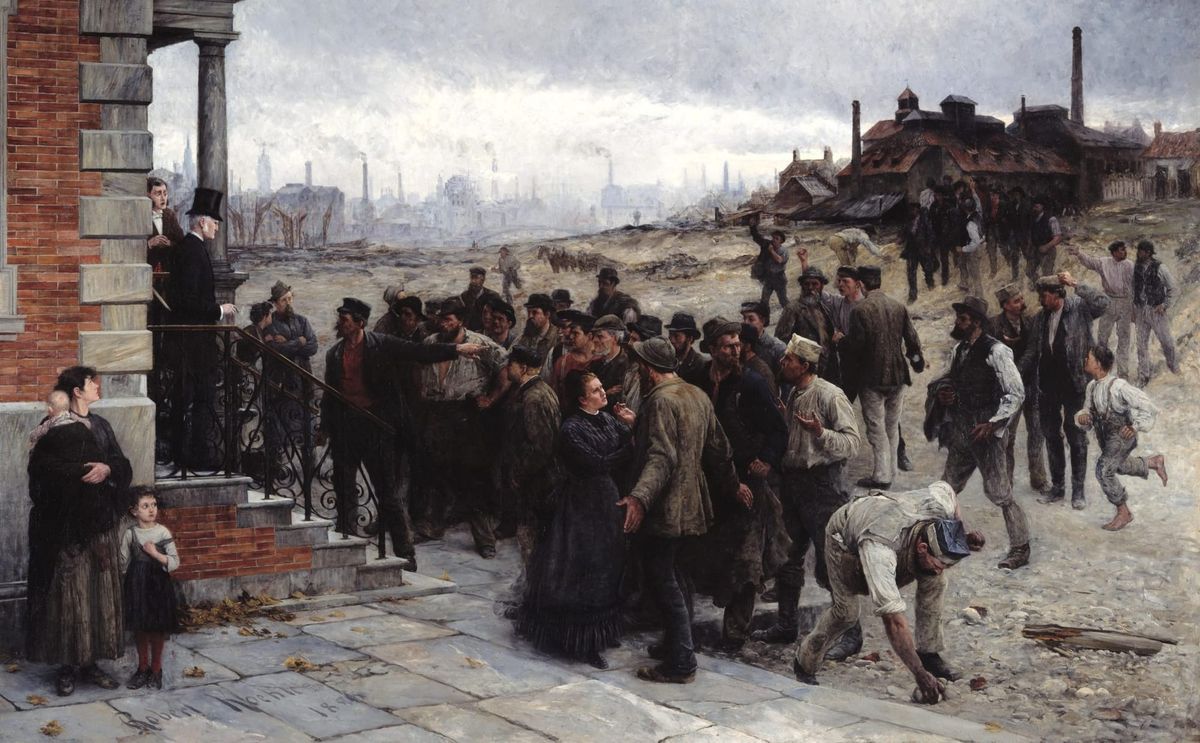
In the United States, it wasn’t until the late 19th-century Industrial Revolution that images of modern strikes became prominent. Historian Christopher Phelps notes that Robert Koehler’s 1886 painting ‘Der Streik’ (‘The Strike’) was the first strike painting exhibited in the U.S. Koehler painted it in Munich before showcasing it at the National Academy of Design in New York City, stirring controversy with its depiction of factory workers confronting a top-hatted employer. Created during a time when American workers were demanding an eight-hour workday, Koehler’s painting coincided with the May 1, 1886, strikes, now celebrated as May Day. Days after the exhibition, the Chicago Haymarket affair unfolded, marking a pivotal moment for labor rights.
Artistic portrayals of strikes have long inspired labor movements into the 20th and 21st centuries. However, as American Studies professor Carol Quirke argues, photography and newsreels significantly altered the landscape for workers. She asserts that news photography initiated a ‘workers’ revolution in the nation’s economic, political, and cultural spheres.’ Quick publication of strike images and documentation of police brutality empowered the public to witness and react to injustices. This Labor Day, as we observe a resurgence in strike activity, artists continue to play a vital role in capturing and participating in these movements, whether through TikToks, photos, or zines. From ancient Egyptian artisans to modern-day protests at New York’s Guggenheim Museum, visual culture consistently affirms one truth: artists have always supported the picket line.