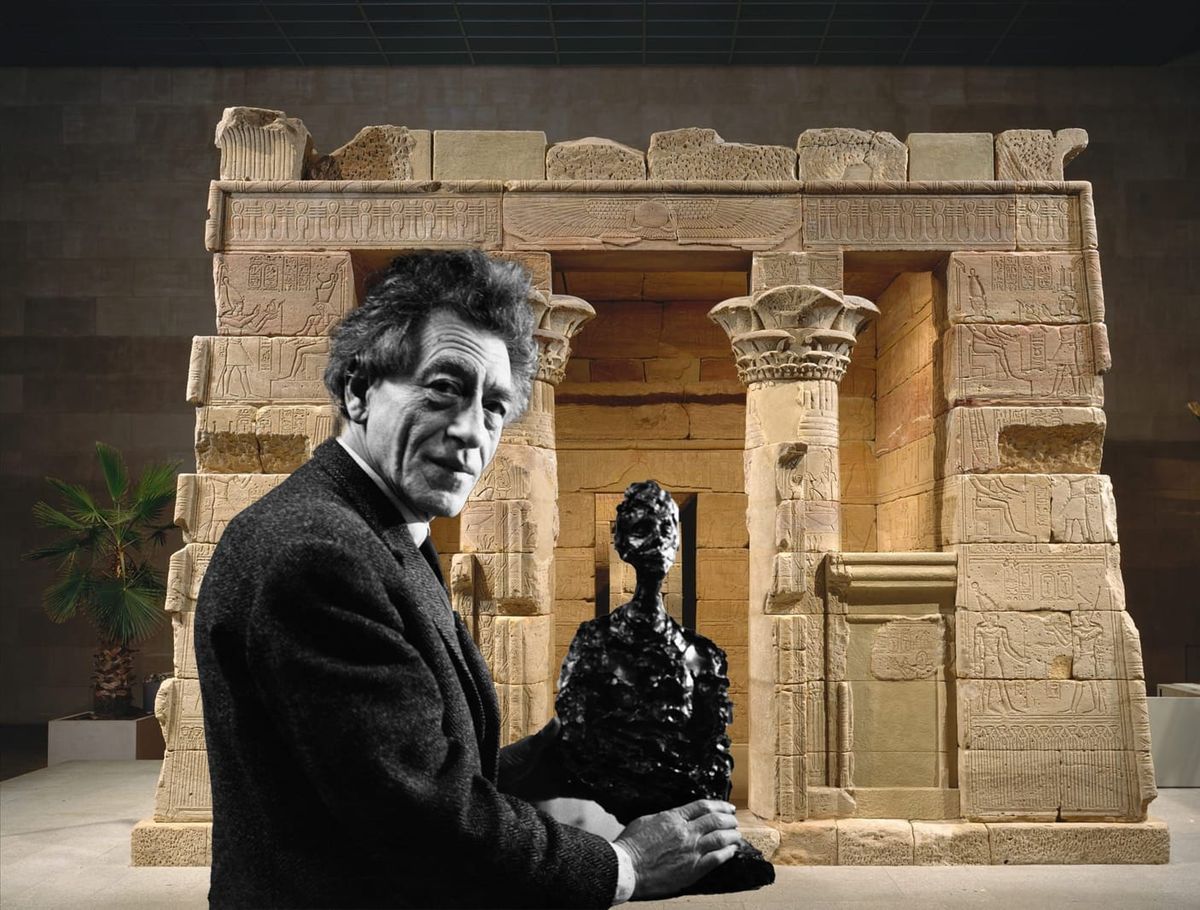
This summer, the Metropolitan Museum of Art will host an intriguing exhibition featuring the slender sculptures of Swiss artist Alberto Giacometti within its Ancient Egyptian Temple of Dendur. Thanks to a loan from the Fondation Giacometti in Paris, the exhibit titled ‘Giacometti in the Temple of Dendur’ will present 17 sculptures by the artist around and inside the first-century BCE Roman Period temple. The foundation will contribute 14 pieces, while The Met will add three from its collection. This temple, dedicated to the Egyptian goddess Isis and her brothers, provides a historical context for Giacometti’s works, many of which depict female figures such as ‘Femme qui marche I (Woman walking)’ from 1932 and ‘Femme de Venise I (Woman of Venice)’ from 1956.
The statues, reminiscent of the temple’s ancient Egyptian carvings, range from 11 inches (27.9 cm) to over 8 feet (2.5 m) in height. Emilie Bouvard, a curator at Fondation Giacometti, noted Giacometti’s lifelong fascination with Ancient Egyptian art, highlighting its blend of naturalism and symbolism. She remarked that placing his work in this historical and architecturally significant setting provides a unique perspective on Giacometti’s art. According to The Met, the artist’s exposure to Egyptian sculpture began during his visits to the Louvre Museum shortly after moving to Paris in 1922, and his sketchbooks reveal the influence of these ancient forms on his later creations.
The Met aims to present the Temple of Dendur as a ‘living sacred environment,’ according to Aude Semat, Associate Curator of Egyptian Art. The exhibition seeks to highlight the temple’s original functions while fostering a dialogue across centuries about sculpture’s role in conveying presence and belief. The temple became a significant exhibit in the museum after being gifted by Egypt in 1965 as thanks for US efforts to save it from flooding due to dam construction on the Nile. Officially acquired in 1967, it was carefully reconstructed in the museum’s Sackler Wing, which opened in 1978. The Sackler name was later removed due to protests over the family’s connection to the opioid crisis.
Giacometti, born in 1901 in Switzerland and raised by his father, Impressionist painter Giovanni Giacometti, initially joined the Surrealism movement in his late twenties but shifted focus in 1935. Before World War II, he concentrated on small-scale works, later developing his signature tall, slender figures post-war. Stephanie D’Alessandro, Met Curator of Modern Art, emphasized that Giacometti’s sculptures, viewed within the temple, enhance our understanding of his quest to capture the essence of human presence.
The exhibition is set to begin on June 12 and will continue until September 8, offering visitors a rare chance to experience Giacometti’s work in a setting rich with historical and cultural significance.