This article is part of Hyperallergic’s 2026 Pride Month series, featuring interviews with queer and trans elder artists throughout June.
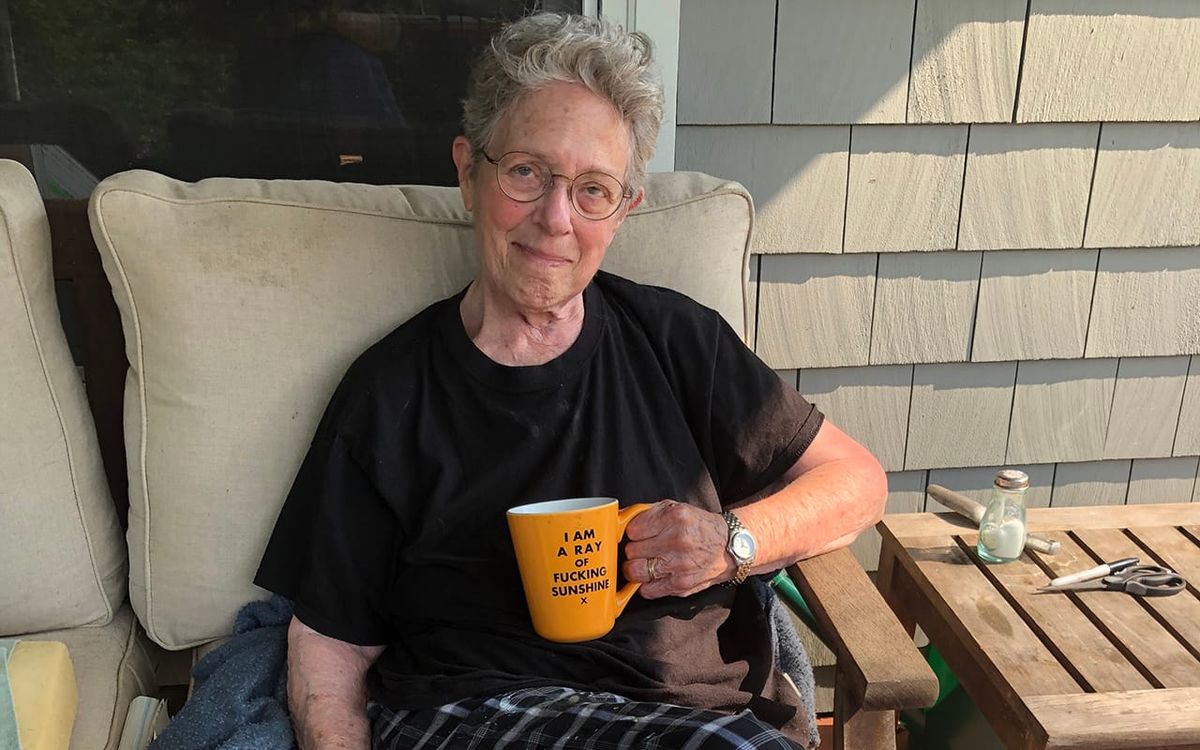
Artist Brenda Goodman was born in Detroit, Michigan, in 1943. She lived in New York City from 1976 to 2009 and now lives and works in Pine Hill, NY, in the Catskill Mountains. Since 1973, she has had about 50 solo exhibitions, most recently at Sikkema Malloy Jenkins, and this fall her work will appear in three New York exhibitions: group shows at Marc Straus Gallery and the New York Studio School in September, followed by a solo exhibition of her collages at JJ Murphy Gallery in October.
Painter Angela Dufresne and I first encountered Goodman’s self-portrait exhibition at Sikkema Jenkins in early 2022. That summer, we introduced ourselves and began spending time with Brenda and her partner, Linda Dunne. Over the course of a long career, Goodman has made paintings that could be described as “abstract” as well as others that are clearly “figurative,” often combining oil paint with pumice, sawdust, sand, ash, translucent washes, and color pencil, or carving incisions into panel surfaces and filling them with paint.
Her openness extends to both materials and subject matter. Because Brenda and I are about 30 years apart in age, I was curious about what it was like for her as a young woman in Detroit in the 1950s and ’60s, and about what she has been making more recently. We spoke in her large studio for nearly two hours, and this edited version has been shortened for clarity.
Asked whether being queer had helped or hindered her career, Goodman said, “None of that. Zero.” She recalled changing her signature early on from Brenda Goodman to B. Goodman because she did not want people to assume she was male or female. She said she did not even know she was gay until the beginning of art school in the early sixties, adding, “My story is that my life has been my work.” In high school, she took evening classes at the Detroit Society of Arts and Crafts, won a four-year scholarship, and became fully focused on becoming an artist.
Goodman described her mother as strongly opposed to that identity, saying she pushed femininity on her and made her wear dresses to art school. “I remember taking a plaid dress, tearing it up, and using it as paint rags,” she said. She also said she grew up in a deeply unhappy home, with a mother who was not affectionate and a father who seemed emotionally absent. After her mother died in 1972, her brother found bottles of pills in the basement, and Goodman said her mother was often on diet pills, which made her erratic.
She said she fell in love with her sixth-grade teacher, Betty Bowman, who gave her the warmth and care she lacked at home and later attended some of her openings. In art school, Goodman began feeling attracted to other female students, which frightened and depressed her. Eventually, she entered a relationship with another artist, and the two lived together for eight years. She added that her mother was accepting of her being gay and was also highly supportive of her art, collecting 90 pieces by the time she died.
Goodman said she never dated a man, though there were a few awkward attempts. One involved a double-date situation in which she was left alone with a man while wearing a girdle her mother had insisted on. “I said, NO WAY. I’m not going to do this,” she recalled, adding that fear of pregnancy and the difficulty of the girdle helped her get out of the situation. Looking back on Detroit in the 1960s and ’70s, she described it as a hard place to live, though her work began receiving recognition and sales from about 1970 to 1976.
She said Gertrude Kasle showed her alongside major New York artists, including a painting hung between a Guston and a Tworkov. Goodman also became part of the Cass Corridor in the early 1970s, where most of the artists had studios and most were men. After her first show in 1973 at the Willis Gallery, she got involved with the poet Faye Kicknosway and made “Things I Love About You,” a large drawing that some of the men mocked because it was personal rather than based on industrial Detroit imagery.
That experience led her to begin making symbols for everyone in her life — herself, her mother, friends, people she liked and people she hated — with those she hated placed in mason jars. She made those symbols for 11 years, calling them a visual diary of her life. She said therapy and drawing helped her process her feelings, and that her work’s strength comes from going inward and then putting those truths into paintings. “There are no walls between me and my work,” she said.
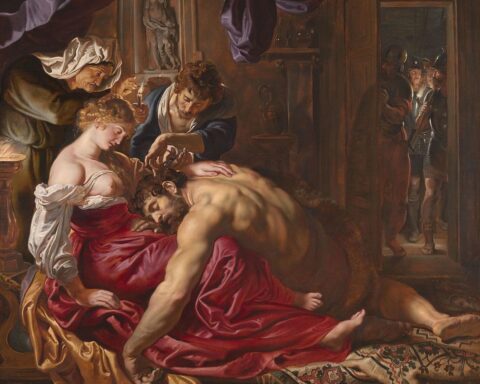
Goodman described her first self-portrait in 1974 as a way of breaking down the defenses she felt she had built up, including a “Detroit face” she could still use when threatened. She also spoke about her long struggle with weight, saying that in the early 90s she hated herself when she weighed 180 pounds, even though she loved painting the body and felt an affinity with Rubens. She painted herself nude in those studio works, though in real life she said she never painted nude in the studio, “not once.”
She moved to New York City after her friend, painter Bobbie Oliver, made her place at 94 Bowery available, and after she had exhausted the venues where she could show in Detroit. Goodman said she had always wanted to live in New York, but the first night alone in the Bowery loft she cried because all of her emotional life was still in Detroit. To get by in those early years, she spent evenings at Bonnie’s, a gay restaurant, where she ate dinner and wrote in her journal without much conversation.
She taught in her loft for several years, continued selling to collectors in Detroit, and had her first New York show in 1980 at Pam Adler Gallery. She became friends with Marcia Tucker, met many artists through her, and joined a spiritual community in upstate New York that became central to her inner search. Goodman met Linda in 1987 on a bus to a gay rights march in DC, and said that relationship transformed her life, offering financial support, emotional support, and more. “It’s going to be 39 years in October. We’ve made it work pretty wonderfully,” she said.
Asked what she is making now, Goodman said she has been creating small collages using pencil, watercolor, and images from earlier paintings that she shrunk in Photoshop and turned into prints. There are about 26 of them. She said she continues to take risks rather than repeat herself, and that in more than 60 years of painting she has made many different series, following whatever she feels she needs to paint.
Goodman said her work has grown beyond her own personal struggles, and that her thinking has expanded in other ways as well. In the 1960s, she said, she did not even know about the Beatles or Motown and knew nothing about politics because she was only painting. Now, she said, her life and work are broader, and she has much more to say about politics.
She also discussed the drawings she made a few years ago that John Yau wrote about in Hyperallergic in November 2024 after visiting her studio. Goodman said she made them while Gaza was constantly on the news, and that a photograph of an elderly woman standing on the rubble of her former home stayed with her. She had recently undergone her second knee surgery and was making drawings at the dining table, combining abstraction and figuration to create a feeling of grief and tragedy.
Goodman said she did not tell John Yau they were her Gaza drawings, explaining that she chose not to identify them that specifically. She added that a curator and artist in London wants to include them in a book called “Drawing the Unspeakable,” which follows a major museum exhibition in the UK focused on drawings shaped by grief, pain, and other experiences that resist words. As she approaches 83, Goodman said mortality is on her mind more than ever, but she still loves painting, keeps experimenting, and remains committed to working with risk and heart. “If I die with a paintbrush in my hand, I’ll be happy,” she said.