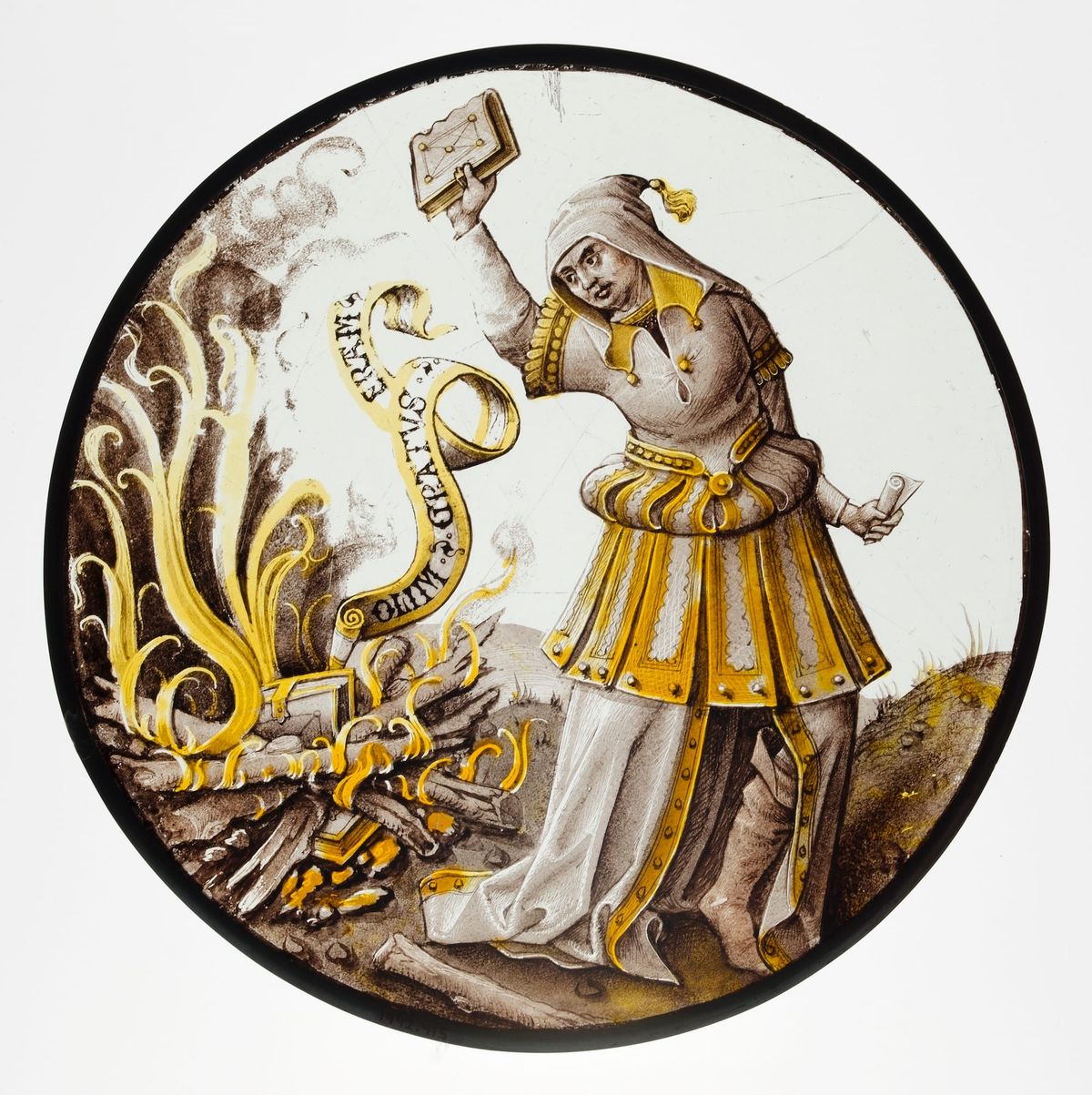
After Spanish physician and theologian Michael Servetus was burned at the stake in 1553 for religious heresy, only three copies of his The Restoration of Christianity survived the fire. One of them, now housed in the University of Edinburgh library, is said to have been personally rescued by Protestant leader John Calvin, the man responsible for Servetus’s execution in Geneva. Anyone familiar with Calvin, who boasted in a letter that he had “purged the Church of so pernicious a monster,” would understand that the book was not saved out of sympathy for Servetus, but from the instincts of a bibliophile — albeit a doctrinaire, zealous, tyrannical one. Still, however strange Calvin’s motives may have been, they are not as troubling as those of artificial intelligence companies, including Anthropic, which have been buying, digitizing, and then pulping out-of-print books to train their large language models. Calvin at least had the excuse of his God; AI companies do not.
In a sobering report by Frank Landymore in Futurism, published last Saturday, Large Language Models (LLMs) are increasingly being trained on their own slop, creating a demand for pre-2022 writing that has not been tainted by AI itself. That is the selling point of ISBNdb, a company that supplies tech firms with bulk book orders ranging from one thousand to one million volumes at a time. A “hydraulic powered cutting machine” removes book spines and pages, which are then scanned and digitized before being pulped. This form of “destructive scanning” exploits a legal loophole to sidestep copyright rules, with the result that “an AI company could be destroying some of the few remaining copies that can be found” of these books.
Book destruction, as Servetus’s fate makes clear, is hardly unusual in history. Nor is pulping books for non-ideological reasons, since publishers destroy nearly 25% of works released each year, almost always because they failed to sell. What makes the latest revelation so distinct and alarming, however, is the rapacious, self-consuming devouring of culture in order to feed the very technology intended to supplant the human.
The indifference of the LLM is unsettling in its own way; one can imagine that if a copy of Servetus’s book fell under the blank eye of the digitizer, it would simply absorb every theological argument into the machine’s hungry maw, where it would become raw material for the advanced plagiarism device that is artificial intelligence. “We see a future where intelligence is a utility,” OpenAI CEO Sam Altman said, “and people buy it from us on a meter.”
That vision points to a technocratic future in which the sacred materiality and craft of the book are defeated, and everything is reduced to predictive binary. It is a literal form of erasure that gives George Orwell’s overused warning — “who controls the past controls the future” — a renewed force. As LLMs grow and shelves empty, the result is an act of libricide: corporate indifference to the destruction of culture, ideas, and humanity itself.