What could the future hold for Muslims, and who gets to envision it? Within the visual arts, these inquiries are actively being explored in studios, exhibition spaces, and online platforms. Artists are increasingly drawing from Islamic traditions and philosophies, utilizing mediums like code, digital environments, installations, and speculative imagery. While some artists identify with ‘Islamic’ or ‘Muslim futurism,’ others operate adjacent to these terms. This evolving narrative is rooted in a rich historical lineage, stretching back to medieval Islamic astronomers and pointing towards future possibilities.
The emergence of Islamic futurism is not happening in a vacuum. Inspired by Afrofuturism’s precedent of mobilizing marginalized histories and cosmologies to envision collective futures, Islamic futurism is more than a single cultural or aesthetic descriptor. It transcends religious practice, touching on regions influenced by Muslim trade, scholarship, and empire. Rather than being confined geographically, it acts as a proposition, questioning how historical awareness informs future visions through global Islamic art.
Calligraphy offers a significant entry point into this discourse. As a medium carrying the devotional weight of Qur’anic revelation, it has shaped art and architecture for centuries. Sudanese modernist painter Ibrahim El-Salahi explored how Arabic script could evolve, pioneering the Hurufiyya movement by integrating calligraphy into modernist compositions. His abstraction of legible letters into dynamic fragments exemplifies a path of introspection and artistic exploration.
Another perspective comes from artist Soraya Syed, of mixed Pakistani-French heritage, who emphasizes the enduring vitality of classical calligraphy. After a seven-year apprenticeship in Istanbul, Syed became the first Briton to earn an icazetname, a formal license certifying mastery of this classical art form. Her works, including the animated installation ‘Hurriyah,’ show the dynamic relationship between human form and script, blending tradition with contemporary practice.
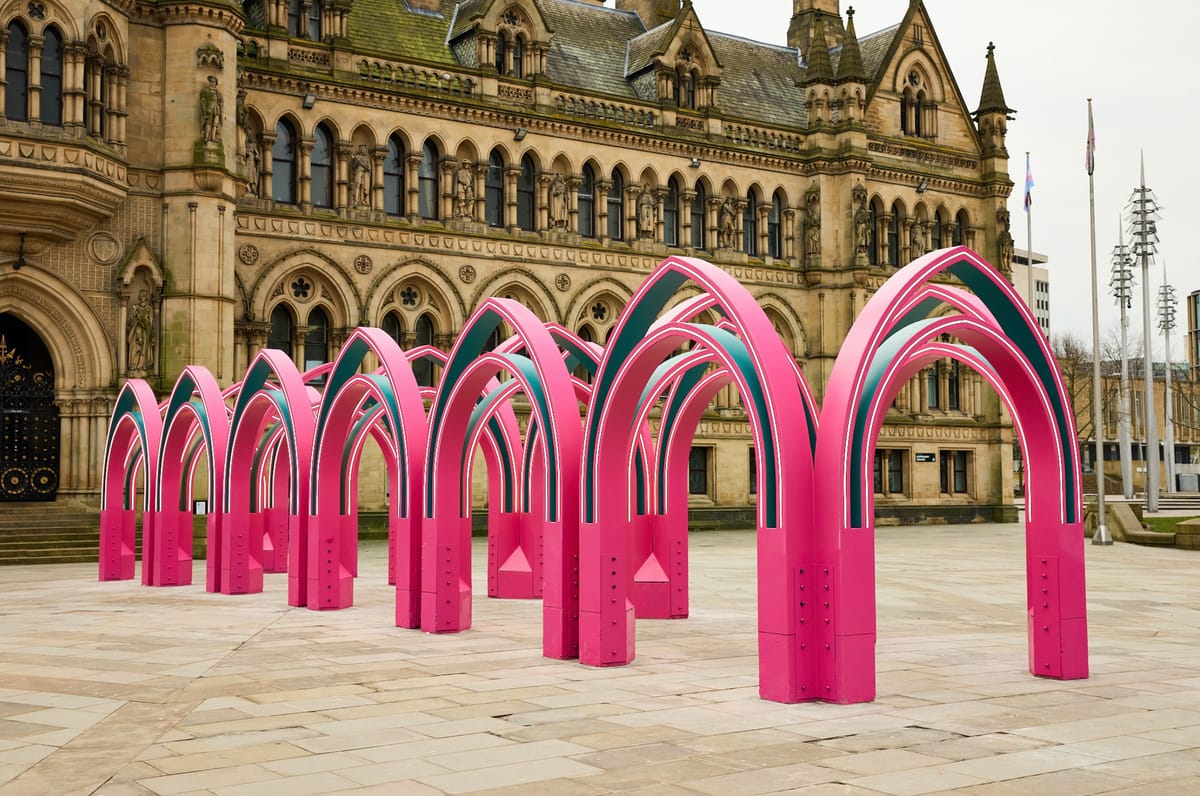
Islamic architecture also embodies philosophical principles of order and balance. Forms often labeled ‘Islamic,’ such as domes and intricate patterns, have roots in Byzantine and Roman traditions, later adapted for sacred and civic spaces. Artist Zarah Hussain extends these geometric traditions using digital systems, animating Islamic patterns through programming languages like C++. Her works like ‘Infinite Light’ and ‘Numina’ use mathematical sequences to evoke spiritual logic, making geometry a bridge between material and spiritual realms.
The ability to depict unseen realities is a hallmark of Islamic visual traditions. Fabrice Monteiro’s series ‘The Prophecy’ (2013) highlights this by merging fashion and documentary photography to address environmental issues in West Africa. Monteiro’s images, featuring djinn emerging from polluted landscapes, emphasize the spiritual and ecological ramifications of human actions, echoing Qur’anic teachings on environmental stewardship.
Collective initiatives like MIPSTERZ further illustrate the communal aspect of Muslim futurism. Founded in 2012, the group provides a platform for Muslim artists, fostering community through events like the ALHAMDU digital conference. Co-founder Yusuf Siddiquee reflects on the term ‘Muslim futurism,’ emphasizing the importance of process over product, and how collaboration shapes their creative endeavors.
Ultimately, Muslim futurism is less about a specific vision and more about the experience it evokes. It is an inclusive space that respects heritage while welcoming diversity, expanding like a dome that gathers without confining, and directing like a mihrab without dictating who stands before it.