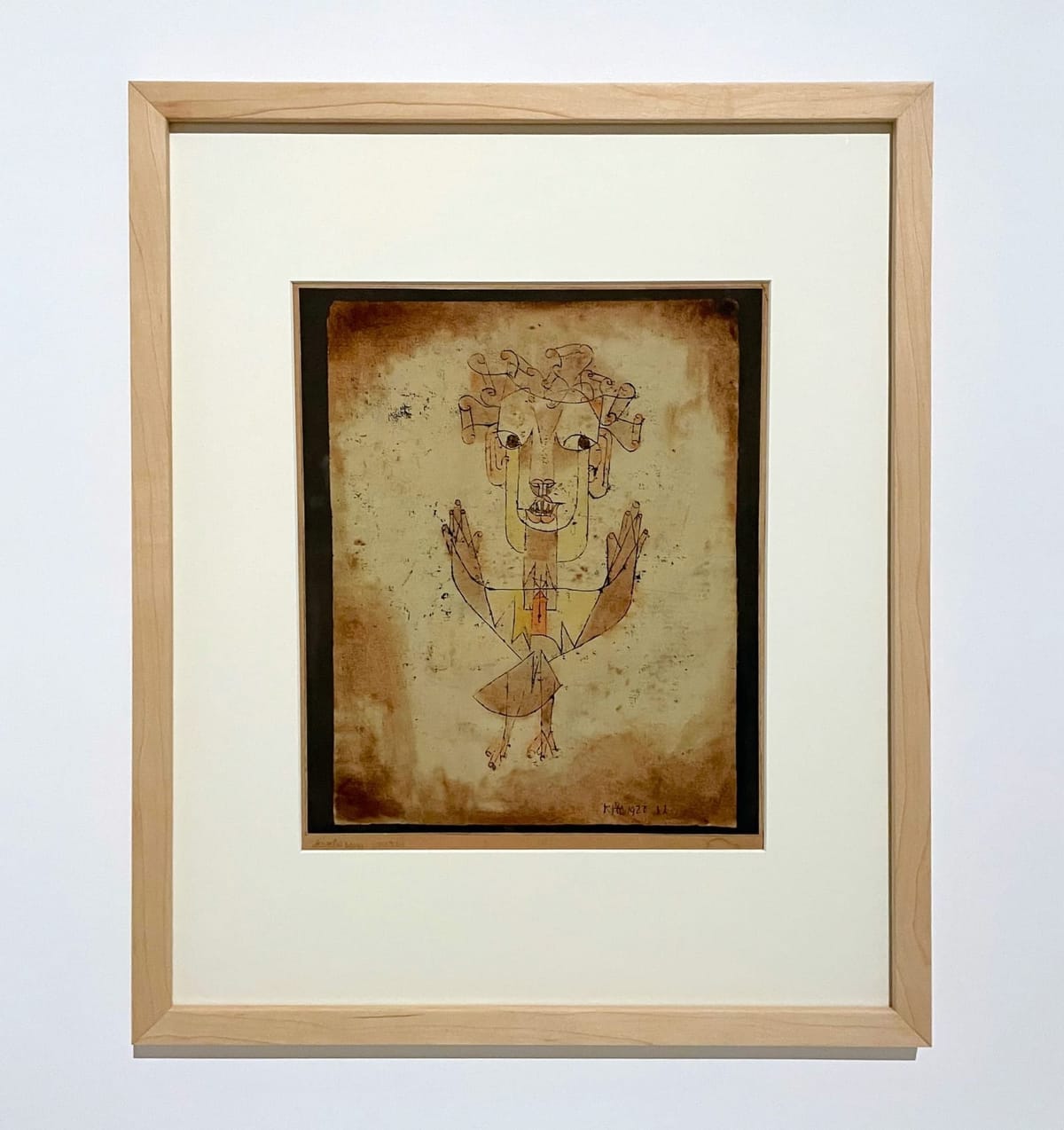
Editor’s Note: This article contains references to self-harm. If you or someone you know is in crisis, contact the Suicide & Crisis Lifeline by calling or texting 988 or visiting 988lifeline.org. Paul Klee: Other Possible Worlds at the Jewish Museum showcases “Angelus Novus” (1920), a pivotal work more renowned for its owner, Walter Benjamin, than its creator. Benjamin acquired the piece in 1921, and it became emblematic of his persecution by the Nazis and subsequent suicide. The exhibition explores the political dimensions of Klee’s art and his quest for artistic liberty in the 1930s, featuring works from as early as 1903 to set the stage for his later political themes.
The highlight, “Angelus Novus,” a watercolor of a quirky angel, occupies its own gallery space. The original, housed at the Israel Museum in Jerusalem, is delayed due to unspecified “current conditions affecting international transport.” Nearby, a quote from Benjamin’s “Theses on the Philosophy of History” (1940) describes the angel’s backward glance at history as a singular catastrophe, with progress symbolized by an advancing storm. The pairing of Klee’s work with Benjamin’s interpretation serves as a focal point, bridging Klee’s 1930s art with Benjamin’s philosophical reflections.
Both Klee and Benjamin were targeted by the Nazis, yet their experiences diverged. Klee, labeled derogatorily as a “Galician Jew,” fled to Switzerland, while Benjamin faced a more perilous path, ending in his suicide in 1940. Although Benjamin viewed “Angelus Novus” as a critique of progress, interpretations of Klee’s intention vary. Annie Bourneuf’s 2022 book suggests a connection to Matthias Grünewald’s “Isenheim Altarpiece,” adding layers of historical context to the piece.
In Klee’s final decade, some works indirectly reference Germany’s descent into fascism, like “Suffering Fruit” (1934) and “Struck from the List” (1933), while others remain ambiguous. His “angel” series, such as “Angel Applicant” (1939), painted during his terminal illness, reflects both a critique of fascism and existential themes. Art historian Gert Schiff noted that Klee’s angels, created as he neared death, navigate existential and political realms.
The exhibition’s understated yet impactful section features Klee’s chalk-and-pencil drawings depicting the “national-socialist revolution,” emphasizing youth and the peril of authoritarianism. Works like “Child Murder” (1933) and “Child-Eater” (1939) illustrate the artist’s insight into the volatility of childhood in a world dominated by power-hungry adults. These poignant pieces, though overshadowed, resonate with the ongoing relevance of Klee’s messages. Paul Klee: Other Possible Worlds is on display at the Jewish Museum (1109 Fifth Avenue, Upper East Side, Manhattan) until July 26, curated by Mason Klein.