LOS ANGELES — The retrospective titled ‘Sex Politics Religion’ marks the first comprehensive exhibition in four decades for Wally Hedrick, a prominent figure of California’s Beat artist scene. This exhibition delves into themes that were once taboo in the 1950s and ’60s: sex, politics, and religion. A key player in San Francisco’s mid-century counterculture, Hedrick’s work reflects his philosophical contemplations and political protests, especially against war. The exhibition is hosted across two venues: Parker Gallery, known for featuring artists from the Bay Area’s rich art history, and The Box, which focuses on underrepresented and politically charged art. Visitors will find early works that parody Abstract Expressionism and use text to create visual and verbal puns, but the main emphasis is on pieces that critique war or glorify heterosexual sex as both joyful and spiritual.
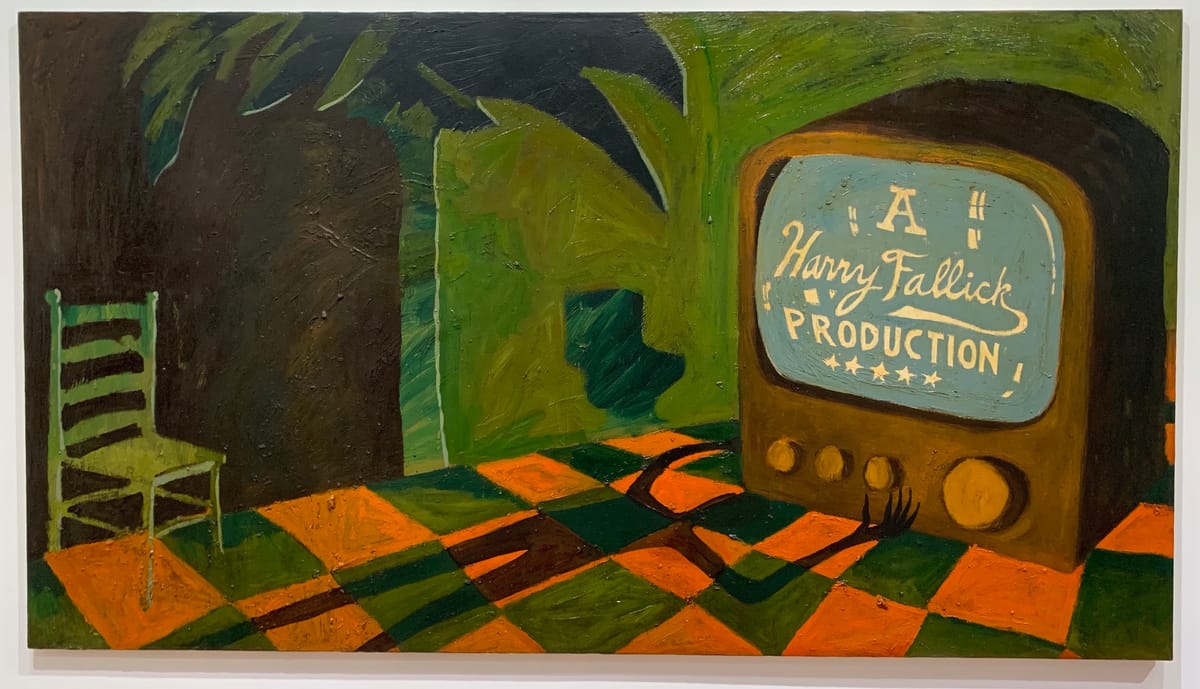
Hedrick’s sharp wit is evident in his rejection of Abstract Expressionism at its peak, choosing instead to create works infused with humor and sexual innuendo. ‘A Harry Fallick Production’ (1959) comments on the rising influence of television, the so-called ‘idiot box’ of the era, depicting a studio corner with a massive TV supported by a shadow, with its title displayed on-screen. This painting is a clever play on an actual TV program credit, turning it into a double entendre, with Hedrick adopting Fallick as his alter ego in a nod to Marcel Duchamp’s Rrose Sélavy.
Addressing more serious themes, Hedrick, a Korean War veteran, responded to the Vietnam War’s escalation by painting over existing works in black in 1957, a protest against the conflict. This act was meant as a refusal to contribute to Western culture during wartime. A decade later, he created the ‘War Room,’ an immersive installation of bolted, black-painted canvases, serving as a space for reflection on war. Hedrick continued to update this work during subsequent conflicts, adding layers of paint in response to events like the Gulf War in 1992 and the Iraq occupation in 2002.
In a 1974 interview, Hedrick proposed that ‘art, love, and spirit’ are essential to creating art. This is exemplified in ‘Spirit + Idea #1’ (1958), a dark abstract work suggesting a spine or heart’s core. Hedrick, a cofounder of Six Gallery where Allen Ginsberg first read ‘Howl,’ shared the Beat generation’s belief in linking love and sex to spirituality. This connection is evident in several pieces, such as ‘Danäe’ (1980–81), depicting divine impregnation, and ‘Mojo: Electrosex Kit #10’ (1979), a diagrammatic exploration of sexual mechanics.
One of Hedrick’s final pieces, ‘Peace Awakening/WWW.COM (Wiggy with Wings)’ (2000), draws from a 1915 sculpture and honors ‘Wiggy,’ his last partner. The painting embodies the ‘Make Love Not War’ ethos, a message that resonates even today, as evidenced by cultural figures like Bad Bunny, who recently echoed similar sentiments. The exhibition ‘Wally Hedrick: Sex Politics Religion’ is open at Parker Gallery and The Box in Los Angeles until April 4, curated by the hosting galleries.