In her mid-80s, Pat Steir remains a vibrant force in the art world. Her inaugural New York exhibition took place in 1964, and she has consistently showcased her work in the city since 1971. Steir’s career, spanning nearly six decades, is marked by her dedication and prolific output. Initially known for painting self-portraits in the styles of other artists, she created her first significant series, The Breughel Series (A Vanitas of Style) (1983–84), displayed at the Brooklyn Museum and beyond. This series featured three paintings of varying sizes, each section interpreted in the style of artists like Jackson Pollock and Georgia O’Keeffe.
Steir’s conceptual approach, focused on art about art, became evident through her exploration of self-portraits and still lifes. By establishing rules for these genres, she continually challenged herself and evolved. By 1988, she ventured into a distinctive style characterized by gestural painting, set constraints, and a blend of mark-making and waterfalls. Her first black and white waterfall painting emerged in 1990, followed by vibrant works in contrasting colors that engaged viewers with their dynamic surfaces.
Despite the risk of predictability in working with similar themes for four decades, Steir’s latest exhibition, Pat Steir: Blue River and Rainbow Waterfalls, at Hauser & Wirth, showcases her ability to embrace the passage of time. The exhibition includes the large-scale ‘Blue River’ (2005) and two series from 2022, Rainbow Waterfall and 9 x 7. In these, Steir sets parameters around a wet brushstroke technique, reminiscent of her earlier 1990s work.
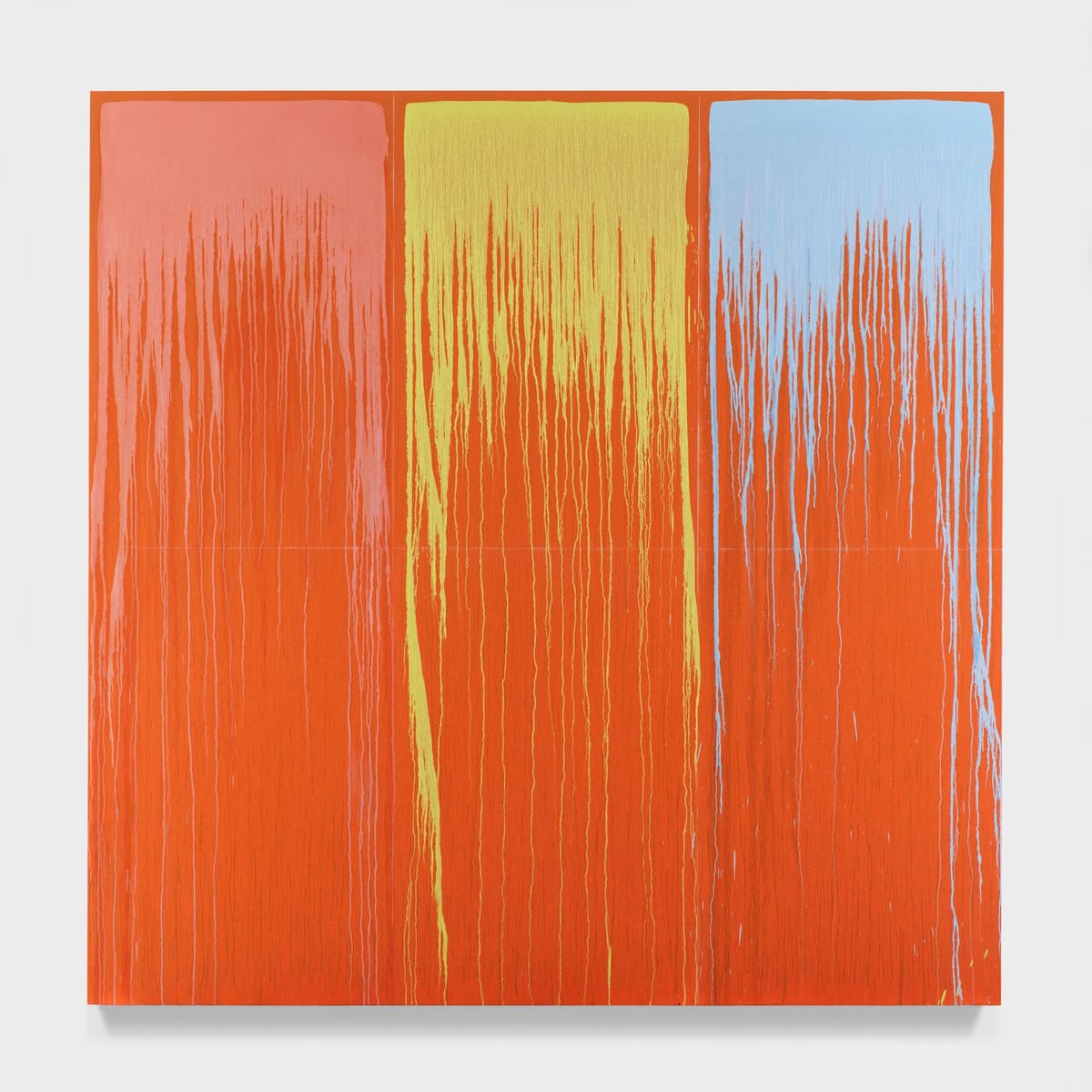
The Rainbow Waterfalls series features square canvases with vertical bands and a horizon line, painted in varied reds. Steir’s technique draws from Jackson Pollock’s, Helen Frankenthaler’s, and Morris Louis’s practices, as well as Chinese ink painting and conceptual art. Meanwhile, the 9 x 7 series offers a more intimate engagement, with two colors interacting on the canvas, creating layers and textures through stacked brushstrokes.
Steir’s mastery of paint allows her to achieve desired effects, from watery to dense. The paintings evoke themes of erosion and accumulation, with craquelure surfaces and rivulets resembling roots. Despite physical limitations, Steir integrates these changes into her art, particularly in the 9 x 7 series, where she gracefully acknowledges the inevitable changes brought by time.